

Updated: July 28, 2026
OPRS may receive compensation when readers open an account through partner links on this page. Our analysis is based on independent research, BBB data, and IRS publications.
Planning a gold IRA sleeve for a 25 to 30 year horizon is a sizing math problem with four documented inputs. The federal framework runs through IRC Section 401(a)(9) for the RMD rules that set the year-by-year withdrawal floor. the SSA Period Life Table anchors the survival-probability cushion behind the planning horizon. And IRC Section 408(m) sets the physical-metals eligibility rules inside the sleeve itself. Updated July 28, 2026.
This guide is written for the surviving spouse or owner of a balance in the five hundred thousand to one million dollar range who is rethinking allocation after a triggering event. That could be the death of a spouse, the sale of a primary residence, or the end of professional employment. It is also for anyone hearing dealer pitches that size the precious-metals sleeve emotionally rather than against the documented planning math.
The framework below produces a single numerical answer for the sleeve in dollars. It derives that answer from the four inputs, then tests it against the FINRA concentration alerts and the OPRS dealer rubric before any custodian or depository paperwork is signed.
Inline note on dealer vetting before sleeve sizing: see our 2026 reality check on the gold IRA dealers we warn longer-horizon investors against before any sleeve-sizing conversation moves to a destination custodian. Element I of the OPRS dealer rubric, the BBB Business Profile, is the first filter we apply on every dealer we review for longer-horizon cases.
Why a 25 to 30 year planning horizon is the right anchor at age 70
The Social Security Administration publishes the Period Life Table each year, with separate columns for male and female life expectancy at every age from birth to one hundred and nineteen. For a female at age 70 in the most recently published table, the median remaining life expectancy is roughly 16 years, which sits in the 50th percentile column.
The planning horizon, however, is not the median. The planning horizon is the age the portfolio must continue to fund spending at the household’s chosen survival probability, which for most retirees is the 75th or 90th percentile column rather than the 50th.
The arithmetic is straightforward. At the 75th percentile, the SSA table places female-at-70 survival at approximately age 92, a 22 year horizon. At the 90th percentile, female-at-70 survival reaches approximately age 98, a 28 year horizon. Households with a family history of longevity and adequate access to medical care typically anchor on the 90th percentile column rather than the median.
A 25 to 30 year horizon is the documented planning band for a female at age 70 who is in normal health and wants the portfolio to survive a long tail.

Precious metals IRA required minimum distribution (RMD) estimator
Once required minimum distributions begin (age 73 now, 75 starting 2033), you divide the prior year-end balance by an IRS life-expectancy factor. The result is taxed as ordinary income on your federal return and, in most states, your state return. You can take a precious metals IRA RMD in cash or in metal.
Estimate only, not tax advice. Uses the IRS Uniform Lifetime Table (most owners). A spouse more than 10 years younger and sole beneficiary uses a different table. Roth IRAs have no lifetime RMD. Sources: IRS Publication 590-B (Table III); IRS RMD FAQs. Consult a tax advisor.
The right dealer explains every fee up front. Get Augusta's free precious metals IRA company checklist.
The same arithmetic for a male at age 70 places the 90th percentile at approximately age 95, a 25 year horizon. Joint planning for a couple uses the joint survival curve, which extends further than either spouse’s individual curve because the portfolio needs to fund the second-to-die.
The joint survival 90th percentile for a couple both at age 70 reaches approximately age 99, a 29 year horizon. The 25 to 30 year band is therefore the right planning anchor for either an individual female or a couple at the same age.
The four documented inputs that size the precious-metals sleeve
Sleeve sizing on a 25 to 30 year horizon is a function of four inputs that can be documented from federal and quasi-federal sources. Each input has a defensible source citation, which is what distinguishes a procedural sizing exercise from a dealer pitch.
Input 1. Planning horizon in years. Sourced from the SSA Period Life Table at the household’s chosen survival probability. The standard procedure is to pull the 90th percentile age-at-survival column for the household’s age and sex, then subtract the current age. For a female at age 70, this returns a 28 year planning horizon.
For a male at age 70, the same procedure returns a 25 year planning horizon. The Period Life Table is updated annually; a refresh of the planning horizon every three to five years is the documented cadence.
Input 2. Starting portfolio balance. Sourced from the most recent custodian statement on each retirement account in the household, summed across accounts. That includes traditional IRAs, Roth IRAs, inherited IRAs, employer plans (401(k), 403(b), 457(b)), and any taxable brokerage accounts the household will use for retirement spending.
The classification matters because the RMD framework under IRC Section 401(a)(9) applies only to traditional pre-tax balances, not to Roth IRAs or taxable accounts. The starting balance is the input the precious-metals sleeve allocation percentage will be applied against.
Input 3. RMD framework selection. Sourced from IRS Publication 590-B, the RMD framework selection depends on the account type. For an owner-IRA at age 73 or older, the Uniform Lifetime Table applies. For a surviving-spouse rollover into the spouse’s own IRA, the Uniform Lifetime Table applies once the surviving spouse reaches the required beginning date.
For an inherited IRA under the surviving-spouse election, the Single Life Table applies, recalculated each year. The RMD framework determines the year-by-year forced withdrawal floor that the sleeve must accommodate without forced bullion sales at unfavorable prices.
Input 4. FINRA concentration ceiling. Sourced from FINRA’s investor education on concentration risk, the standard concentration framework places single-asset-class sleeves in the 5 to 15 percent range of total retirement portfolio value. Precious-metals sleeves at the higher end (10 to 15 percent) are documented in financial-planning literature as appropriate for preservation-oriented households. Sleeves above 15 percent move into concentration territory that FINRA’s investor alerts flag as elevated risk, regardless of the underlying asset.

Worked example: a 70 year old female, 750k inherited IRA, 28 year horizon
The example below applies the four inputs to a representative case in the Margaret persona profile: a surviving spouse at age 70 with a 750,000 dollar inherited IRA balance from a late husband. She has no professional employment income; Social Security is her only fixed-income floor. The household preference is the 90th percentile survival probability anchor. The arithmetic is procedural, not advisory; the same sequence applied to a different starting balance or horizon returns a different sleeve dollar figure.
Step 1. Planning horizon. SSA Period Life Table 90th percentile column for female at age 70 returns survival to approximately age 98, a 28 year horizon. The horizon is the constraint the sleeve must survive without forced liquidation at unfavorable prices.
Step 2. Starting balance and account classification. 750,000 dollars in an inherited IRA under the surviving-spouse rollover election (treat-as-own) places the entire balance inside the traditional pre-tax framework. The Uniform Lifetime Table applies at the surviving spouse’s age once the required beginning date is reached. At age 73, the Uniform Lifetime Table divisor is 26.5, which translates to a first-year RMD of roughly 28,300 dollars on a 750,000 dollar balance (750,000 divided by 26.5).
Step 3. Sleeve allocation percentage. Applying the FINRA concentration framework at the 10 percent midpoint of the 5 to 15 percent band returns a 75,000 dollar precious-metals sleeve on a 750,000 dollar starting balance.
The 10 percent allocation is the documented preservation-oriented midpoint; a household with a stronger preservation tilt may select 12 to 15 percent, and a household with a higher-growth tilt may select 5 to 7 percent.
The Margaret persona profile typically lands in the 10 to 12 percent band based on the preservation tilt of a surviving spouse with no remaining employment income.
Step 4. RMD-accommodation test. The procedural test is whether the non-sleeve portion of the portfolio (675,000 dollars in cash, bonds, and equities outside the metals) can fund the annual RMDs without requiring a bullion sale at year-end. At a starting 4 percent withdrawal rate, the non-sleeve portion generates roughly 27,000 dollars annually, which covers the first-year RMD of 28,300 dollars within rounding. The sleeve is sized to avoid forced sales rather than to drive cash flow.

The procedural sleeve-sizing workflow
The five-step workflow below documents the sequence a household runs to convert the four inputs into a single sleeve dollar figure. Each step produces a paper deliverable retained in the household’s planning file. The workflow runs serially because each step output feeds the next step’s input.
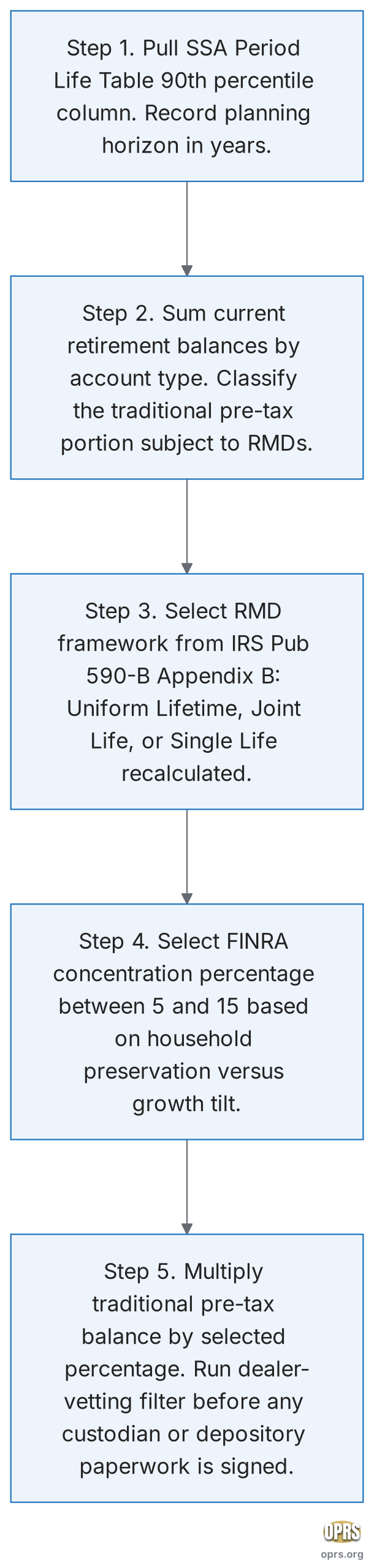
Step 1 pulls the SSA Period Life Table for the current year and records the 90th percentile age-at-survival column for the household’s age and sex. The horizon in years is the deliverable. Step 2 sums the household’s current retirement balances by account type and records the percentage of total in traditional pre-tax versus Roth versus taxable.
The classification matters because the RMD framework applies only to the traditional pre-tax portion. Step 3 selects the RMD framework based on account type and records the applicable IRS table from Publication 590-B Appendix B (Uniform Lifetime, Joint Life and Last Survivor, or Single Life).
Step 4 selects the sleeve allocation percentage from the FINRA concentration band based on the household’s preservation versus growth tilt. The deliverable is a single percentage between 5 and 15. Step 5 multiplies the starting traditional-balance dollar figure by the allocation percentage and writes the sleeve dollar figure on the planning sheet.
The same sheet records the non-sleeve dollar figure and tests it against the projected first-year RMD to confirm the non-sleeve portion can fund the RMD without forced bullion sales.
Common procedural errors on 25 to 30 year horizon sleeve sizing
The errors below recur in OPRS intake forms and dealer cold-call transcripts from households at the Margaret persona profile. Each error is correctable inside the same sleeve-sizing exercise before any custodian or depository paperwork is signed.
Error 1. Anchoring the horizon on median life expectancy rather than the 90th percentile. A 70 year old female who anchors on the 16 year median life expectancy builds a portfolio that runs out of non-sleeve liquidity in the right tail of the survival distribution. The 90th percentile column is the documented planning anchor.
The SSA Period Life Table 90th percentile column is the documented planning anchor; the 50th percentile is the median used for actuarial reserves, not for individual household planning.
Error 2. Sizing the sleeve as a percentage of the deceased spouse’s pre-death portfolio rather than the surviving spouse’s current portfolio. The starting balance for sleeve sizing is the surviving spouse’s current consolidated balance after any spousal rollovers and beneficiary distributions are complete. A surviving spouse who sizes the sleeve before the inherited IRA rollover is complete ends up with a sleeve based on the pre-rollover snapshot, which is rarely the post-rollover allocation the household actually wants.
Error 3. Pricing the sleeve from the dealer’s quoted bullion premium rather than the spot-price reference. A 75,000 dollar sleeve target at a typical bullion premium of 5 to 8 percent above spot returns roughly 69,000 to 71,250 dollars in spot-equivalent bullion.
The dealer should quote both the dollar-amount delivery (the 75,000 dollar sleeve) and the equivalent ounces at the prevailing spot price. A dealer who refuses to quote the spot-equivalent ounce count is failing the price-transparency test in FINRA Notice 22-08 on complex products.
Error 4. Treating the sleeve as the only longevity hedge. Precious metals do not produce cash flow and do not directly hedge longevity in the actuarial sense. The sleeve is a preservation allocation that sits alongside the household’s longevity-hedge instruments (Social Security and the RMD framework). The sleeve sizing exercise is one input in the broader longevity-planning sheet, not the answer by itself.
Error 5. Signing a self-directed IRA destination on a dealer cold call within ninety days of the triggering event. The first ninety days after a triggering event (death of a spouse, sale of a primary residence, retirement) are the highest-pressure dealer-call window.
A household that signs a self-directed IRA destination on a cold call, before completing the four-input sleeve-sizing exercise, often locks in a sleeve two to three times larger than the FINRA concentration band supports. Our dealer list documents the operators we have flagged for this specific cold-call pattern.
The 27+ dealer reality check at the sizing stage
Once the four-input sizing exercise returns a sleeve dollar figure, the next step is dealer vetting before any custodian paperwork is signed. Our dealer rubric runs four institutional signals against every operator: BBB Business Profile (Element I), third-party publisher recognition (Element II), educator compensation structure (Element III), and published fee schedule (Element IV).
Of the 27 plus gold IRA dealers we have reviewed for the 2026 cycle, three pass all four rubric elements. The remaining majority fail one or more elements and land on the list of operators we warn 25 to 30 year horizon households against.
Before any sleeve-sizing recommendation lands on a destination custodian
A 25 to 30 year horizon sleeve-sizing decision crosses the dealer-vetting filter before any custodian or depository paperwork is signed. The OPRS 2026 reality check on the dealers we warn against, and the small number we currently consider acceptable for longer-horizon households, is the first read.
3 of 27+ gold IRA dealers reviewed by OPRS make the 2026 trusted list.
When the sleeve sizing intersects with the dealer-vetting layer
A sleeve-sizing exercise that returns a dollar figure (75,000 dollars on a 750,000 dollar balance at the 10 percent allocation midpoint) is the starting point for the dealer conversation, not the conclusion. The destination is a self-directed IRA at an IRS-approved custodian with bullion stored at an IRS-approved depository under IRC Section 408(m).
Home storage was rejected in McNulty v. Commissioner, 157 T.C. No. 10 (2021); any dealer who proposes home storage on a 25 to 30 year horizon sleeve is a disqualifying red flag under the OPRS rubric.
If a gold IRA destination is on the table for the sized sleeve, the dealer-vetting process applies before any custodian paperwork is signed. The Augusta Precious Metals education evaluation, with an industry-reported around fifty thousand dollar minimum-funding threshold, publishes a Company Comparison Checklist that the household can request before any IRA-opening commitment.
The checklist evaluates four institutional signals. The first two are BBB A+ accreditation since 2014 with no complaints on file and Money Magazine’s Best Overall Gold IRA Company recognition 2022 through 2026. The third is Investopedia’s Most Transparent Gold IRA Company 2022 through 2026. The fourth is Augusta’s salaried non-commissioned educators in the Education-First Learn-Talk-Decide process.
The full OPRS 2026 dealer list for longer-horizon households sits underneath the dealer-vetting layer.
The Company Comparison Checklist
Augusta Precious Metals publishes a Company Comparison Checklist that walks a 25 to 30 year horizon household through the four institutional signals to require from any gold IRA dealer. Those signals are BBB rating and accreditation history, third-party publisher recognition (Money Magazine, Investopedia), educator compensation structure, and published fee schedule. The checklist is the highest-quality lead asset Augusta offers. It is appropriate for a household still in the dealer-vetting stage rather than the immediate-purchase stage.
This page is informational; it is not financial or tax advice. Affiliate link. OPRS may earn a commission if a qualifying account is opened.
Frequently asked questions on sizing a gold IRA for a 25 to 30 year horizon
Why use the 90th percentile of the SSA Period Life Table rather than the median?
The median is the actuarial midpoint, which by definition means half the population outlives it. A household that anchors planning on the median ends up with a portfolio that runs out of non-sleeve liquidity in the right tail of the survival distribution.
The 90th percentile column captures the tail where a household with normal health and adequate medical access is statistically likely to land, and it is the documented planning anchor in retirement-income literature. Reviewing the planning horizon every three to five years against the most recent SSA Period Life Table refresh is the cadence.
What is the right precious-metals sleeve percentage at the Margaret profile?
The FINRA concentration framework places single-asset-class sleeves in the 5 to 15 percent band. For a surviving spouse with no remaining employment income, a 750,000 dollar inherited IRA balance, and a 28 year planning horizon, the documented preservation-oriented midpoint sits at 10 percent.
A household with a stronger preservation tilt may select 12 to 15 percent; a household with a higher-growth tilt may select 5 to 7 percent. The percentage is a household decision constrained by the FINRA concentration ceiling, not a dealer recommendation.
Does the inherited-IRA rollover election change the sleeve sizing?
The election affects the RMD framework that the non-sleeve portion of the portfolio must accommodate, but it does not change the FINRA concentration ceiling on the sleeve itself. A surviving spouse who elects the spousal rollover (treat-as-own) uses the Uniform Lifetime Table at the surviving spouse’s age.
A surviving spouse who elects the Inherited IRA treatment uses the Single Life Table recalculated each year, which produces a higher RMD divisor in most years. The sleeve sizing exercise applies the same FINRA band in either case; the RMD framework selection only changes the non-sleeve liquidity test in Step 4.
Should the sleeve include silver, platinum, or palladium in addition to gold?
IRC Section 408(m) permits gold, silver, platinum, and palladium inside a self-directed IRA. The purity standards in the statute are .995 fine for gold, .999 for silver, and .9995 for platinum and palladium, with the American Eagle exception for gold.
The procedural sleeve-sizing exercise treats the precious-metals allocation as a single bucket; the within-bucket split between gold, silver, platinum, and palladium is a secondary decision. A typical preservation-oriented split inside the sleeve is 70 to 80 percent gold and 20 to 30 percent silver, with platinum and palladium absent or minor.
The split affects the bullion premium and storage logistics, not the sleeve sizing math.
Sources cited
- Social Security Administration: Period Life Table (Actuarial Publications)
- IRC Section 401(a)(9): Required distributions framework
- IRC Section 408(m): IRS-approved precious metals inside an IRA
- IRS Publication 590-B: Distributions from Individual Retirement Arrangements, including the Uniform Lifetime Table and Single Life Table in Appendix B
- FINRA Investor Insights: Concentration Risk in retirement portfolios
- FINRA Regulatory Notice 22-08: Complex products and price-transparency obligations
- SEC Office of Investor Education: Updated investor bulletin on self-directed IRAs
- IRC Section 72: Annuity treatment for distributions from qualified retirement plans
- IRS RMD Comparison Chart: IRAs vs Defined Contribution Plans
Three procedural steps, in order. First, pull the most recent SSA Period Life Table and record the 90th percentile age-at-survival column for the household’s age and sex. Subtract the current age and write the planning horizon in years on the planning sheet.
Second, sum the current retirement balances by account type. Classify the traditional pre-tax portion that the sleeve allocation will apply against. Then select the FINRA concentration percentage (5 to 15) that matches the household’s preservation versus growth tilt.
Third, multiply the traditional pre-tax balance by the selected percentage to get the sleeve dollar figure. Then run the dealer-vetting filter on every operator the sleeve dollar figure attracts before any custodian or depository paperwork is signed.