

Updated: July 30, 2026
OPRS may receive compensation when readers open an account through partner links on this page. Our analysis is based on independent research, BBB data, and IRS publications.
Households researching a Gold IRA in 2026 usually start with the dealer marketing they see on television or in mailers. The full industry has three moving parts, not one. A self-directed IRA holding physical precious metals under IRC Section 408(m)(3) requires a non-bank trustee or custodian approved by the IRS under 26 CFR Section 1.408-2(e). The metals themselves sit in a third-party depository. The dealer arranges the transaction.
The Gold IRA market is a niche inside the larger self-directed IRA universe. The GAO-18-485 report on self-directed IRAs documented multi-decade growth in alternative-asset IRAs alongside fee variation across approved custodians of more than ten times for the same nominal service. The dealer side carries the largest visible marketing spend, the depository side carries the lowest visible profile, and the custodian side handles all IRS reporting.
Element I of an industry view is sizing the market by player category. Element II is mapping the value chain that takes a 401(k) or IRA transfer and ends with physical metal in an IRS-compliant vault. Element III is reading the trend lines that shape 2026 decisions: regulatory posture, central bank gold demand, fee compression, and dealer-side complaint patterns.
For households still narrowing the dealer side of that map, it is worth screening any candidate against the 2026 OPRS list of gold IRA operators we currently caution against before any meeting is scheduled. The sections below walk each element in order.
Before any dealer meeting is scheduled
The dealer is the part of the Gold IRA chain a household can still reverse before a wire is sent. The custodian and depository names usually arrive on the dealer’s recommended application, which makes the dealer choice the most consequential single decision in the sequence. Screening the dealer against an independent caution list is the lowest-friction precaution available before any paperwork is signed.
3 of 27+ gold IRA dealers reviewed by OPRS make the 2026 trusted list. Updated July 2026.
How big is the Gold IRA market in 2026?
The Gold IRA market does not publish a single industry-wide assets-under-management figure. The IRS reports total IRA assets in aggregate, not by asset class held inside the IRA. The best available anchor is the broader self-directed IRA segment, where the GAO and trade associations have produced periodic estimates.
The Retirement Industry Trust Association and other trade groups have historically estimated self-directed IRA assets at several hundred billion dollars across all alternative asset classes (real estate, private debt, private equity, precious metals, cryptocurrency). Within that, precious metals IRAs are a minority share. Industry-reported retail Gold IRA assets sit in the low-to-mid tens of billions of dollars range, with the figure rising during gold price rallies and falling during long periods of metal price stagnation.
The number of households holding a Gold IRA is similarly not centrally reported. Industry surveys and dealer disclosures suggest a population in the low hundreds of thousands of US accounts. The typical Gold IRA balance ranges from the IRS-allowed minimum (no statutory floor, but most dealers set a working minimum) up through the high six figures for households consolidating multiple 401(k) and IRA balances after retirement.
One useful proxy for retail gold demand is US Mint American Eagle bullion coin sales, published monthly by the US Mint bullion sales page. Monthly figures fluctuate from low five-figure ounces in quiet months to high six-figure ounces during demand spikes. Gold IRAs absorb a notable share of that retail bullion flow, with the remainder going to non-IRA collectors and bar-and-coin investors.
The three player categories that move the metal
A Gold IRA transaction touches three distinct businesses, each regulated by a different framework. Knowing which company plays which role is the foundation of any informed dealer comparison.
The dealer. The customer-facing side of the industry. The dealer markets the Gold IRA concept, fields the inbound call or web inquiry, recommends a custodian, ships the order, and earns the spread between the dealer asking price and the underlying spot or COMEX settlement. OPRS reviewed 27 or more active US Gold IRA dealers across 2026, with most marketing budgets concentrated among the top ten operators.
The custodian or non-bank trustee. The IRS-approved entity that holds legal title to the IRA assets, handles all annual reporting on Form 5498, processes contributions and distributions, and issues the year-end statements. Custodian status requires approval under 26 CFR Section 1.408-2(e) and ongoing compliance with IRS reporting standards. Roughly two dozen US firms are widely cited as actively servicing precious metals SDIRA accounts in 2026, with a small set of names recurring across most dealer application packets.
The depository. The third-party vault operator that physically holds the bars and coins. Depository status is not a formal IRS designation, but the depository must be a non-bank trustee approved under 26 CFR Section 1.408-2(e) or a bank with vault operations.
Five to six major depository operators currently handle the bulk of US Gold IRA storage volume. Common operator names cited in industry trade reporting include Delaware Depository Service Company, International Depository Services Group (Delaware and Texas facilities), and Brinks Global Services.
Some dealers operate dedicated relationships with one or two preferred custodians and a single depository. Others present the customer with a choice from a short list. The custodian and depository are switchable after the account opens, but the friction (re-titling, depository re-shipment, paperwork) keeps most accounts at the originating combination.
What drives demand: gold by sector and the central bank trend
The retail Gold IRA market does not exist in isolation. Global gold demand is the macro backdrop households see in the financial press, and the sector breakdown explains where retail Gold IRA flows fit within the broader picture. The World Gold Council publishes quarterly and annual demand statistics that are the most cited industry reference.
Can you roll your account into a precious metals IRA? Eligibility checker
Most retirement money can move into a precious metals IRA once it qualifies as an eligible rollover distribution. Pick your account type and situation for a general answer. Always confirm specifics with your plan administrator or custodian.
General guidance only, not tax or financial advice. Eligibility depends on your specific plan document and IRS rules; confirm with your plan administrator and a tax advisor. A direct trustee-to-trustee transfer avoids the 60-day rule and 20% mandatory withholding.
The right dealer explains every fee up front. Get Augusta's free precious metals IRA company checklist.
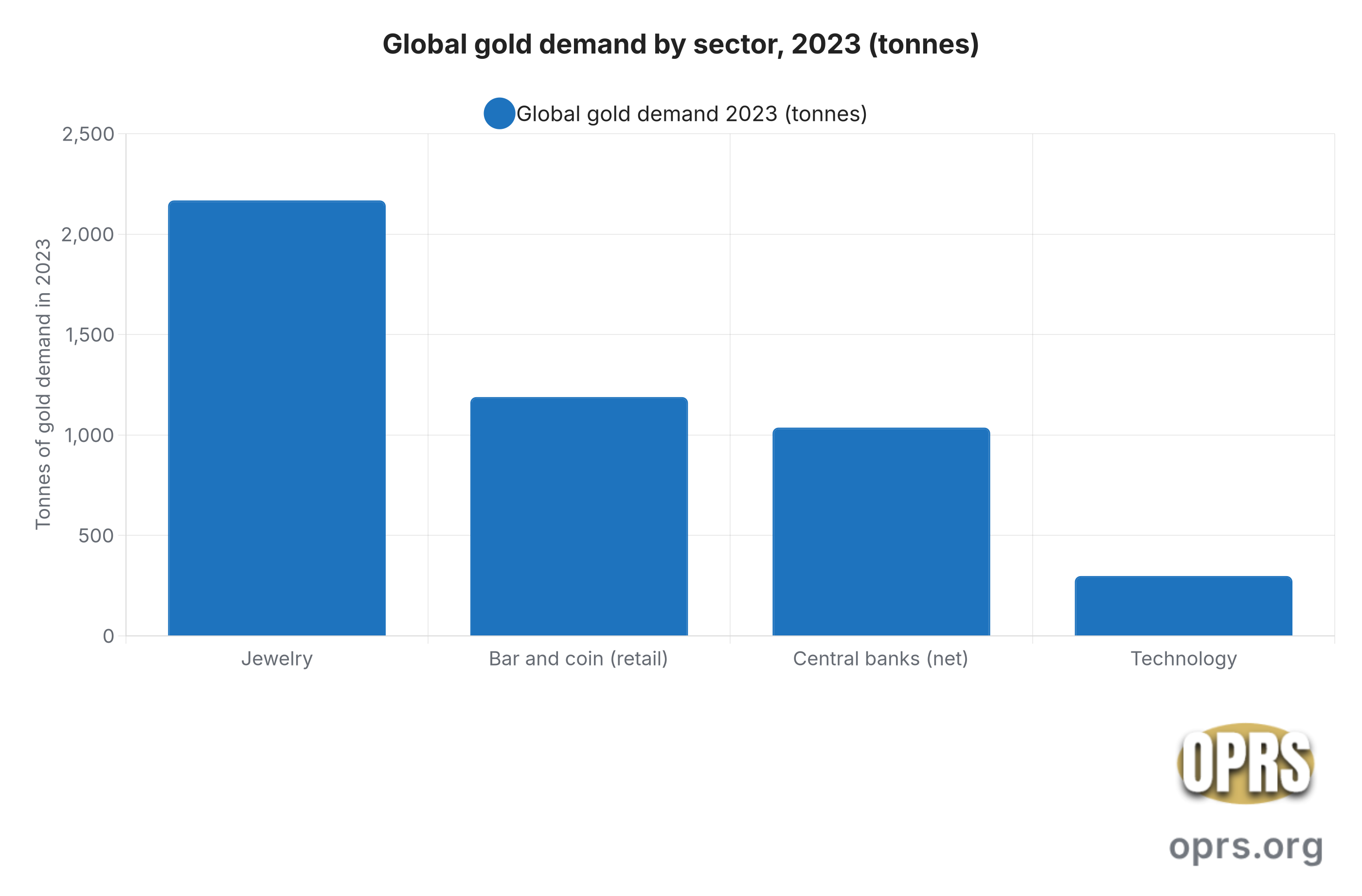
The 2023 sector mix shows jewelry as the largest single category at 2,168 tonnes, followed by central bank net purchases at 1,037 tonnes, retail bar and coin investment at 1,189 tonnes, and technology applications at 298 tonnes. Retail investment (the bar and coin category) is the segment most directly relevant to Gold IRA flows, because Gold IRAs purchase the same physical product (bullion coins and bars) as non-IRA retail investors.
The central bank category is the single most cited demand-side story shaping 2026 retail marketing. Central bank net buying has run above 1,000 tonnes per year since 2022, the highest sustained level the World Gold Council has recorded.

The shift in central bank behavior is the macro narrative most often repeated in dealer marketing materials. The retail interpretation runs that if sovereign reserve managers are accumulating gold, individual retirement portfolios may have a parallel diversification case. The interpretation is a market thesis, not a forecast. Investment outcomes in any asset class depend on entry price, holding period, and the household’s broader portfolio context.
The ETF sector is the macro counter-story. Gold ETF holdings were a net outflow during 2023 even as bar and coin investment and central bank demand were strong. The pattern (physical demand up, paper demand down) is one of the structural features of the current cycle that distinguishes it from the 2008 through 2012 rally.
How an industry transaction flows
A first-time Gold IRA account opening touches every player category in a specific sequence. The procedural map below tracks a typical 401(k) or traditional IRA rollover from the moment the inquiry call ends to the moment the metals settle in the vault.
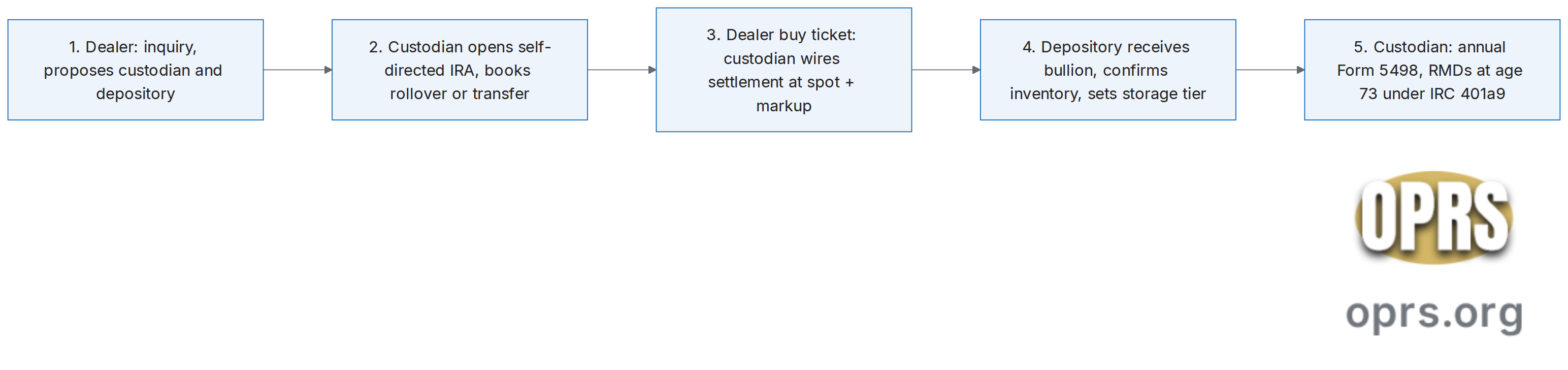
The dealer-led version of this flow takes four to eight weeks for a direct trustee-to-trustee transfer. The 60-day rule under IRS Publication 590-A applies only to indirect rollovers, where the funds pass through the household’s personal bank account before being redeposited. Most reputable dealers route their customers to direct trustee-to-trustee transfers to keep the rollover outside the 60-day clock.
The custodian books the rollover, the dealer prepares the buy ticket, the custodian wires settlement, and the depository confirms inventory. The IRS form trail runs through Form 1099-R (from the originating plan, coded for the rollover) and Form 5498 (from the receiving custodian, reporting the rollover and the year-end fair market value). Distribution reporting begins in later years when the account starts required minimum distributions at age 73 under IRC Section 401(a)(9).
The regulatory framework shaping the industry
Three regulatory layers govern the US Gold IRA industry. The first is the Internal Revenue Code, principally Sections 408 and 4975, which set the rules for IRA-eligible assets, prohibited transactions, and the non-bank trustee or custodian requirements. The second is the SEC and FINRA framework that applies to the dealer side when securities-like marketing claims appear. The third is the FTC framework on consumer-facing advertising and the patchwork of state attorney general consumer protection actions.
The IRS layer is the most stable. Section 408(m)(3) defines the bullion eligibility test (99.5 percent purity for gold bars and coins, 99.9 percent for silver, 99.95 percent for platinum and palladium, with a separate carve-out for American Eagle coins regardless of fineness). The list of approved non-bank trustees is maintained by the IRS and updated periodically.
The SEC and FINRA layer governs the dealer side when marketing language crosses into securities-like representations. The FINRA investor insights on precious metals fraud document the disclosure red flags regulators flag in dealer marketing: undisclosed markups, undisclosed minimums, and outsized promised performance without disclosed basis. The SEC investor.gov self-directed IRA alert lists fee opacity among the top three risk categories for retail investors.
The FTC and state attorney general layer is the most active in 2026. Several settled CFTC and state actions against specific dealers in the 2020 through 2024 window produced consent orders and multi-million-dollar restitution programs, most cited in OPRS investigative coverage. The pattern shaping the regulatory posture is that retail Gold IRA complaints concentrate on a small number of operators, while the larger transparent operators draw far fewer complaints relative to volume.
Three trends shaping the 2026 industry
Trend 1: fee transparency pressure. The fee structure question is the single most contested line in custodian agreements, and BBB complaint patterns concentrate on undisclosed basis-point schedules, first-year promotional waivers that reset, and segregated-storage upcharges. The pressure on operators to publish complete fee schedules upfront has intensified across 2026. For the deeper cost mechanics, the 2026 Gold IRA fee industry averages benchmark walks the six-line-item fee stack.
Trend 2: depository consolidation. The vault side of the industry has consolidated around five to six major operators handling the bulk of US Gold IRA storage volume. The dealer-recommended depository on most application packets in 2026 falls within that short list. The overview of IRS-compliant Gold IRA depositories walks each major operator and storage tier.
Trend 3: tighter dealer marketing scrutiny. The FINRA and SEC investor alerts have moved the floor on what dealer marketing can claim. Specific claims about future gold prices, promised outsized performance, or imminent currency events are the strongest signal that a dealer falls outside the regulatory floor. Households can verify any dealer’s BBB profile, complaint history, and any state attorney general action before any meeting is scheduled.
A fourth secondary trend worth noting is the shift in dealer business model from high-pressure sales floor to education-led inbound. Operators that publish detailed company checklists and run their inbound process on a learn-talk-decide framework tend to draw the smallest complaint volumes relative to lead count. The dealer side of the industry is bifurcating along that line in 2026.
Frequently asked questions on the 2026 Gold IRA industry
How many active Gold IRA dealers operate in the US in 2026?
OPRS reviewed 27 or more active US Gold IRA dealers across 2026, with the marketing budgets concentrated among the top ten operators. The full list of active dealers fluctuates as new entrants appear and older operators wind down or face regulatory action. The reviewed-dealer total is a snapshot, not a regulatory census.
How many IRS-approved non-bank trustees offer precious metals IRA services?
Roughly two dozen US firms are widely cited as actively servicing precious metals SDIRA accounts in 2026, drawn from the broader IRS list of approved non-bank trustees under 26 CFR Section 1.408-2(e). The total number of approved non-bank trustees across all asset classes is larger, but only a subset is set up operationally for physical precious metals.
How big is the Gold IRA industry in dollar assets?
The Gold IRA industry does not publish a single assets-under-management figure. Industry-reported retail Gold IRA assets sit in the low-to-mid tens of billions of dollars, rising during gold price rallies and falling during long periods of price stagnation. The figure is dwarfed by the broader US IRA market (more than 13 trillion dollars across all asset classes), where the precious metals slice is a small minority share.
Is gold a regulated asset class for IRA purposes?
Yes. Physical gold held in an IRA falls under IRC Section 408(m)(3), which sets the bullion eligibility test and the trustee or custodian requirements. The metals themselves must meet the 99.5 percent purity standard for bars, with a statutory exception for American Eagle coins. The custodian must be an IRS-approved non-bank trustee under 26 CFR Section 1.408-2(e) or a bank.
How does the Gold IRA industry compare to gold ETF holdings in IRAs?
A paper gold ETF held inside a conventional IRA at a major brokerage carries an expense ratio of roughly 0.17 to 0.40 percent per year, with no separate custodian, storage, or transaction fees beyond standard brokerage charges. A physical Gold IRA carries the six-fee stack documented in the OPRS fee benchmarks. The two are different products with different structural cost profiles, not direct substitutes.
The Gold IRA industry view comes down to a structural map: three player categories, one regulatory framework, three demand trends. The macro backdrop (central bank buying above 1,000 tonnes per year since 2022) shapes the marketing narrative households see in 2026, but the operational decision happens at the dealer level. The dealer choice drives the custodian and depository defaults that follow.
For households considering whether the structural shape of the industry suits their retirement plan, the practical recipe runs in four moves. Map the three player categories (dealer, custodian, depository) for any operator under review. Confirm the dealer is not on the OPRS 2026 caution list. Request a complete written fee schedule before any account agreement is signed. Verify the regulatory standing of the dealer through BBB, FINRA, and state attorney general records.
For households reviewing the structural shape of the 2026 Gold IRA industry before any meeting, Augusta Precious Metals publishes a company checklist that walks through the diligence items OPRS recommends a retiree confirm in writing before signing any custodian agreement.
Augusta carries a BBB A+ rating with zero complaints (accredited since 2014). It holds the Money Magazine Best Overall Gold IRA Company recognition for 2022 through 2026 and the Investopedia Most Transparent Gold IRA Company recognition for 2022 through 2026. The company runs on an Education-First Process (Learn, Talk, Decide) rather than the high-pressure-call model retirees repeatedly flag in BBB complaints against other operators. Industry-reported minimum around $50,000 in eligible IRA or 401(k) funds.
Affiliate disclosure: OPRS may earn a commission if a reader proceeds with Augusta after reviewing the checklist. The checklist itself is free and contains no purchase commitment.
Three of 27+ gold IRA dealers reviewed by OPRS make the 2026 trusted list. Households who would prefer to compare alternatives before requesting any single dealer’s materials can start with the OPRS dealer caution list for 2026 and work down from the small recommended subset to the company materials of choice.
More on OPRS
- 2026 Gold IRA fee industry averages: what to expect. The six-line-item fee stack at industry-reported ranges.
- Gold IRA setup process overview. The six-step procedural sequence for opening a self-directed Gold IRA.
- Gold IRA depositories explained. The IRS-compliant vault operators that handle US storage volume.
- The 2026 OPRS list of gold IRA operators we currently caution against. The dealer-screening companion before any application is signed.
Sources cited
- IRC Section 408: Individual Retirement Accounts, including 408(m)(3) bullion fineness and trustee requirements
- 26 CFR Section 1.408-2(e): Approved non-bank trustee and custodian requirements
- IRC Section 401(a)(9): Required minimum distribution rules at applicable age
- IRS Publication 590-A: Contributions to Individual Retirement Arrangements, covering rollovers and trustee-to-trustee transfers
- IRS Publication 590-B: Distributions from Individual Retirement Arrangements
- GAO-18-485: Retirement Savings, IRS Could Help Improve Compliance with the Prohibited Transaction Rules for Self-Directed IRAs
- SEC investor.gov self-directed IRA glossary entry and investor alert
- FINRA investor insights: Precious metals fraud and disclosure red flags
- US Mint bullion coin production and sales figures