

Updated: July 30, 2026
OPRS may receive compensation when readers open an account through partner links on this page. Our analysis is based on independent research, BBB data, and IRS publications.
30-second verdict
- The price you sell IRA gold at is the COMEX spot on the day of sale, not the price you paid at purchase. The IRA wrapper does not change that math.
- Five separate line items sit between the spot price and the cash credited to your IRA cash account: the dealer bid, any liquidity fee, the buyback spread, the custodian close-out, and the depository pull.
- On a 200,000 dollar position, the net proceeds wired back into the IRA range from roughly 184,000 dollars on LBMA-grade bullion to roughly 80,000 dollars on so-called premium coins, before any income tax on the distribution.
- The tax bill on a cash distribution comes off the fair-market value reported on Form 1099-R, not the dollar amount net of the dealer spread. The dealer cost is the price math; the tax is on top.
The price math on the way out of a gold IRA is rarely the math the brochures showed on the way in. The buy-side ticket runs spot plus markup. The sell-side ticket runs spot minus spread, then the custodian and depository fees come off, and the holder still owes ordinary-income tax on the fair-market value the day the metals leave the account. The gap between those numbers is the liquidation price math.
This page lays out the line items in order. The worked dollars sit on a 200,000 dollar position at three product tiers. The cash-versus-in-kind paths follow, then the four errors that show up most often at the sell ticket. Element I is the definition of liquidation inside the IRA wrapper. Element II is the five-line cost stack between spot and the wired dollar. Element III is the dollars-and-cents worked example. Element IV is the cash-versus-in-kind tax-timing choice.
See the 2026 OPRS shortlist of gold IRA dealers we clear and the ones we warn against before any rollover paperwork. The liquidation question belongs in the first conversation, not at the eventual exit.
Screen the dealer before the entry, not after the exit
The cash actually wired to your IRA at the eventual sell ticket is set by the dealer, the custodian, and the depository you select today. The OPRS shortlist scores those three operators on a public-only trust-signal stack: BBB accreditation, third-party magazine recognition, named-depository transparency, and a published process around exit. The screen happens before the rollover paperwork, not after the liquidation invoice arrives.
3 of 27+ gold IRA dealers reviewed by OPRS make the 2026 trusted list. Updated July 2026.
What liquidation actually means inside an IRA wrapper
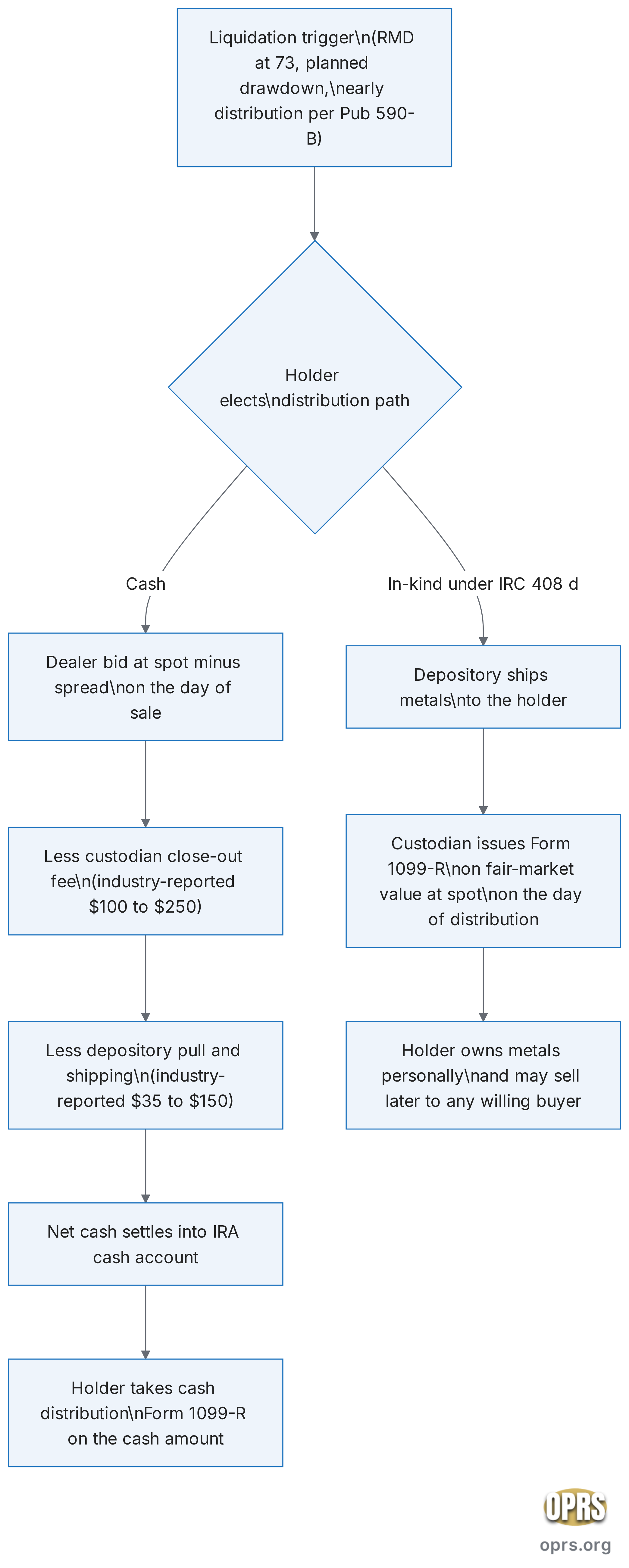
Liquidation is the conversion of the metals back into cash inside the IRA. The trigger is usually a required minimum distribution under IRC Section 401(a)(9), a planned drawdown after 59-and-a-half, or an early distribution under the rules in IRS Publication 590-B.
The mechanical sequence is the same across dealers. The custodian sends a liquidation instruction to the depository. The depository transfers the metals to the dealer. The dealer pays cash for the metals at the bid price on the day of sale. The cash settles back into the IRA cash account at the custodian. Only then does the holder elect a cash distribution, a Roth conversion under IRC Section 408A, or a transfer to another IRA.
The IRA wrapper changes the tax treatment of the distribution. It does not change the dealer’s bid price. Every line item between spot and the wired dollar is a commercial transaction the IRS and FINRA do not regulate. The custodian fee is the custodian’s. The depository pull is the depository’s. The buyback spread is the dealer’s.
For the upstream entry mechanics, see our gold spot price vs IRA markup math guide. The exit math we lay out below is the mirror image of that entry math. It carries two added line items the entry side does not: the buyback spread on the dealer’s bid, and the custodian close-out on the IRA side of the wire.
The five line items between spot and the dollar you receive
The price math starts at the COMEX spot price the day the depository ships. From that gross number, five line items come off in sequence. Each one is a separate operator with separate paper.
- Dealer bid price on the day of sale. The bid sits below the COMEX spot price by some amount the dealer sets. On LBMA Good Delivery bars and major sovereign coins, the bid runs 1 to 3 percent below spot. On so-called premium and proof coins, the bid often reverts toward the underlying gold content at or near spot, regardless of the premium the holder paid at purchase.
- Round-trip buyback spread. This is the cumulative gap between the ask the holder paid at purchase and the bid the dealer pays at sale. World Gold Council reference material puts the bullion-bar round-trip spread at 3 to 7 percent. The 2022 New York Attorney General consent order against Lear Capital documented undisclosed charges of up to 33 percent on premium-coin sales, with individual transactions reaching 87 percent.
- Dealer liquidity fee or commission at sale. Some operators bill a separate liquidity fee on the bid side, especially on smaller positions or out-of-network coins. Others embed it in the spread. The line item is in the buyback policy when the policy is written, and absent when it is not.
- Custodian close-out and account fees. The self-directed IRA custodian charges a per-event fee for processing the liquidation and the wire. Industry-reported ranges run 100 to 250 dollars per transaction, with annual account maintenance billed separately at 80 to 300 dollars.
- Depository pull and shipping fee. The IRS-approved depository charges a pull fee when metals leave the vault, plus insured shipping to the dealer. Industry-reported ranges run 35 to 150 dollars on standard transfers.
The chart below converts those five line items into a single net-proceeds number on a 200,000 dollar position, sliced by product tier. The wider the round-trip spread, the smaller the slice that survives as cash back inside the IRA.

Precious metals IRA fee-drag calculator
Precious metals IRAs charge mostly flat dollar fees (setup, annual custodian, storage). Flat fees take a much bigger bite out of a small account than a large one. Enter your numbers to see the drag.
Estimate only. Fee amounts vary by provider and are often not published; enter figures you confirm in writing. This tool ignores metal price changes and the dealer spread, which also affect returns. Not financial advice.
The right dealer explains every fee up front. Get Augusta's free precious metals IRA company checklist.
The differences in the chart are not about gold itself. The underlying metal is the same across product tiers. The differences are about which container the dealer routed the saver into at purchase. A holder of LBMA bullion keeps roughly 184,000 dollars of a 200,000 dollar position at exit. A holder of premium coins purchased through a high-spread operator may keep less than half that.
Worked example: a 200,000 dollar position at three product tiers
The table walks the math on a single 200,000 dollar gold IRA position, held for 5 years through a stable spot price. The spot assumption is held flat so the price-math line items show up cleanly. In a real account, spot moves; the line items below are layered on top of that movement, not in place of it.
| Line item | LBMA bullion bars | American Gold Eagle, common date | Premium or proof coins |
|---|---|---|---|
| Purchase ticket: ask price paid | $200,000 | $200,000 | $200,000 |
| Dealer ask premium over spot at entry | 3 to 5 percent | 6 to 10 percent | 20 to 40 percent or higher |
| Spot price assumed flat for 5 years | $0 movement | $0 movement | $0 movement |
| Dealer bid at sale (relative to spot) | Spot minus 1 to 3 percent | Spot minus 2 to 5 percent | Spot, reverting to gold content |
| Round-trip bid-ask spread | ~5 percent | ~8 to 12 percent | ~30 to 60 percent (documented up to 87 percent) |
| Gross sale proceeds at dealer bid | $190,000 | $184,000 | ~$100,000 to $140,000 |
| Less: custodian close-out fee | ($150) | ($150) | ($150) |
| Less: depository pull and shipping fee | ($75) | ($75) | ($75) |
| Net cash credited to IRA cash account | $189,775 | $183,775 | ~$99,775 to $139,775 |
| Status (versus original 200,000 dollar position) | ~95 percent retained | ~92 percent retained | ~50 to 70 percent retained |
The retained-percentage row on the bottom is the single most important number on the page. A 95-percent-retained outcome on LBMA bullion means the dealer math cost the position 5 cents on the dollar, on top of any spot movement. A 50-percent-retained outcome on premium coins means the dealer math cost the position 50 cents on the dollar, before any spot movement contributes to the final dollar count.
The holder who needs 200,000 dollars of liquidity at age 73 to satisfy an RMD finds that a 95-percent-retained position covers the requirement cleanly. The same holder in the 50-percent-retained tier finds the position is now 100,000 dollars short of the RMD target. The product-tier choice at entry is the most consequential line on the eventual exit ticket.
Run any prospective dealer through the OPRS shortlist screen before the purchase ticket signs. The product-tier choice and the dealer-trust-signal stack are the same decision: the dealers that fail the screen are the operators that route savers into the high-spread product tiers in the first place.
Cash versus in-kind: two distribution paths, two different math equations
The liquidation price math above describes the cash-distribution path. The dealer buys the metals at the bid; the cash settles back into the IRA; the holder takes a cash distribution and pays ordinary-income tax on the dollar amount.
An in-kind distribution under IRC Section 408(d) works differently. The depository ships the physical metals from the vault to the IRA holder’s home or to a non-IRA storage account. The holder owes ordinary-income tax on the fair-market value of the metals on the day of distribution, reported on Form 1099-R.
The dealer’s bid price never enters the in-kind math. The fair-market value is set by the IRS-recognized pricing convention on the distribution date, typically the COMEX spot price for the day. The custodian and depository fees still apply. The buyback spread does not.
An in-kind path is materially better than a cash path for a holder of premium or proof coins, because the in-kind path bypasses the buyback spread entirely. The holder ends up with metals in hand, valued at spot for tax purposes, with the option to sell later to any willing buyer at a competitive price. The trade-off is that the holder now owns and stores the metals personally, with all the security and insurance considerations that brings.
For an RMD holder, the in-kind path requires careful timing. The IRS lets the holder satisfy the RMD with the fair-market value of the in-kind distribution, but the calculation has to land on the right tax year. IRS guidance on IRAs covers the documentation trail. The custodian and the holder share responsibility for the Form 1099-R coding that goes to the IRS.
Four common errors at the liquidation moment
The errors below are the ones that show up most often when the price-math conversation happens at the sell ticket instead of at the buy ticket. Each one has a correction that costs nothing if applied at the entry stage and a lot once the position is set.
- Error 1: Treating the buy-side ask as a reversible decision. The dealer’s ask price at purchase sets the round-trip spread for the life of the position. A holder who paid a 30 percent premium for proof coins at entry cannot recover that premium at exit. The correction is to ask the dealer for the indicative bid on the same piece during the entry call, then sign only when the spread is documented in writing.
- Error 2: Confusing the dealer’s buyback spread with the IRS tax bill. The dealer spread is a commercial cost; it is netted into the cash before the distribution. The income tax is a separate bill on the fair-market value of the distribution. A holder who plans for one and not the other arrives at the wrong number on both sides. The correction is to model both lines on the same worksheet before any distribution request signs.
- Error 3: Assuming the dealer is obligated to buy back at a specific price. No IRS, FINRA, or SEC rule sets a floor on the dealer bid. FINRA guidance on precious metals fraud documents the operational warning signs. The correction is to require the buyback policy in writing at the entry stage, with the price formula tied to the spot bid on the day of sale.
- Error 4: Liquidating into a soft market for an avoidable reason. The dealer bid moves with the spot price. A forced sale into a 10-percent-down spot move costs an additional 10 percent on top of the round-trip spread. For an RMD where timing is fixed by age 73, this is unavoidable. For a discretionary distribution, splitting the sale across two tax years often produces a better blended price. The correction is to plan the distribution schedule one tax year ahead, not the week the cash is needed.
Each of these errors compounds with the others. A premium-coin holder who liquidates into a soft market without modeling the income tax can lose 70 cents on the dollar between spot, spread, and tax. For your spouse or heirs, the framework only works if these four errors get documented in the household file alongside the custodial paperwork.
When the liquidation price-math frame is not the right tool
The liquidation price-math frame is the wrong primary tool when the exit strategy is an in-kind distribution to a beneficiary rather than a cash liquidation. The metals ship from the depository to the beneficiary. The dealer’s bid does not enter the chain. The depository pull, the Form 1099-R coding, and the beneficiary’s basis on the metals are the operative variables.
The frame is also the wrong tool when the holder converts the gold IRA into a Roth IRA under IRC Section 408A before the eventual exit. The conversion is a taxable event on the fair-market value of the metals. It does not require a sale; the metals stay in the depository, retitled into the Roth account. The price math at conversion is the spot-based fair-market value, not the dealer bid.
The frame matters most for a cash-distribution exit and for an RMD-driven liquidation at age 73 or later, where the custodian needs cash in the account to satisfy the distribution. That is the case where the five line items between spot and the wired dollar set the final outcome.
Vet the dealer on the 4-award trust stack before the rollover
Augusta Precious Metals publishes a free company comparison checklist. It walks through the custodian, depository, fee, and buyback documentation that a gold IRA exit plan has to coordinate with the custodian.
The trust posture rests on a four-award public stack. Money Magazine has named Augusta Best Overall Gold IRA Company from 2022 through 2026. Investopedia has named Augusta Most Transparent Gold IRA Company across the same window. The BBB shows an A+ rating with zero complaints, accredited since 2014. More than 4,000 5-star ratings sit across Trustpilot, Google, and Consumer Affairs.
The Education-First process (Learn, Talk, Decide) routes the buyback conversation through a salaried, non-commissioned educator. Augusta’s industry-reported minimum is around 50,000 dollars.
OPRS may receive compensation when readers proceed. Editorial selection is independent. Updated July 2026.
How do I confirm my buyback price the day I want to sell?
Request the indicative bid in writing on the same trading day. The bid is set on a live spot reference, so an indicative quote at 10am is not the same as a settled bid at 3pm. The dealer should be willing to lock the bid for a stated window once the holder confirms the liquidation instruction with the custodian.
The custodian holds the actual authority to release the metals. The dealer’s quoted bid only becomes a settled sale once the custodian instructs the depository. A dealer that quotes one bid and settles at another without a written policy is the warning sign the OPRS shortlist screens for at entry.
Does the IRA wrapper change the dealer price I receive?
No. The dealer’s bid is the same dollar number the same dealer would pay any walk-in seller for the same coin or bar. The IRA wrapper changes who receives the cash (the custodian) and the tax treatment of the eventual distribution. It does not change the bid.
The custodian’s account fees and the depository’s pull fees are the IRA-specific add-ons. They apply because the metals live in a regulated depository under IRC Section 408, not in a private safe deposit box. Those fees show up on the IRA settlement statement, separate from the dealer’s bid.
What happens to my liquidation price if the dealer goes out of business?
The metals belong to the IRA, not to the dealer. They sit at the IRS-approved depository under the custodian’s account. If the dealer ceases operations, the holder still owns the metals and can elect an in-kind distribution or instruct the custodian to find a different dealer to handle the buyback.
The price math changes, because the bid now comes from a different operator. The exposure is to the difference between the original dealer’s bid spread and the replacement dealer’s bid spread on the same product class. This is one structural reason to prefer dealers with documented BBB and third-party recognition records at the entry stage, and to confirm the named depository handles transfers across multiple dealers if needed.
Sources cited
- IRC Section 408, Individual Retirement Accounts
- IRC Section 408(d), Tax Treatment of Distributions
- IRC Section 408A, Roth IRAs
- IRC Section 401(a)(9), Required Distributions
- IRS Publication 590-B, Distributions from Individual Retirement Arrangements (IRAs)
- IRS Form 1099-R, Distributions From Pensions, Annuities, Retirement or Profit-Sharing Plans, IRAs, Insurance Contracts, etc.
- IRS, Individual Retirement Arrangements (IRAs)
- FINRA, Precious Metals Fraud Insights
- New York Office of the Attorney General, $6 million settlement and consent order with Lear Capital (January 2022)
- SEC Investor.gov, Commodity Pool Investments
More on OPRS
- Bid-ask spread for IRA gold explained for the round-trip spread concept that sits one layer above the dollars-and-cents math on this page.
- Gold IRA buyback programs compared for the head-to-head dealer comparison on buyback posture across the three operators on the OPRS shortlist.
- Gold spot price vs IRA markup math for the mirror-image entry-side math the liquidation math eventually unwinds.