

Updated: July 28, 2026
OPRS may receive compensation when readers open an account through partner links on this page. Our analysis is based on independent research, BBB data, and IRS publications.
30-second verdict
- The COMEX spot price is the wholesale reference for one troy ounce of pure gold. The IRA buyer never pays it. The price wired from the IRA account is always spot plus fabrication plus dealer margin.
- Typical retail markup over spot runs two to five percent on LBMA bullion bars, four to eight percent on a one-ounce American Gold Eagle, twenty to forty percent on a proof Gold Eagle, and far higher on so-called premium or numismatic coins.
- New York Office of the Attorney General, $6 million settlement and consent order with Lear Capital (January 2022)
- The IRA wrapper changes none of the math. The dealers OPRS warns against are the operators that route savers into the premium-coin tier on a self-directed IRA application.
The spot price quoted on financial news is not the price a saver pays on a gold IRA invoice. Spot is the wholesale reference. The IRA buyer pays a retail price that is spot plus fabrication plus the dealer margin. The size of the dealer margin is the line item that decides whether the rollover is a fair transaction or a regulator case.
This page lays out the math in four parts. First, what the COMEX spot price actually references. Second, how that price stacks up to the IRA invoice. Third, what the typical markup looks like by product class. Fourth, what the regulator record says about the high end. The numbers come from IRS publications, the World Gold Council, the CME Group COMEX market, and public state regulator settlements. None of the math changes because the wrapper is an IRA.
Before any six-figure rollover signs, see the 2026 OPRS dealer list and the operators we warn against. The markup math is the same at every dealer. The operators we rule out are the ones that route the saver into the premium-coin tier on the application.
Before you sign
The markup over spot price should appear on the application or the order ticket, in dollar figures and as a percent, before the funds wire. If the dealer will not state the markup line on paper before the order signs, that single behavior is a stronger signal than any sales pitch on the same call.
Updated July 2026. 3 of 27+ gold IRA dealers reviewed by OPRS make the 2026 trusted list.
What the COMEX spot price actually is
The COMEX spot price is the wholesale reference for one troy ounce of pure gold, quoted in U.S. dollars, traded through the CME Group COMEX precious metals exchange in New York. The number moves continuously during market hours. Financial news quotes the spot price as the gold price. That label is technically correct, in the sense that COMEX spot is the single most-referenced number in the global gold market.
The COMEX spot price assumes a few things a retail saver does not get. It assumes a wholesale lot size, typically 100 troy ounces. It assumes settlement through a COMEX-approved depository, between exchange members. It assumes no fabrication into a coin or a bar of the buyer’s choosing.
A retail saver buying one ounce of gold for a self-directed IRA does not transact at spot. The retail buyer transacts at spot plus the cost to make a one-ounce coin or bar, plus the dealer’s margin for sourcing, holding, and selling that piece.
The London Bullion Market Association also publishes a twice-daily LBMA Gold Price fixing in London. The two prices track each other closely. For the purpose of reading a U.S. gold IRA invoice, the COMEX spot price is the right reference number.
The four-stage price stack from spot to IRA invoice
Between the COMEX spot price and the price wired from a self-directed IRA account, four stages stack on top of each other. The first stage is the spot price itself.
The second is the wholesale cost paid by the dealer to a refiner or a mint to turn raw bullion into a saleable LBMA bar or a sovereign coin. The third is the dealer margin charged on top of the wholesale cost. The fourth is the retail price the IRA custodian wires from the buyer’s retirement account to the dealer.

Precious metals IRA fee-drag calculator
Precious metals IRAs charge mostly flat dollar fees (setup, annual custodian, storage). Flat fees take a much bigger bite out of a small account than a large one. Enter your numbers to see the drag.
Estimate only. Fee amounts vary by provider and are often not published; enter figures you confirm in writing. This tool ignores metal price changes and the dealer spread, which also affect returns. Not financial advice.
The right dealer explains every fee up front. Get Augusta's free precious metals IRA company checklist.
Stage two, the fabrication charge, is real and structurally unavoidable. A refiner or a mint has to actually produce the bar or coin. The U.S. Mint, the Royal Canadian Mint, and the Austrian Mint each charge a fixed per-ounce production cost for sovereign coins. LBMA-accredited refiners charge a similar per-ounce cost for Good Delivery bars. Industry-reported fabrication ranges run two to five percent over spot on bullion bars and three to six percent over spot on the major sovereign coins.
Stage three, the dealer margin, is where the math becomes a buyer’s question. A dealer that sells a one-ounce American Gold Eagle at six percent over spot is operating inside the industry-reported range. A dealer that sells the same coin at twenty-five percent over spot is operating outside the range and inside the territory regulators have flagged in past consent orders.
The IRA wrapper at stage four does nothing to the math. The IRA custodian wires whatever amount the order ticket says. The IRS rule on permitted metals does not police the price. That role belongs to the buyer at the application stage.
Typical markup ranges by gold product class
The total markup over spot price varies by the kind of gold the saver buys. LBMA Good Delivery bars sit at the low end. Common-date one-ounce sovereign coins sit a notch above that. Proof and special-issue coins sit several tiers above. So-called premium or numismatic coins, the category most often flagged in state regulator actions, sit at the high end.
The chart below shows the typical retail markup over the COMEX spot price by gold product class on a self-directed IRA invoice. The low end and the high end of each range are industry-reported figures, drawn from World Gold Council reference material, dealer published premium schedules, and public regulator settlements where the high end of the premium-coin range is documented.
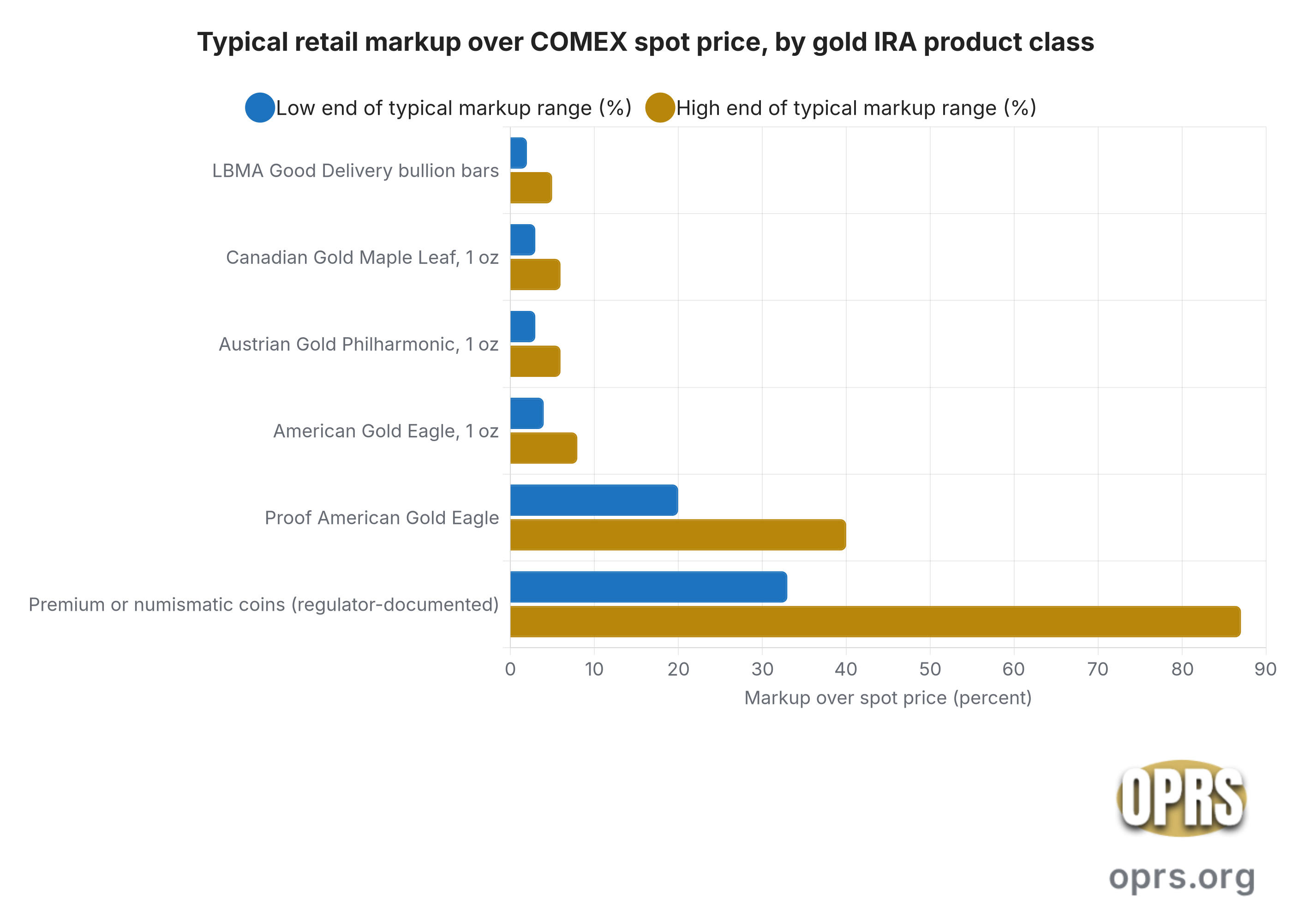
The bullion tier and the common-date sovereign tier are the two product classes most often named on rollover paperwork OPRS clears. The proof tier carries a real numismatic premium tied to scarcity and finish quality. That premium is documented and disclosed by the U.S. Mint at issue. The premium-coin tier at the bottom of the chart is the category where regulators have intervened.
So-called premium or rare numismatic coins are the category where the markup math becomes a regulator question rather than a buyer-preference question. The category is often described to savers as a higher-quality investment, a store of value if price controls return, or a coin with collector value above the gold content. None of those framings change the math on the application line.
The 2022 consent order between the New York Attorney General and Lear Capital is the most-cited public record on the high end of the premium-coin range. The Bureau found that Lear charged its customers an average markup of 33 percent on premium coin transactions. Individual transactions ran above 87 percent over the underlying metal value. The order required restitution and ongoing oversight.
The Commodity Futures Trading Commission has filed similar enforcement actions involving premium-coin pricing across the broader precious metals space. The Federal Trade Commission has also published guidance on misleading precious metals investment claims aimed at retirement savers. The throughline across the cases is the same: the price on the invoice is far above the underlying metal value, and the buyer did not see the markup line clearly stated before the order signed.
The IRA structure carries one specific aggravating factor in the premium-coin context. The metals sit at a third-party depository under the custody of the IRA custodian. The buyer cannot easily liquidate at any price close to the purchase price, because the underlying gold content is the only value that the wholesale buy-back market will pay. The premium paid at purchase rarely returns at sale.
Why the IRA wrapper does not change the markup math
The Internal Revenue Service rules on a self-directed IRA holding precious metals cover the kind of metals that may be held and the qualifying custodian and depository that must hold them. The rules do not police the price paid for the metals at the dealer stage. Internal Revenue Code Section 408(m) lists the IRA-eligible bullion and coin specifications. Internal Revenue Code Section 408(n) governs the qualifying entities.
What no IRS rule does is set a markup ceiling. A coin that meets the Section 408(m) specifications can be sold to the IRA at any retail price the dealer quotes and the saver accepts. The IRS does not audit the markup line. The custodian wires the amount on the order ticket. The depository takes physical custody. None of that machinery looks at the spread over spot.
The buyer is the only line of defense on the markup. The dealer sets the price. The custodian and the depository handle the back-end mechanics. The IRA wrapper provides tax deferral on the holding, not price discipline on the transaction.
How to read the markup line on the application
A saver heading into a gold IRA consultation can apply a short readable check at the application stage. The check has four steps. Each step takes one question and one written answer.
- Ask the COMEX spot price on the day of the order. The dealer should quote it from the live market feed. Write it down.
- Ask the per-ounce price on the order ticket. The dealer should state the retail price in dollars for the specific coin or bar. Write that down.
- Calculate the markup. Subtract the spot price from the order price. Divide by the spot price. The result is the markup as a percent.
- Match the markup to the product class. Bullion bars at two to five percent. Common-date sovereign coins at three to eight percent. Proof coins at twenty to forty percent. Above forty percent on a non-proof coin is the regulator-flagged zone.
If the dealer cannot answer step one and step two on the same call, in writing, before the order ticket signs, that single behavior is the strongest signal in the rollover. A second behavior worth treating as a stop signal is a dealer who routes the conversation away from the markup question and toward a sales argument about scarcity, finish quality, or historic price floors on the coin.
OPRS clears dealers that publish the markup on the order ticket as a matter of course. If you want a starting point before the consultation, check the dealer against the 2026 OPRS list first.
Common mistakes savers make on the markup line
Five recurring patterns show up on the markup line of gold IRA paperwork that should not. Each one is the result of a paperwork shortcut the saver pays for at the order stage rather than the application stage.
The first is the missing spot reference. The order ticket states a per-coin retail price but does not state the COMEX spot price at the same moment. The math cannot be checked after the fact, because the spot price moves continuously. Without the spot reference at the order stage, the markup percent is not auditable.
The second is the bullion-to-premium switch on the consultation call. The saver calls the dealer asking about a bullion-bar or sovereign-coin allocation. The dealer routes the recommendation toward proof or premium coins, citing scarcity, special editions, or future appreciation. The product class shifts from the two-to-five-percent range to the twenty-to-forty-percent range without the saver tracking the move.
The third is the bundled buy-back guarantee. The dealer promises to buy the metals back at a guaranteed future price or with a stated minimum spread. The promise is contingent on the dealer being in business at the time of sale and willing to honor the terms. Premium coins rarely sell back at the original retail price on the wholesale market.
The fourth is the all-in price quote with no markup line. The dealer states one number that includes the coin, the fabrication charge, the dealer margin, the shipping to the depository, and the first-year storage fee. The saver cannot separate the storage and shipping component from the actual markup over spot. Ask for the components broken out in writing.
The fifth is the percentage-only quote with no dollar figure. The dealer states a markup as a percent without anchoring it to the current spot price. A six-percent markup at $2,000 spot is $120 per ounce. A six-percent markup at $4,000 spot is $240 per ounce. The percent is the right metric to compare across dealers. The dollar figure is the right metric to size the actual cost.
What a fair markup actually looks like in dollars
Translating the percentage ranges into dollars makes the math easier to read on a real order ticket. Assume a working spot price of $2,500 per troy ounce for the examples below. Use the current spot at the time of the consultation for the actual order.
| Product class | Typical markup over spot | Per-ounce premium at $2,500 spot | Order price per ounce |
|---|---|---|---|
| LBMA Good Delivery bullion bar | 2 to 5 percent | $50 to $125 | $2,550 to $2,625 |
| Canadian Gold Maple Leaf, 1 oz | 3 to 6 percent | $75 to $150 | $2,575 to $2,650 |
| Austrian Gold Philharmonic, 1 oz | 3 to 6 percent | $75 to $150 | $2,575 to $2,650 |
| American Gold Eagle, 1 oz common date | 4 to 8 percent | $100 to $200 | $2,600 to $2,700 |
| Proof American Gold Eagle | 20 to 40 percent | $500 to $1,000 | $3,000 to $3,500 |
| Premium or numismatic coin (regulator-documented) | 33 to 87 percent | $825 to $2,175 | $3,325 to $4,675 |
On a $200,000 rollover, the choice between a four-percent bullion markup and a thirty-percent premium-coin markup is the difference between $8,000 and $60,000 paid above the underlying metal value. Both transactions clear under the IRA rules. Only one of them holds up on resale at anything close to the original retail price.
Sources cited
- IRS Publication 590-A: Contributions to Individual Retirement Arrangements (IRAs)
- IRS Publication 590-B: Distributions from Individual Retirement Arrangements (IRAs)
- 26 U.S. Code Section 408: Individual Retirement Accounts (Cornell Law)
- CME Group: COMEX Gold market and approved depository disclosures
- New York Office of the Attorney General, $6 million settlement and consent order with Lear Capital (January 2022)
- Commodity Futures Trading Commission: precious metals enforcement actions and press releases
- SEC Investor Bulletin: Self-Directed IRAs and the Risk of Fraud
- FINRA Investor Insights: Self-Directed IRAs and Alternative Investments
- FTC Consumer Advice: Investing in Gold, Silver, and Bullion Coins