

Updated: July 28, 2026
OPRS may receive compensation when readers open an account through partner links on this page. Our analysis is based on independent research, BBB data, and IRS publications.
The 2023 FBI Elder Fraud Report found that Americans aged 60 and older lost $3.4 billion to fraud that year. Investment fraud ranked as the largest category by dollar volume (FBI Internet Crime Complaint Center, 2023 Elder Fraud Report).
Element I of any defensive posture for a six- or seven-figure rollover is treating the dealer minimum as a fixed entry rule rather than a tier of pricing that grows more flexible for larger balances. Before any dealer is on the phone, glance at the 2026 OPRS dealer list to eliminate disqualified operators from the choice set.
The remainder of this guide explains how minimums actually function, what a $500,000 to $1 million balance changes in practice, and the four-step procedural framework a saver can run before signing anything.
This guide is written for the surviving spouse or any saver with an inherited or rolled balance between $500,000 and $1 million who is deciding whether and how to enter a gold IRA. The audience here is procedural, not aspirational: what minimums mean, what dealers can and cannot adjust, and how to document the negotiation so the family record is clean.
How dealer minimums actually work
A gold IRA dealer minimum is the threshold a saver must transfer or roll over to open an account. Industry-reported minimums vary widely across operators: Augusta Precious Metals sits at an industry-reported minimum around $50,000, Birch Gold around $10,000, and Noble Gold around $20,000. These figures are not list prices that scale up or down with relationship.
They are floor rules that the dealer applies to incoming funds before the account is opened. A saver below the threshold is declined; a saver above the threshold is admitted on the same fee schedule as everyone else above the threshold.
The minimum is set by the dealer, not the IRS. The IRS itself imposes no minimum balance for a self-directed IRA holding precious metals under IRS Publication 590-A.
The dealer minimum exists for operational reasons. The per-account cost of custodian onboarding, depository setup, and the dealer’s own educator or sales time is roughly fixed. So dealers route smaller balances to other products or decline them entirely. That structure means the minimum is mechanical: not negotiable for someone below it, and not a hint of flexibility above it.
Four pieces of any dealer’s fee schedule matter for a saver above the minimum. First, a one-time account setup fee (industry-reported $50 to $250). Second, an annual administration fee (industry-reported $80 to $300). Third, an annual storage fee (industry-reported $100 to $300, with segregated storage typically higher than co-mingled). Fourth, the buy and sell spreads on the actual metal.
A dealer that quotes only a single headline number, or that hides any of these four lines behind a sales conversation, has failed the first procedural test.
What changes when your balance is $500,000 to $1 million
The genuine difference at a six- or seven-figure balance is not on the per-ounce side of the trade. It is on the effective-fee side. Flat annual fees of roughly $580 (a $230 setup amortized over five years plus $200 administration plus $150 storage) consume a different percentage of the balance at each tier. The chart below illustrates the arithmetic for a typical flat fee structure across three balance bands.

Precious metals IRA fee-drag calculator
Precious metals IRAs charge mostly flat dollar fees (setup, annual custodian, storage). Flat fees take a much bigger bite out of a small account than a large one. Enter your numbers to see the drag.
Estimate only. Fee amounts vary by provider and are often not published; enter figures you confirm in writing. This tool ignores metal price changes and the dealer spread, which also affect returns. Not financial advice.
The right dealer explains every fee up front. Get Augusta's free precious metals IRA company checklist.
The practical consequence: a saver with $1 million is paying about $580 a year in flat fees, which is roughly 0.06 percent of the balance. A saver with $100,000 pays the same $580, which is roughly 0.58 percent of the balance. The fees themselves are not lower at the larger balance; the percentage they represent is lower. That arithmetic shapes what a large-balance saver can credibly ask for.
The second thing a large balance changes is the dealer’s eagerness. A six- or seven-figure roll-in is a profitable opening for any dealer in the niche, both for the immediate buy-sell spread and for the ongoing storage relationship. That eagerness manifests as faster callbacks, the assignment of a senior educator or rep, and longer scheduled education sessions.
None of that is the same as a discount, and conflating the two is the most common reasoning error a large-balance saver makes inside the negotiation conversation.
What does not change at a large balance: the per-ounce dealer markup on bullion (which is set against the live spot price plus a published premium tier), the IRS-approved metals list under 26 U.S.C. §408(m), the custodian onboarding rules, the segregated-versus-co-mingled depository election, and the buyback spread the dealer applies on a future sale. A pitch that suggests any of those bend for a large balance is a pitch to evaluate carefully.
The four-step negotiation framework for a large-balance rollover
The framework below takes about two weeks of elapsed time and roughly four hours of active work. Done in sequence, it produces a documented record the saver can show a CPA, an estate attorney, or an adult family member, and it reduces the negotiation to what is actually movable. Skipping a step is the most common failure mode.
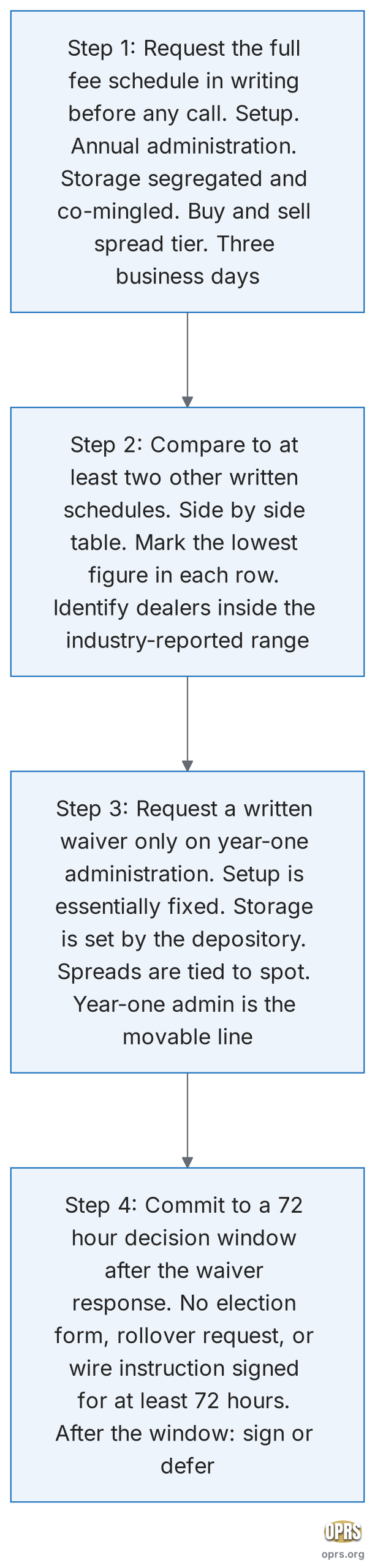
- Request the full fee schedule in writing before any call. Email or postal-mail request for a PDF that lists the four fee lines: setup, annual administration, annual storage (segregated and co-mingled both), and the published buy and sell spread tier. A dealer that will not produce the schedule before a sales call has answered the procedural question. Allow three business days.
- Compare to at least two other written schedules. Repeat step 1 with two additional dealers. Lay all three schedules side by side in a four-column table (one column per dealer plus a column for the line item). Mark the lowest figure in each row. The exercise reveals which dealers are inside the industry-reported ranges and which are not, and it forms the documentary record for step 3.
- Request a written waiver only on year-one administration. Of the four fee lines, the year-one administration fee is the most consistently waived across the industry on six- or seven-figure rollovers. Setup is essentially fixed, storage is set by the depository (not the dealer), and the buy and sell spreads are tied to spot. A written, dated, signed waiver of the year-one administration fee is a reasonable ask. A verbal promise is not. Document the request and the response in the comparison table.
- Commit to a 72-hour decision window after the waiver response. No election form, rollover request, or wire instruction is signed for at least 72 hours after the written waiver is received. The window lets the saver re-read the schedule without a rep on the call, lets a family coordinator or CPA verify the math, and lets the saver re-confirm the depository election. After 72 hours the saver signs or defers; either is a documented decision.
The framework’s purpose is not to extract concessions for their own sake. It is to confine the negotiation to lines that actually vary across dealers, and to convert verbal promises into written commitments before any signature. A dealer that refuses any step is a dealer the saver has already learned about.
What is negotiable and what is not, line by line
The table below maps each common fee line to whether it tends to be negotiable on a large balance, and to the typical industry-reported range. The figures are industry-reported and vary by dealer; the table is a frame for the comparison in step 2 of the framework above, not a quote.
| Fee line | Industry-reported range | Negotiable on $500k+ | Notes |
|---|---|---|---|
| Account setup (one time) | $50 to $250 | Rarely (Limited) | Often paid to the custodian, not the dealer. Dealer cannot waive what it does not collect. |
| Annual administration | $80 to $300 | Sometimes (Year 1 only) | The most consistently waived line on six- and seven-figure rollovers. Request in writing. |
| Annual storage (co-mingled) | $100 to $200 | Rarely (Set by depository) | Depository sets the rate. Dealer can absorb year one in promotions but rarely reduces ongoing. |
| Annual storage (segregated) | $150 to $300 | Rarely (Set by depository) | Same logic as co-mingled. Segregated costs more because of dedicated vault space. |
| Buy spread on metal | 2% to 8% above spot | Sometimes (On size) | Tied to spot price and published premium tier. Large orders may sit lower in the tier but the spread is not custom. |
| Sell spread on metal (buyback) | 1% to 5% below spot | Rarely (Tied to market) | The spread reflects the dealer’s resale risk. Promises of a custom buyback for a specific saver are pseudo-negotiable. |
The pattern: of the six lines, only the year-one administration fee and (rarely) the buy spread move under any negotiation. A dealer that offers concessions on multiple other lines is offering something else, and the framework’s step 2 comparison usually surfaces what.
Before the dealer call, the saver should already have ruled out operators flagged in state-attorney-general consent actions or with unresolved BBB complaint patterns. Check this dealer against the 2026 OPRS list before any of the four steps begin. The framework assumes the choice set is already clean.
The five most common mistakes large-balance savers make
Mistake 1: treating the minimum as a hint of a sliding scale. Minimums are floors, not tiers. A saver who walks in expecting Augusta or Birch to quote a lower per-ounce price for a $750,000 roll-in is misreading the structure. The per-ounce price is set against spot plus published premium.
The room to negotiate is on annual administration in year one, not on metal price. The remedy is step 1 of the framework: request the published fee schedule before the conversation.
Mistake 2: accepting a verbal “special rate just for you”. Verbal promises evaporate at the contract stage. A rep who offers a custom-sounding concession on the call and cannot put it in a dated written waiver is offering nothing of contractual weight. The remedy is step 3: request the waiver in writing, dated, signed, with the line item and the year named.
Mistake 3: agreeing to “premium” or “rare” coin upgrades because of the large balance. A pitch that pivots from bullion to numismatic or “premium” coins is moving you from a transparent spread (spot plus published premium) to an opaque spread (whatever the dealer says the rare coin is worth).
The IRS-approved metals list under 26 U.S.C. §408(m) already covers what is permissible. The premium upgrade is not a privilege of the large balance; it is a margin opportunity for the dealer.
Mistake 4: consolidating an entire retirement balance into the gold IRA on the basis of the negotiation. Concentration risk is concentration risk. A waiver of a year-one administration fee is not a basis for moving 100 percent of a retirement balance to one asset class.
The framework here is procedural about the gold IRA contract, not directive about the share of the household balance that should be precious metals. That share is a question for a fee-only fiduciary advisor under the SEC Investment Advisers Act of 1940, not a gold dealer.
Mistake 5: signing under the pressure of a “today only” expedited rollover offer. No legitimate inherited-IRA or large-balance rollover is timing-sensitive at the dealer end. The 60-day rule under 26 U.S.C. §408(d)(3) applies to indirect rollovers and is a 60-day window, not a 24-hour one. A direct trustee-to-trustee transfer has no 60-day clock at all.
A dealer that pitches urgency on a six-figure rollover is pitching a structure the framework is designed to reject. The remedy is step 4: commit to the 72-hour decision window and document any urgency pitch in the file.
When the negotiation framework is not enough
Two situations push the saver past the framework’s four steps. First, when the inherited IRA itself is still inside the spousal-rollover-versus-inherited-IRA decision under IRS Publication 590-B, the dealer conversation is premature. Decide the IRS election with a CPA first, then take that decision into the dealer negotiation as fixed input.
Second, when the balance crosses the $1 million threshold and the saver is approaching first RMD age (73 under SECURE 2.0), the gold IRA’s distribution mechanics interact with the saver’s broader Medicare IRMAA bracket. That becomes the larger question at that point. Consult your tax advisor before treating the dealer negotiation as the binding decision.
The framework keeps the family record clean for the next generation. Adult children and surviving spouses inherit not just the balance but the documentation trail: which dealer was chosen, what was negotiated, what was waived, what was paid. A documented negotiation is a household asset for the next generation that an undocumented one is not.
Frequently asked questions
Can I get below the dealer minimum if my balance is large enough elsewhere?
No. The minimum applies to the funds transferred or rolled over into the specific gold IRA the dealer is opening for you, not to your total household net worth.
A saver with a $5 million household balance but only $30,000 to direct into a gold IRA is below the Augusta industry-reported minimum. Augusta will decline that saver on the same terms as a saver with $30,000 total. Birch and Noble carry lower industry-reported minimums and would admit the same saver.
The minimum reads the in-account balance, not the off-balance-sheet wealth.
Does a $1 million rollover unlock a lower per-ounce price on the metal?
Not in a meaningful sense. The per-ounce price is set against the live spot price plus a published premium tier. Large orders can sit at the bottom of the dealer’s published premium tier, which is a posted price not a custom price.
A pitch that frames a “special rate” on the per-ounce side as a privilege of the large balance is conflating a posted tier with a personal discount. The room to negotiate sits on the annual administration line, not on metal price.
Should I split my balance across two or three dealers to spread the risk?
The custodian and depository are where the operational risk sits, not the dealer that sold the metal. A saver concerned about dealer concentration can use the framework’s step 2 comparison to pick the dealer with the strongest depository relationship. Look for a segregated vault with an independent, reputable depository rather than splitting balances across multiple dealers.
Splitting doubles or triples the annual administration fees and the documentation burden for no diversification benefit on the metal itself. Discuss the custodian-and-depository pairing with your CPA before splitting.
What if the dealer offers a “free” silver bonus for transferring a larger balance?
Free silver in exchange for a larger transfer is a marketing structure, not a discount. The cost of the bonus silver is built into the buy spread on the rest of the order. Calculate the effective spread on the full order including the bonus silver before treating it as a concession.
The Federal Trade Commission has issued repeated guidance about precious-metals promotional bonuses through its consumer guidance on bullion investing. A bonus that is genuinely above the line will survive the math; one that exists to cover an inflated spread will not.
How long should I expect the full negotiation framework to take?
About two weeks of elapsed time. Step 1 (requesting the schedule) takes three business days. Step 2 (comparing three schedules) takes a working afternoon plus the additional dealer turnaround time. Step 3 (requesting the written waiver) takes another three business days. Step 4 (the 72-hour decision window) closes the cycle. Any dealer that pushes a faster timeline than that is pushing the saver past the framework, which is the framework’s point of detection.
The framework above is a procedural protocol any saver with a $500,000 to $1 million inherited or rolled balance can run without permission from anyone. The setup cost is three written fee schedules, one comparison table, and one 72-hour decision window.
Before any dealer is on the call, rule out disqualified operators using the 2026 OPRS dealer list. Have one benchmark dealer with documented public credentials to compare any pitch against.
The benchmark dealer for the comparison in step 2
For a six- or seven-figure rollover, the saver needs a benchmark dealer with documented public credentials to compare any pitch against.
The educator team is salaried and non-commissioned, and the public process framing is Learn, Talk, Decide. The industry-reported minimum sits around $50,000, which puts a $500,000 to $1 million rollover well above the threshold.
The company comparison checklist Augusta sends on request is a written document the saver can place in column one of the step 2 comparison table, with no dealer rep on the call.
Industry-reported minimum around $50,000. Free company comparison checklist on request.
Sources cited
- FBI Internet Crime Complaint Center, 2023 Elder Fraud Report
- IRS Publication 590-A, Contributions to Individual Retirement Arrangements
- IRS Publication 590-B, Distributions from Individual Retirement Arrangements
- 26 U.S.C. §408, Individual retirement accounts (IRS-approved metals and rollover rules)
- SEC, Investment Advisers Act of 1940
- Federal Trade Commission, Investing in Bullion and Bullion Coins