

Updated: June 23, 2026
OPRS may receive compensation when readers open an account through partner links on this page. Our analysis is based on independent research, BBB data, and IRS publications.
The 2023 FBI Elder Fraud Report logged $3.4 billion in losses from Americans aged 60 and older. Investment fraud was the largest category by dollar volume. The full data is in the FBI Internet Crime Complaint Center, 2023 Elder Fraud Report.
The household-side mirror image of that exposure is the inherited-IRA decision a widow makes inside her own family, with adult children disagreeing in the next room. Element I of any defensive posture for a six- or seven-figure inherited balance is a decision framework that the household commits to before any dealer call is scheduled.
Before you read further, glance at our 2026 reality check on gold IRA dealers to understand the operator landscape the disagreement is happening inside.
This guide is written for the surviving spouse who has just transferred her late husband’s IRA into a beneficiary IRA, and for the adult children who are arguing about what she should do next. The framework here is a decision process, not a verdict on who is right.
Before the household conversation begins
A family disagreement about an inherited IRA is the wrong moment to also discover that the dealer pitching the rollover is one of the operators under active state-attorney-general scrutiny. The 2026 OPRS reality check names the operators we currently warn six-figure savers against, the few we consider acceptable, and the BBB and state-AG actions behind each verdict. Read it before the family meeting is scheduled.
3 of 27+ gold IRA dealers reviewed by OPRS make the 2026 trusted list.
Why adult children disagree about an inherited IRA decision
Disagreement is the default state of a household sitting on a six- or seven-figure inherited IRA, not the exception. The surviving spouse holds the legal decision rights, but the adult children hold a remainder-interest expectation under the will and an information set built over decades with the decedent.
The IRA sits at the intersection of three legal regimes the family rarely understands at equal depth. The first is the IRS rules for spousal beneficiaries under IRS Publication 590-B. The second is the SECURE Act 10-year rule for non-spouse beneficiaries under 26 U.S.C. §401(a)(9). The third is the contract terms on the receiving IRA at the dealer or custodian on the call.
The most common substantive disagreements fall into four categories. Whether to roll the inherited IRA into a gold IRA at all. Whether to elect the spousal rollover under 26 U.S.C. §408(d)(3) or keep the inherited-IRA structure with the surviving spouse as beneficiary. Whether to take distributions now or stretch the account using the smallest required minimum distribution divisor. And whether to use any portion of the balance for current gifts under the annual gift-tax exclusion.
Each disagreement maps to a different IRS code section, a different time horizon, and a different beneficiary outcome at the surviving spouse’s death.
The disagreement is rarely about money in the abstract. In practice it is about three implicit questions the family has not yet articulated: who has authority to decide, what information the decision is based on, and what happens if the decision turns out wrong. The framework below answers those three in sequence.
Who legally owns the decision
The single most consequential clarification a family can make at the start of the conversation is also the one most often skipped. The surviving spouse owns the decision, full stop. Adult children are not signatories on the inherited IRA, do not appear on the spousal-rollover election form, and have no procedural standing with the custodian.
The IRS recognizes only the named beneficiary on the decedent’s account. After the spousal election, that beneficiary becomes either the surviving spouse in her own right under the spousal rollover (IRC §408(d)(3)) or the surviving spouse as beneficiary of the decedent’s inherited IRA. The second option is the alternative election under IRS Publication 590-B, chapter 1.
That said, three layers can shift the practical center of gravity. Contingent beneficiaries named on the IRA give the adult children a documented stake in the outcome even without a current vote.
A durable power of attorney executed by the surviving spouse can name an adult child as agent for financial decisions if the spouse becomes incapacitated. That agency is dormant while the spouse retains capacity, but it shapes the longer arc of the relationship.
State law on financial exploitation of vulnerable adults creates a fiduciary tripwire for anyone in the family who attempts to override the surviving spouse’s decision under pressure.
The legal answer, then, is: the surviving spouse decides, the adult children have a voice and a stake but not a vote. Any conversation that confuses the two should be reset before it goes further. This becomes step 1 of the framework below.
The five-step decision framework when the family disagrees
The framework below takes about three weeks of elapsed time and roughly six hours of active work, distributed across the surviving spouse, one designated adult child, and one external professional. Each step has a deliverable. Done in sequence, the family ends with a documented decision the surviving spouse made, after a structured deliberation that respected the adult children’s voice without confusing it with a vote. Skipping a step is the most common failure mode.
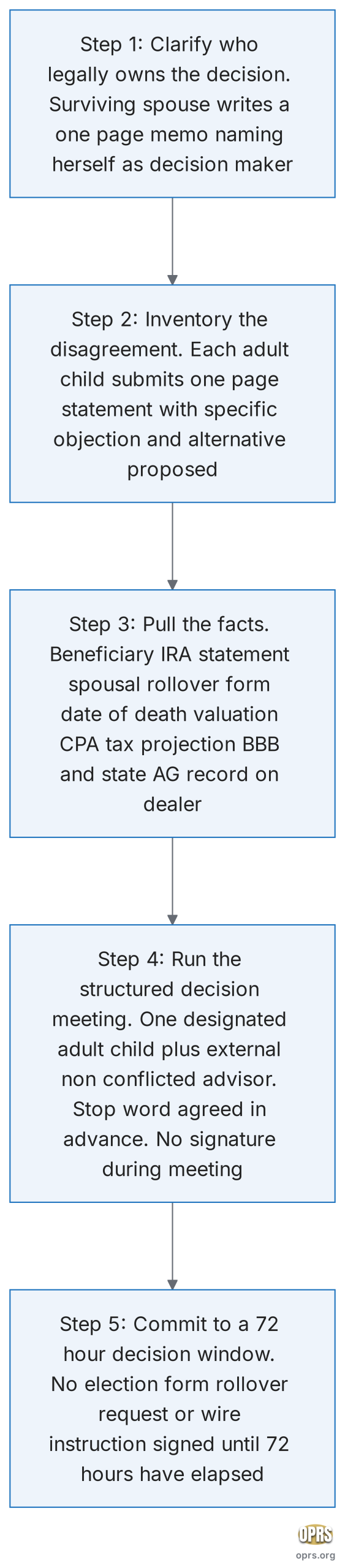
- Clarify who legally owns the decision and write it down. The surviving spouse names herself as decision-maker on a one-page memo, lists the adult children as advisory voices, and dates the memo. The memo is shared with every adult child before step 2 begins. This step takes 30 minutes and prevents the most common derailment: an adult child treating the conversation as a vote.
- Inventory the specific disagreement in writing. Each adult child submits a one-page statement that names the specific decision they disagree with (rollover yes or no, spousal election A or B, distribution timing, gift to family), the alternative they propose, and the basis. Vague disagreement is not actionable. Specific disagreement attached to a code section, a tax outcome, or a household priority is.
- Pull the facts. The surviving spouse and one designated adult child assemble the document set: the latest beneficiary IRA statement, the spousal rollover election form, the date-of-death valuation, the current-year tax projection from the CPA, the BBB profile and state-AG consumer-protection record for any dealer under consideration, and the OPRS 2026 reality-check verdict on that dealer. Allow three hours.
- Run the structured decision meeting. The meeting includes the surviving spouse, the designated adult child, and one external non-conflicted advisor (estate attorney, fee-only fiduciary advisor, or CPA). Other adult children participate by speakerphone or video. Agenda is fixed: 15 minutes per disagreement listed in step 2, surviving spouse speaks last, no contract or signature during the meeting. A stop-word agreed in advance lets any participant pause the discussion.
- Commit to a 72-hour decision window. No election form, rollover request, or wire instruction is signed for at least 72 hours after the meeting ends. The window lets the surviving spouse re-read documents without family in the room, lets the coordinator independently verify the dealer’s BBB and state-AG record, and lets any dissenting adult child write a one-page note for the file. After 72 hours the surviving spouse signs or defers; either is a documented decision.
The RMD math behind the spousal rollover vs. inherited IRA choice
One of the most common disagreement nodes in the framework is the spousal election itself. The reason the family disagreement is genuinely substantive at this node, and not just a question of style or trust, is that the required-minimum-distribution divisor is materially different between the two options. The IRS publishes both tables in IRS Publication 590-B, Appendix B.
The Uniform Lifetime Table (used by the surviving spouse if she elects the spousal rollover and treats the IRA as her own) produces a larger divisor at every age between 73 and 100. A larger divisor means a smaller required distribution and more tax-deferred growth.
The Single Life Table (used if the surviving spouse keeps the inherited-IRA structure with herself as beneficiary) produces a smaller divisor and a larger required distribution.
For a widow at ages 73, 75, 78, and 80, the Uniform Lifetime Table divisors are 26.5, 24.6, 22.0, and 20.2. The Single Life Table divisors at the same ages are 16.4, 14.8, 12.4, and 10.8. The chart below compares the two side by side.
The practical consequence: a $750,000 inherited IRA at age 75 produces a roughly $30,500 RMD under the spousal rollover versus roughly $50,700 under the inherited-IRA election. At a 22% marginal federal tax rate, the difference in current-year tax owed is roughly $4,450.

A common misconception: the lower-tax-this-year answer is not automatically the right answer. The spousal rollover forfeits the inherited-IRA exception to the 10% early-withdrawal penalty under 26 U.S.C. §72(t) before age 59½.
For a widow under 59½ who needs access to the funds before that age, the inherited-IRA election is the right choice even though the divisor is smaller. The alternative is a 10% penalty layered on top of ordinary income tax.
The framework’s step 4 is where this nuance gets surfaced; it is also where adult children who have not done the homework tend to argue most loudly for the wrong election.
The five most common mistakes families make at this decision
Mistake 1: treating the conversation as a vote. The surviving spouse owns the decision. Adult children who frame the conversation as a majority decision among siblings are setting up a process that has no legal standing with the custodian or the IRS. The remedy is step 1: write down who owns the decision before any other step begins.
Mistake 2: deciding the spousal election before pulling the tax projection. The choice between the spousal rollover and the inherited-IRA election turns on a small number of facts. Those facts include the surviving spouse’s age, her projected marginal federal tax bracket, whether she will need IRA funds before age 59½, and the balance relative to her other resources. Deciding without those facts is deciding without information. The remedy is step 3.
Mistake 3: scheduling the dealer sales call inside the decision window. A dealer rep on the phone is an additional participant in the deliberation, and not a neutral one. Schedule the dealer call only after the framework has produced a decision, never as part of it.
Mistake 4: letting one adult child speak for the rest. Designating a coordinator under step 3 is appropriate. Letting that coordinator speak for siblings in step 4 is a process error. Each adult child who submitted a step-2 statement gets 15 minutes in the meeting; the coordinator runs logistics, not the agenda.
Mistake 5: signing under family pressure rather than deferring. The 72-hour rule exists to disarm the pressure that builds at the end of step 4. If the surviving spouse is still uncertain at hour 72, the decision is to defer, not to sign. A deferred decision is a documented decision and can be revisited in 30, 60, or 90 days. A signature under family pressure on a six-figure rollover is precisely the category the framework is designed to prevent.
When to bring in an external mediator
Not every family disagreement can be resolved by a structured process inside the household. Three triggers warrant bringing in a paid external mediator before the framework begins. First, when the family has argued about the inherited IRA for more than 30 days without progress, the disagreement has likely shifted from substance to relationship and a neutral third party is required.
Second, when one adult child has a documented conflict of interest, the mediator’s role is to surface that conflict on the record. A conflict of interest includes an unpaid loan from the decedent, a business interest the IRA balance might fund, or a remarriage dynamic.
Third, when the surviving spouse meets a FINRA Rule 2165 “specified adult” concern, the receiving custodian itself may already be reviewing the disbursement. This applies when the spouse is age 65 or older and there is reasonable basis to believe she is being pressured.
The right mediator profile depends on the trigger. For substance-shifted-to-relationship cases, a licensed family mediator certified by the Association for Conflict Resolution is the appropriate first call. For conflict-of-interest cases, the estate-planning attorney who handled the decedent’s will is usually positioned to mediate without taking sides, since the attorney already has the document set in hand.
For pressure-on-the-surviving-spouse cases, two layers of defense apply. The first is the surviving spouse’s fee-only fiduciary advisor, governed by the SEC, Investment Advisers Act of 1940. The second is a named FINRA Rule 4512 trusted contact at the custodian. FINRA Rule 2165 permits a 15-business-day pause on a disbursement when a specified adult may be facing exploitation. The household-side analog is the framework’s 72-hour rule extended to 15 business days when those conditions are present.
The dealer choice intersects the family decision
The substantive disagreement about whether to roll into a gold IRA at all is harder to resolve when the dealer on the table is one of the operators already flagged in state-attorney-general actions. Eliminate the disqualified operators from the choice set before the family meeting begins. The OPRS reality check on gold IRA dealers names the operators we currently warn six-figure savers against and the few we consider acceptable.
3 of 27+ gold IRA dealers reviewed by OPRS make the 2026 trusted list.
Frequently asked questions
Can my adult children legally block the rollover or distribution?
No. Adult children are not signatories on the inherited IRA, do not appear on the spousal-rollover election form, and have no procedural standing with the custodian or the IRS. They can voice concerns, document objections, and refuse to participate, but they cannot block the surviving spouse from signing an election form she has lawful authority to sign.
The only legal mechanisms that change that picture are a court-supervised guardianship or a previously executed durable power of attorney activated by the spouse’s incapacity. Neither applies to a competent surviving spouse facing family disagreement.
What if the adult children disagree with each other and not just with me?
That is the most common pattern in practice and the one the framework is designed for. Step 2 asks each adult child to submit a one-page statement, which surfaces sibling-to-sibling disagreement on the record. Step 4 gives each adult child 15 minutes in the meeting.
The structure does not require siblings to agree with each other; it requires each of them to articulate a position the surviving spouse can weigh. The surviving spouse then decides on the basis of the documented record. Sibling consensus is not required for a clean decision.
Should I tell the dealer about the family disagreement on the sales call?
No. The dealer does not need information about household dynamics, and disclosing it gives a non-compliant rep a pressure lever. The dealer call happens only after the framework has produced a decision, and the surviving spouse describes the decision as her own.
If a rep asks whether the family agrees with the rollover, the appropriate answer is that the decision is the IRA holder’s and the call is to verify costs and procedure. A dealer that pushes back on that framing has answered the question of whether the family should work with them.
What if one adult child wants me to gift them part of the IRA now?
An IRA cannot be gifted directly. Funds must first be distributed to the account holder as ordinary income. If the spouse is under 59½ and has elected the spousal rollover, that distribution may also carry the 10% additional tax under IRC §72(t). Only after distribution can any gift to an adult child be made.
The 2026 annual gift-tax exclusion is $18,000 per recipient per donor under IRS Form 709 instructions; gifts above that require filing Form 709. A request for an immediate gift belongs in step 2 of the framework, with a written rationale and an alternative proposed.
What if the dealer offers an “expedited rollover” if I decide today?
End the call. No legitimate inherited-IRA rollover is timing-sensitive at the dealer end. The 60-day rule under IRC §408(d)(3) gives 60 calendar days to complete an indirect rollover, but that window is generous, and a direct trustee-to-trustee transfer has no 60-day clock at all. A dealer pitching urgency is pitching a structure the framework is designed to reject. Report the call to the BBB, the state attorney general’s consumer-protection division, and the dealer’s headquartered-state attorney general.
The framework above is a household process the surviving spouse can put in place without permission from anyone. The setup cost is one one-page memo (step 1), one written statement per adult child (step 2), and one structured meeting (step 4). Before any dealer is contacted, the family should already have the OPRS 2026 reality-check verdict on the dealer and a benchmark non-pressure option to compare any pitch against.
The Education-First option to benchmark against during the family decision
For a six- or seven-figure inherited IRA, the surviving spouse needs a benchmark dealer with documented public credentials to compare any pitch against.
The educator team is salaried and non-commissioned, and the public process framing is Learn, Talk, Decide. The industry-reported minimum sits around $50,000, which puts most spousal inherited IRA balances inside the eligible range.
The company-comparison checklist Augusta sends on request is a written document the family can review during step 3 of the framework, with no dealer rep on the call.
Industry-reported minimum around $50,000. Free company comparison checklist on request.
Sources cited
- FBI Internet Crime Complaint Center, 2023 Elder Fraud Report
- IRS Publication 590-B, Distributions from Individual Retirement Arrangements (inherited IRA election + Appendix B RMD tables)
- 26 U.S.C. §401(a)(9), Required minimum distributions (SECURE Act 10-year rule)
- 26 U.S.C. §408(d)(3), Rollover contributions and spousal rollover election
- 26 U.S.C. §72(t), 10-percent additional tax on early distributions
- FINRA Rule 2165, Financial Exploitation of Specified Adults
- FINRA Rule 4512, Customer Account Information (Trusted Contact)
- SEC, Investment Advisers Act of 1940
- IRS Form 709, United States Gift (and Generation-Skipping Transfer) Tax Return