
Updated: July 28, 2026
OPRS may receive compensation when readers open an account through partner links on this page. Our analysis is based on independent research, BBB data, and IRS publications.
The in-service rollover is one of the most under-used planning tools available to working plan participants. It is the one tool that lets a current employee diversify part of a 401(k), 403(b), or 457(b) balance into IRS-approved precious metals without separating from service.
The mechanics turn on a single document: the plan document filed by the employer with the Internal Revenue Service. The Code sets the outer envelope of what is allowed; the plan sets the inner envelope of what is offered.
Most participants discover the gap between those two envelopes the hard way, after a dealer has already opened an IRA and the plan administrator has already told them no.
Element I of the planning sequence is the plan document review. The Summary Plan Description (SPD) or the underlying plan document is the binding constraint on whether an in-service distribution is available at all, which money sources are eligible, and what minimum-age or service threshold applies.
The downstream sequencing (custodian selection, dealer vetting, metal allocation) only matters if Element I returns a green light. For the related sequence that applies to a federal participant still in service, see our TSP-75 age-based in-service withdrawal guide. For the late-starter context where this question usually arises, see our late-starter 55 to 65 ten-year strategy guide.
Before you start
The in-service mechanics are forgiving once the plan permits the distribution. The dealer step is not. Most basis-preservation errors on partial in-service rollovers trace back to a dealer who pressured a cash distribution instead of a trustee-to-trustee transfer. Others stem from a dealer who promised an in-service withdrawal the plan document does not in fact allow. Our reality check on gold IRA dealers names the operators a working participant should rule out before any plan paperwork moves.
3 of 27+ gold IRA dealers reviewed by OPRS make the 2026 trusted list. Updated July 28, 2026.
What the Code allows and what the plan offers are two different questions
The Internal Revenue Code sets the maximum scope of in-service distributions, not the minimum. Under IRC §401(k)(2)(B), elective deferrals to a 401(k) plan are generally distributable only on separation from service, attainment of age 59½, death, disability, or hardship. Older money sources are governed by separate, generally more permissive rules. These include after-tax contributions, employer non-elective contributions, employer matching contributions, and prior-plan rollover money already inside the 401(k), all governed under IRC §401(a) and Treasury regulations §1.401-1(b)(1)(ii).
The plan document then narrows that envelope. A plan can choose to mirror the Code’s outer limits, to be more restrictive, or to layer additional conditions (a minimum-service requirement, a minimum-balance threshold, a maximum-frequency cap).
The plan can also write a money-source distinction into the in-service feature: for example, allowing employer matching contributions to be distributed at age 55 while elective deferrals must still wait to 59½.
The participant has no say over the plan-level choice; the Summary Plan Description (SPD), the plan document, and the plan administrator are the three artifacts that govern what is actually available.
Our take: the most common eligibility mistake is treating the IRS rules as the eligibility rules. A participant who reads about the age-59½ threshold in IRS Publication 590-A often arrives at their plan administrator expecting a green light at 59½ that the plan does not in fact grant.
The plan can require continued employment past 59½, can require a separate written election, can require spousal consent on certain plan designs, and can deny in-service distributions of elective deferrals entirely. The SPD is the place the participant has to verify all of this before any dealer paperwork is signed.
The five money sources inside a typical 401(k) and why they matter
A 401(k) balance is a single account number on the participant statement, but inside the recordkeeper’s system it is partitioned into separate money sources. Each source carries its own contribution origin (employee or employer), its own tax treatment (pre-tax, Roth, or after-tax), and its own in-service distribution rules. The five sources most commonly seen are:
- Pre-tax elective deferrals. The participant’s pre-tax salary reductions. Distributable in-service at age 59½ or older under IRC §401(k)(2)(B), plus the limited hardship channel.
- Roth elective deferrals. Post-tax salary reductions to the Roth 401(k) subaccount. Same in-service distribution rule as pre-tax elective deferrals (age 59½ plus hardship), with the additional Roth 5-year clock under IRC §402A.
- After-tax (non-Roth) contributions. Voluntary post-tax employee contributions to a separate subaccount, distinct from Roth. Many plans permit in-service distribution of these regardless of age, because the Code does not impose the §401(k)(2)(B) restriction on them.
- Employer matching contributions. The employer’s match on participant deferrals. In-service distribution rules vary by plan; many permit distribution at a stated age (often 55, 59½, or after a stated service period) once vested.
- Employer profit-sharing or non-elective contributions. Employer money outside the match. Similar in-service flexibility to the match, often with the same minimum-age or service trigger.
A separate sixth source frequently appears: prior-plan rollover money. If the participant rolled a previous employer’s 401(k) into the current plan, that rollover-source money is typically distributable in-service at any age, because it never lost its IRA-equivalent rollover character. This is the source many in-service rollovers actually run through, and it is the source most participants do not realize they have.
The direct rollover preserves the full balance; the cash distribution does not
Once the plan permits the in-service distribution of the chosen money source, the routing question becomes the next planning lever. The Code recognizes two paths: a direct trustee-to-trustee transfer to an IRA under IRC §402(c), and a cash distribution paid to the participant with the 60-day rollover window. The two paths produce different 1099-R reporting, different cash flow, and different downstream risk profiles.
The direct trustee-to-trustee path produces a 1099-R with Distribution Code G in Box 7, a gross amount in Box 1 equal to the transferred balance, and a taxable amount of zero in Box 2a. No federal withholding applies. The receiving IRA custodian issues a Form 5498 reflecting the rollover contribution. The participant’s tax filing for the year shows the rollover on Form 1040 line 5a (gross) and line 5b (taxable, zero) with the notation “Rollover” alongside.
The cash distribution path triggers the 20 percent mandatory federal withholding under IRC §3405(c)(1) on any portion that is an eligible rollover distribution paid to the participant. The participant has 60 days from receipt to deposit the gross amount (including the 20 percent that the IRS now holds) into an IRA to complete the rollover.
The 20 percent withheld becomes refundable on the tax return only after the rollover is fully completed. In the meantime, the participant has to come up with that 20 percent from outside funds to avoid leaving it taxable as a partial distribution.
How a $100,000 in-service rollover compares across four routing choices
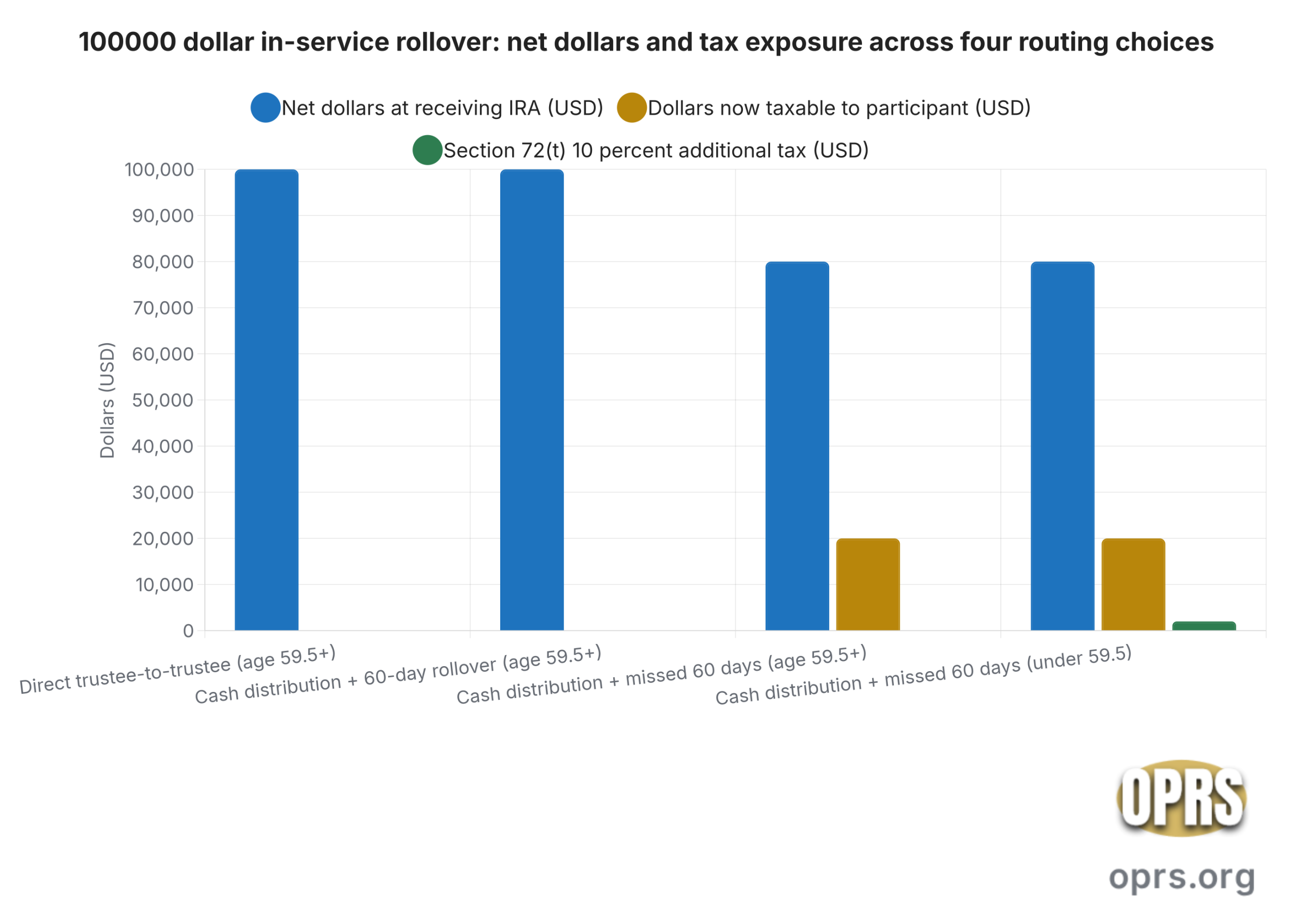
The dollar impact of the routing choice is most visible at the margin. A participant moving $100,000 from an employer plan to a self-directed IRA via the in-service channel can land in four practical positions, depending on the routing and the age threshold. The figure below tracks the net dollars that arrive at the receiving IRA (and remain there free of additional tax) under each.
Can you roll your account into a precious metals IRA? Eligibility checker
Most retirement money can move into a precious metals IRA once it qualifies as an eligible rollover distribution. Pick your account type and situation for a general answer. Always confirm specifics with your plan administrator or custodian.
General guidance only, not tax or financial advice. Eligibility depends on your specific plan document and IRS rules; confirm with your plan administrator and a tax advisor. A direct trustee-to-trustee transfer avoids the 60-day rule and 20% mandatory withholding.
The right dealer explains every fee up front. Get Augusta's free precious metals IRA company checklist.
The chart makes the trade-off explicit: only the direct trustee-to-trustee transfer preserves the full $100,000 with zero mechanical risk. The cash-distribution path can preserve the full amount in theory, but only if the participant successfully sources the withheld 20 percent from outside funds and completes the deposit inside the 60-day window.
Any failure on either condition turns the withheld amount (and potentially the early-distribution amount) into a taxable event, with the 10 percent additional tax under IRC §72(t) stacking for participants under age 59½. For the post-divorce planning context where this math compounds with single-filer thresholds, see our single-filer tax strategy post-divorce guide.
The seven-step procedural sequence at a glance
Stacking the eligibility, source-selection, and routing decisions into a single procedural sequence produces the flow below. The diagram is the planning artifact most participants find easier to reason about than the narrative version.

The seven steps fall into three phases. Discovery (Steps 1 and 2) uses the plan document as the source of truth. Preparation (Steps 3 through 5) sets up the receiving IRA and the distribution paperwork. Execution (Steps 6 and 7) initiates the transfer and purchases the metals. The recordkeeper handles Steps 6 and 7 in parallel from the plan side; the participant handles them in series from the receiving side.
Common errors that derail in-service rollovers
Across the case files OPRS has reviewed, four error patterns recur on otherwise-careful in-service rollover requests. None are sophisticated; all are common.
Error 1: assuming the plan allows what the Code allows. This is the single most common error. A participant reads about the 59½ threshold in IRS material, files a request without reviewing the SPD, and receives a denial from the plan administrator. The fix is mechanical: pull the SPD before any dealer paperwork moves. Then confirm in writing with the plan administrator that the chosen money source is in-service-distributable for a participant of the participant’s age and service tenure.
Error 2: choosing the wrong money source. Plans often allow in-service distribution of after-tax or rollover-source money at any age while restricting elective deferrals to 59½. A participant who requests an elective-deferral distribution at 55 will be denied; the same participant requesting an after-tax contribution distribution at 55 may well be approved. The recordkeeper’s participant-services line can confirm the source breakdown on a recent quarterly statement.
Error 3: accepting a cash distribution when a direct rollover was requested. Some plan administrators default to cutting a check to the participant when the rollover destination paperwork is incomplete or ambiguous. The participant receives a check (already net of 20 percent withholding), assumes the check is the direct rollover, and deposits it into a personal account.
The 60-day clock now runs. The fix is to confirm with the plan administrator that the distribution paperwork specifies the receiving IRA custodian by name, with the custodian’s payee address and account number, before the request is submitted.
Error 4: signing dealer paperwork before the plan paperwork. A dealer who promises an in-service rollover without first reviewing the SPD is making a promise the plan, not the dealer, controls. The vetting sequence should run plan-side first (SPD pull, administrator confirmation, source identification, dollar amount confirmed), then custodian-side (IRA opened, payee instructions issued), then dealer-side (metals selection, allocation).
Reversing that order is the most common path to a stranded request, where the participant has opened an IRA and signed dealer paperwork only to learn the plan does not permit the contemplated distribution.
Where the dealer choice intersects the in-service sequence
An in-service rollover is no harder than any other direct trustee-to-trustee transfer once the plan administrator approves the request. The complication arrives one step earlier, when a dealer pushes a cash distribution route or promises an SPD outcome the plan does not in fact deliver. Vetting the dealer before the plan paperwork is the practical safeguard.
3 of 27+ gold IRA dealers reviewed by OPRS make the 2026 trusted list. Updated July 28, 2026.
What we did not include in this guide
Three adjacent topics show up in some in-service rollover guides but sit outside the core procedural sequence:
403(b) plans. Tax-sheltered annuity plans under IRC §403(b) follow a parallel but separate set of in-service distribution rules, with the elective-deferral 59½ restriction in §403(b)(11) and additional contract-level constraints from the annuity provider. The seven-step sequence broadly applies, but the SPD review becomes a contract review, and the money-source partitioning is structurally different. Physicians and clinical staff at hospital-system 403(b) plans should reference the parallel guide at physician 403(b) in-service distribution.
Governmental 457(b) plans. State and local government 457(b) plans under IRC §457(b) do not impose the 10 percent additional tax under §72(t) on distributions, including in-service distributions that the plan allows. The trade-off is that 457(b) plans typically restrict in-service distributions more tightly than 401(k) plans. Federal Thrift Savings Plan participants follow a different framework entirely; the TSP-75 channel is covered in our TSP-75 age-based in-service withdrawal guide.
Hardship withdrawals. The hardship withdrawal channel under §401(k)(2)(B)(i)(IV) is sometimes confused with the in-service rollover because both keep the participant in service. The hardship channel is narrower, requires demonstrated immediate and heavy financial need, is not rollable to an IRA, and is fully taxable in the year of distribution. The two channels do not substitute for each other.
Frequently asked questions
Does an in-service rollover stop my future 401(k) contributions?
No. The in-service rollover removes a portion of the existing vested balance from the plan. It does not affect the participant’s salary-deferral elections, the employer’s match obligations, or the participant’s continued eligibility to participate in the plan. The participant can submit an in-service rollover and continue making payroll deferrals to the same 401(k) account in the same pay period.
Can I do an in-service rollover if I am younger than 59½?
Possibly, depending on the plan and the money source. Elective deferrals are generally locked until 59½ under IRC §401(k)(2)(B). After-tax contributions, employer match, employer profit-sharing, and prior-plan rollover money may be in-service-distributable earlier if the plan permits. The SPD is the source of truth; the IRS rule sets the maximum, the plan sets the actual.
What 1099-R code should I expect on a direct in-service rollover?
Distribution Code G (direct rollover to a qualified plan or IRA) with a $0 taxable amount in Box 2a and the gross amount equal to the rollover in Box 1. If any Roth 401(k) portion is included, a separate Code H may apply for the Roth-to-Roth direct rollover component.
The receiving IRA custodian issues Form 5498 reflecting the rollover contribution; the participant reports the rollover on Form 1040 line 5a (gross) and line 5b (taxable, zero) with the notation “Rollover” alongside.
Can I roll the entire vested 401(k) balance via the in-service channel?
Mechanically possible if the plan permits in-service distribution of all the participant’s vested money sources, but uncommon in practice. Plans typically allow in-service distribution of one or two sources, not all of them. The full-balance rollover is usually a post-separation event. The in-service variant is most often used for partial diversification of specific money sources rather than full-balance moves.
Are there spousal-consent rules on an in-service rollover?
Plan-specific. Plans subject to qualified joint and survivor annuity (QJSA) rules under IRC §417, primarily money-purchase pension and defined-benefit plans, require spousal consent on certain distributions. Most 401(k) plans are exempt from QJSA if structured as profit-sharing plans with the spousal-default-beneficiary feature. The plan document or SPD identifies whether spousal consent is required; the recordkeeper’s distribution form will request it where applicable.
Does an in-service rollover affect Required Minimum Distributions later?
Yes, indirectly. RMDs from the employer plan continue to apply to the balance remaining inside the plan after the rollover, on the participant’s RMD start date schedule under IRC §401(a)(9). The rolled-over balance becomes IRA money for RMD purposes and follows the IRA RMD schedule from the participant’s first RMD year.
Participants still in service past their RMD start age may benefit from the “still-working exception” on the employer plan side; that exception does not extend to the IRA portion.
Three planning artifacts should exist before any rollover paperwork moves. First: a copy of the current SPD with the in-service distribution section highlighted. Second: a recent quarterly statement showing the money-source breakdown of the participant’s vested balance. Third: written confirmation from the plan administrator naming the eligible money sources and the receiving custodian payee instructions.
The dealer selection follows the plan-side confirmation. The metals selection follows the IRA opening. Reversing that order is the single most expensive sequencing error in the in-service rollover workflow. It is also the one we see most often in the case files of participants who arrived at a result after the request had already gone wrong.
Sources cited
- 26 U.S. Code §401 (Qualified pension, profit-sharing, and stock bonus plans, including §401(k)(2)(B) in-service distribution rules)
- 26 U.S. Code §402(c) (Rollover treatment of eligible rollover distributions)
- 26 U.S. Code §402A (Roth contribution programs and 5-year clock)
- 26 U.S. Code §403(b) (Tax-sheltered annuity plan distribution rules)
- 26 U.S. Code §457(b) (Governmental and tax-exempt deferred compensation plans)
- 26 U.S. Code §72(t) (10 percent additional tax on early distributions)
- 26 U.S. Code §3405 (Special rules for pensions, annuities, and certain other deferred income, including 20 percent mandatory withholding)
- 26 U.S. Code §408(m) (Investment in collectibles; IRS-approved precious metals exception)
- 26 U.S. Code §417 (Definitions and special rules for purposes of minimum survivor annuity requirements)
- IRS Publication 590-A (Contributions to Individual Retirement Arrangements)
- IRS Publication 575 (Pension and Annuity Income)
- IRS Tax Topic 558 (Additional Tax on Early Distributions from Retirement Plans)
More on OPRS
- Late-starter gold IRA: a ten-year strategy for ages 55 to 65
- QDRO and divorce gold IRA rollover rules
- Gold IRA after divorce: rebuilding retirement
- Single-filer tax strategy post-divorce
- TSP-75 age-based in-service withdrawal
- Physician 403(b) in-service distribution
- The OPRS reality check on gold IRA dealers