

Updated: July 28, 2026
OPRS may receive compensation when readers open an account through partner links on this page. Our analysis is based on independent research, BBB data, and IRS publications.
The day the decree is signed, every retirement-relevant federal tax threshold the household lived under collapses to roughly half its prior width.
The common thread is that the decree halves the headroom on nearly every gate at once: deduction, deduction phase-out, Roth ceiling, NIIT trigger, and IRMAA tiers all tighten in the same filing year. The practical consequence is that a conversion or contribution that was comfortably inside the brackets while married can now cross two or three of these thresholds on a single move.
Here is the core challenge. A project-manager-tier earner aged 55 to 60 who enters the year after the decree with a $150,000 to $250,000 post-QDRO rollover balance is now filing a single return. The same dollar of conversion, contribution, or investment income carries a higher marginal cost.
The QDRO mechanics themselves are covered in our QDRO divorce rollover rules guide; this article is the single-filer tax-strategy companion that pairs with it and with the related Roth conversion ladder post-divorce guide.
30-second verdict
- Rewrite the federal tax setup before the first single-filer return is filed. Update Form W-4 with the post-decree filing status, recompute quarterly estimated tax under IRC Section 6654, and reproject the IRC Section 219(g) IRA deduction phase-out under the new single ceiling.
- Treat the Roth IRA income limit under IRC Section 408A(c)(3) as the new ceiling. The single-filer phase-out begins at a lower modified AGI than the married-filing-jointly equivalent; a $150,000 wage base that fit cleanly inside the joint allowance may now block direct Roth contributions and force the backdoor route.
- Project IRMAA two years ahead. The Medicare Part B and Part D surcharge under 42 U.S. Code Section 1395r looks back two tax years. A single-filer AGI spike at age 63 lands on the IRMAA scoring for the first Medicare year at age 65.
- Use the catch-up contribution lane under IRC Section 219(b)(5)(B). Filers 50 and older get an additional $1,000 IRA catch-up. For the late-starter rebuild that is real annual room into the IRC Section 408(m)(3) precious metals slice inside a self-directed IRA wrapper.
- State conformity is not federal. Arizona, a community property state common to the OPRS divorced-filer audience anchor, conforms to federal AGI but applies its own deductions, credits, and itemizing rules on top. The state recompute has to be a separate exercise.
What the single-filer status changes federally on day one
Federal filing status is determined as of the last day of the tax year under IRC Section 7703. A decree of divorce or separate maintenance entered on or before December 31 sets the entire tax year to single. Head of household applies if a qualifying dependent is in the home for more than half the year under IRC Section 2(b).
The IRS does not pro-rate the year. A January decree leaves the full prior tax year on the joint return; a December decree resets the same calendar year to single. That binary timing drives the urgency of the post-decree tax recompute.
Five federal threshold sets move at once when filing status shifts from joint to single. The IRC Section 1 marginal rate bands compress to half their joint width across the 22 percent, 24 percent, 32 percent, and 35 percent rates.
The IRC Section 63 standard deduction drops from the joint amount to the single amount. For 2026, the joint figure was approximately $30,000 and the single figure approximately $15,000 per the IRS annual revenue procedure cycle. Consult IRS Notice 2024-80 for the current-year exact amounts.
The IRC Section 219(g) IRA deduction phase-out for an active retirement-plan participant closes earlier on a single return. The IRC Section 408A(c)(3) Roth IRA contribution phase-out closes earlier as well.
The IRC Section 1411 Net Investment Income Tax kicks in at a lower modified AGI threshold, and the 42 U.S. Code Section 1395r IRMAA Medicare surcharge tiers drop to roughly half their joint ceilings.
In practice: the dollar of taxable income that used to sit safely under multiple soft thresholds now sits above more than one of them simultaneously. The single-filer return has more cliffs and the cliffs are closer together.
The five thresholds that compress: a side-by-side
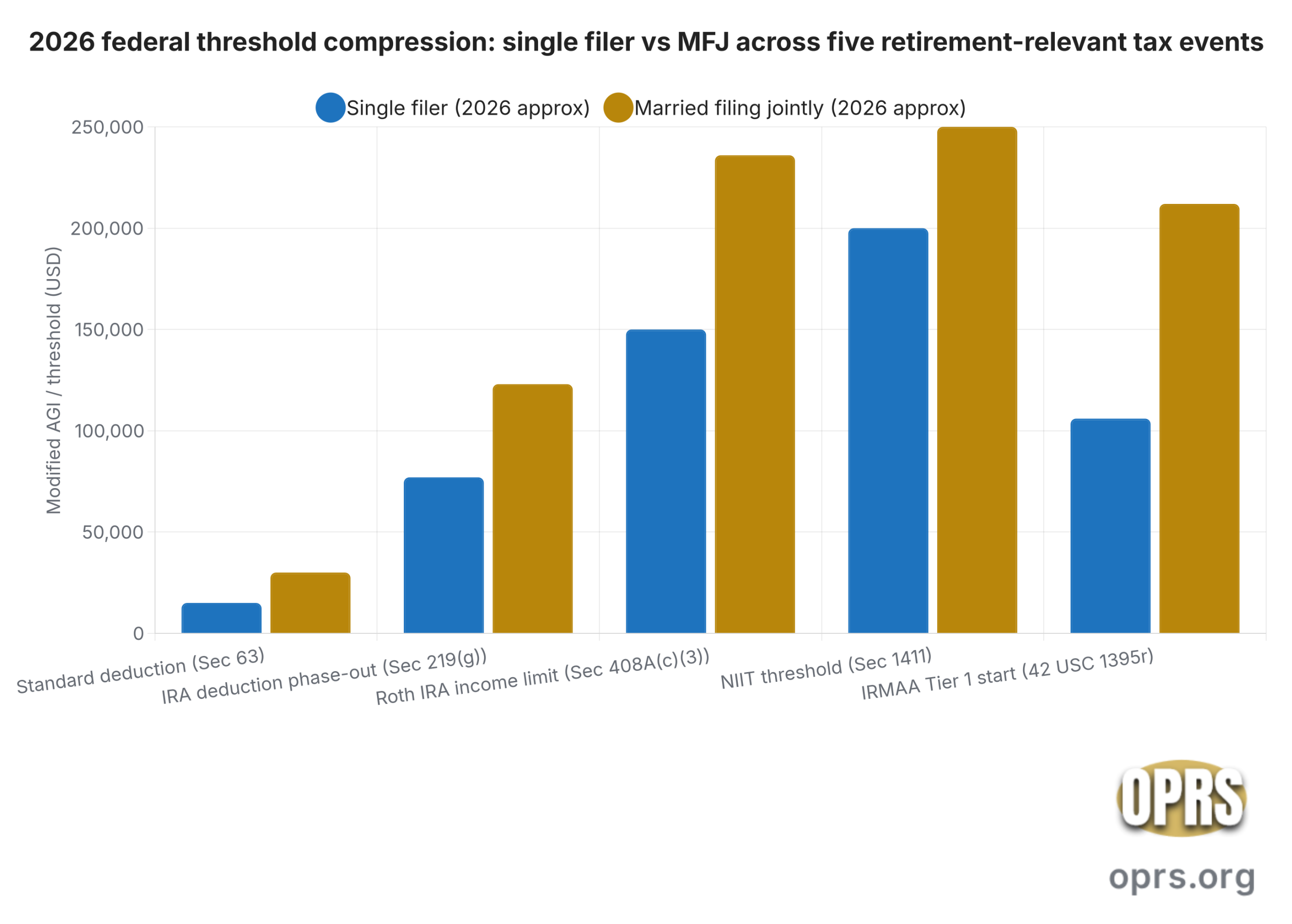
The table below maps the approximate 2026 single and married-filing-jointly thresholds at each of the five tax-event lines that drive retirement decisions for the post-QDRO rebuild filer. The single column shows what the return now uses; the joint column shows what the household lost. Numbers are rounded to the nearest $25 and traced to the IRS revenue procedure cycle; verify against the current-year guidance before any tax-position decision.
| Tax event | Single filer (2026 approx) | MFJ (2026 approx) | Single as % of MFJ |
|---|---|---|---|
| IRC Section 63 standard deduction | $15,000 | $30,000 | 50% |
| IRC Section 219(g) IRA deduction phase-out (active participant) | $77,000 to $87,000 | $123,000 to $143,000 | roughly 60% |
| IRC Section 408A(c)(3) Roth IRA income limit (phase-out start) | $150,000 | $236,000 | roughly 64% |
| IRC Section 1411 Net Investment Income Tax threshold | $200,000 | $250,000 | 80% |
| 42 U.S. Code Section 1395r IRMAA Tier 1 start | $106,000 | $212,000 | 50% |
Precious metals IRA early-withdrawal penalty estimator
Taking money out of a precious metals IRA before age 59 and a half triggers a 10% federal additional tax on top of ordinary income tax. State add-on taxes vary; check your state. The federal penalty is estimated below.
Estimate only, not tax advice. The 10% federal additional tax applies to early distributions before age 59 and a half; specific exceptions exist. Your state may add its own tax, and ordinary income tax applies separately. Source: IRS Publication 590-B. Consult a tax advisor.
The right dealer explains every fee up front. Get Augusta's free precious metals IRA company checklist.
The IRMAA cliff is the cleanest illustration. A joint return at a $200,000 modified AGI sits under Tier 1 and pays the standard Part B premium with no surcharge. The same $200,000 modified AGI on a single return crosses two IRMAA tiers, adding both a Part B and a Part D surcharge per Medicare-eligible person for the lookback year. The arithmetic is the same household income; the filing-status change is what creates the surcharge.
Here is what that means for your IRC Section 408(m)(3) precious metals allocation inside a self-directed IRA. A Roth conversion that pushes single-filer AGI across an IRMAA tier two years before Medicare enrollment carries the income tax cost plus two years of surcharge cost.
A divorced filer who absorbed the guidance in our gold IRA after divorce rebuild guide still needs to size each conversion against this expanded cost table, not against the federal tax cost alone.
Visualizing the five-threshold compression
The chart below stacks the same five thresholds against the typical $150,000 to $250,000 post-QDRO modified AGI band that the OPRS desk sees in the divorced 55 to 60 audience.
At $200,000 modified AGI, the single filer crosses the standard deduction, IRA deduction, Roth IRA income limit, NIIT, and IRMAA Tier 2 ceilings in sequence. The joint filer at the same income remains under three of the five.
Rebuilding the IRA contribution lane on the catch-up rule
The IRC Section 219(b)(5) annual IRA contribution limit applies on the single return the same way it applied on the joint return, but the IRA deduction phase-out under IRC Section 219(g) tightens.
For an active participant in an employer retirement plan (the typical project-manager profile), the single-filer deduction phase-out band closes at a single modified AGI roughly 60 percent of the joint band.
A wage base that placed the prior household just at the edge of full deductibility on a joint return may now place the post-divorce single filer in the partial or fully phased-out range.
The catch-up provision under IRC Section 219(b)(5)(B) adds $1,000 of annual IRA contribution capacity for filers 50 and older, indexed for inflation under SECURE 2.0 Section 108 starting 2024. For the late-starter rebuild aged 55 to 60, that is real room: a $7,000 base plus a $1,000 catch-up means $8,000 of fresh contribution each year.
A percentage of that can be allocated to IRC Section 408(m)(3) eligible precious metals consistent with the household risk plan.
If single-filer modified AGI exceeds the Roth contribution phase-out under IRC Section 408A(c)(3), the backdoor Roth route remains available. That means a nondeductible Traditional IRA contribution under IRC Section 408(o), followed by a conversion to Roth under IRC Section 408A(d)(3).
The conversion is taxable on any pre-tax balance under the IRC Section 408(d)(2) pro-rata rule across all Traditional IRAs of the same taxpayer. If the post-QDRO rollover sits in a Traditional IRA, the pro-rata rule limits the tax-free fraction of the backdoor conversion.
The mechanics are in the related Roth conversion ladder post-divorce guide. Before the contribution, check the dealer side of the rollover by reviewing the 2026 OPRS list of gold IRA dealers we currently warn against.
The post-decree tax setup: a five-step annual cycle
The single-filer tax setup is not a one-time election. It is an annual cycle that has to be rerun each tax year while the bracket-arbitrage window stays open between the QDRO settlement year and Social Security claiming. The order matters because Step 2 depends on a real projection that cannot be done in December once the year is mostly closed.

Two operational notes. First, the Form W-4 reset under IRC Section 3402 is the single most-missed item in the post-decree rebuild. A W-4 that still says married after the decree under-withholds for the full balance of the year. That creates an IRC Section 6654 estimated tax penalty on the eventual single-filer return.
Reset the W-4 with the new employer or payer the same week the decree is final. Second, the quarterly estimated payment under IRC Section 6654 uses Form 1040-ES. The safe-harbor rule is the lesser of 90 percent of the current-year liability or 110 percent of the prior-year tax. The prior-year multiplier is 100 percent if prior-year AGI was under $150,000.
Alimony, community property, and the AGI math
Two structural items in many divorces complicate the single-filer AGI computation. The first is alimony. Under the Tax Cuts and Jobs Act of 2017, IRC Section 215 deductibility of alimony paid was repealed. IRC Section 71 taxability of alimony received was also zeroed for any decree executed after December 31, 2018.
A post-2018 decree means alimony is neither deductible by the payer nor includable in the recipient’s gross income. The full mechanics, including the grandfather rule for pre-2019 decrees, are covered in our alimony tax rules pre-2019 vs TCJA guide.
For the single-filer AGI projection: a post-2018 decree means the alimony cash flow does not move modified AGI either way, but the cash itself is also not IRA-eligible compensation under IRC Section 219(f)(1).
The second item is community property. Nine states use community property: Arizona, California, Idaho, Louisiana, Nevada, New Mexico, Texas, Washington, and Wisconsin (Alaska is opt-in).
Community property law assigns half of each spouse’s earnings during the marriage to the other spouse. That split can affect investment income, rental income, and certain retirement account interest at the federal level under IRC Section 66 when spouses file separate returns during the separation.
Once the decree is final and the year-end filing status is single, community property assignment ends prospectively, but unresolved transfers within the property settlement may still affect the closing single-filer return for the divorce year.
Arizona, the typical anchor state for the OPRS divorced-filer audience, conforms to federal AGI but applies state-specific itemized deductions and retirement-account exclusions on top. The 2026 Arizona individual income tax operates on a 2.5 percent flat rate per state legislative action effective 2023, which removes the bracket compression problem at the state level but preserves the federal one.
For California, the state bracket compression compounds the federal compression. California has progressive brackets up to 13.3 percent, and the state tax cost on a Roth conversion or capital gain realization may matter more than the federal cost alone.
IRC Section 408(m)(3) precious metals inside the rebuilt IRA
The IRA wrapper choice (Traditional vs Roth) drives the after-tax treatment of any IRC Section 408(m)(3) eligible precious metals slice held in the rebuilt account.
Inside a Traditional self-directed IRA, the metals appreciate tax-deferred. Any gain on distribution is taxed at ordinary rates. If the recipient is under 59 and a half, the IRC Section 72(t) 10 percent additional tax also applies.
Inside a Roth self-directed IRA, the metals appreciate tax-free and qualified distributions after the IRC Section 408A(d)(2)(B) five-year clock and age 59 and a half are tax-free. The single-filer Roth income limit closes earlier than the joint limit, which steers many post-divorce filers toward the backdoor route or the conversion-ladder route inside the Traditional IRA.
The IRC Section 408(m) text, accessible at 26 U.S. Code Section 408, governs both eligibility and the prohibited-transaction perimeter. Eligible metals include gold at 0.995 fineness, silver at 0.999, and platinum and palladium at 0.9995, in coins or bars from approved refiners.
IRC Section 4975 and IRC Section 4975 disallow home storage of IRA-held metals (McNulty v. Commissioner, 157 T.C. No. 10, 2021).
For the late-starter rebuild filer, the dealer choice on the rollover side is at least as important as the federal tax setup. The 2026 OPRS list names the operators we currently warn against alongside the few we currently trust.
The single-filer return cannot recover from a prohibited-transaction unwind, so dealer vetting comes first.
Augusta Precious Metals is part of the OPRS-reviewed dealer shortlist. Augusta has held a BBB A+ accreditation since 2014 with no complaints on file. Money Magazine named it Best Overall Gold IRA Company every year from 2022 through 2026.
Augusta operates an Education-First process (Learn, Talk, Decide) staffed by salaried, non-commissioned educators. The industry-reported minimum sits around $50,000. If the post-QDRO balance sits below that line, the OPRS shortlist names two alternatives with lower thresholds.
Common mistakes the OPRS desk sees in the single-filer rebuild
- Filing the next return on the old W-4 status. The decree changes the filing status as of the last day of the tax year, but employer-side withholding does not auto-adjust. A “married” W-4 left in place under-withholds federal tax for the rest of the year and seeds an IRC Section 6654 underpayment penalty. Reset Form W-4 within the same week as the decree.
- Treating alimony cash as IRA-eligible compensation. Post-2018 alimony is not earned income under IRC Section 219(f)(1). A regular Roth or Traditional IRA contribution funded with alimony cash is an excess contribution under IRC Section 4973, subject to the 6 percent excise tax until corrected via Form 5329.
- Ignoring the IRMAA two-year lookback at age 63 and older. A single-filer AGI spike at age 63 lands on the 42 U.S. Code Section 1395r Medicare scoring at age 65. The IRMAA Part B and Part D surcharges add to the federal income tax cost of any Roth conversion or capital gain realization during the lookback years. Project the surcharge cost alongside the income tax cost.
- Skipping Form 8606 in any nondeductible-contribution or conversion year. Every conversion and every nondeductible Traditional IRA contribution requires Form 8606 to establish basis. Filing without the form extends the IRC Section 6501 statute of limitations on the return and may force a recomputation later.
- Letting the divorce-year capital gains realizations stack onto the single-filer return. Property settlement transfers under IRC Section 1041 are non-taxable between spouses incident to divorce, but post-decree dispositions of awarded assets follow the recipient’s basis. A capital gain on the sale of a marital asset in the same tax year as the decree lands on a single-filer return with a compressed capital gains bracket, often at the 15 percent or 20 percent rate where it would have been 0 percent or 15 percent jointly.
- Underestimating the spousal-IRA-to-Roth path for the remarried filer. A remarriage on a joint return restores the IRC Section 219(c) spousal IRA contribution capacity that the post-2018 alimony rule removed, opening a separate Roth contribution lane parallel to the conversion mechanics. The point matters for the late-starter rebuild because it keeps the account clean for your spouse or heirs in the eventual estate plan.
FAQ
What filing status applies for the year the decree is signed?
Filing status is determined as of the last day of the tax year under IRC Section 7703.
A decree of divorce or separate maintenance entered on or before December 31 sets the entire tax year to single. Head of household applies if a qualifying child resides in the home more than half the year and the filer pays more than half the cost of keeping up the home under IRC Section 2(b).
A decree entered January 1 or later leaves the prior tax year on the joint return.
Does the post-QDRO Traditional IRA rollover by itself change the single-filer AGI?
No. A direct trustee-to-trustee rollover of a qualified domestic relations order distribution from the employer plan into the alternate payee’s own Traditional IRA is non-taxable under IRC Section 402(e)(1)(B). The rollover itself does not appear on Form 1040 line 4b as taxable income. What does move single-filer AGI is the post-rollover behavior: any subsequent Roth conversion, distribution, or NIIT-triggering investment income realization on the rolled balance.
If I am 55 and a half and pull from the post-QDRO IRA directly, does the IRC Section 72(t) waiver still apply?
The IRC Section 72(t)(2)(C) waiver applies to qualified-plan distributions made directly to the alternate payee under a QDRO.
The waiver does not survive a rollover into the alternate payee’s own IRA. Once the QDRO carve-out lands in an IRA, subsequent distributions follow the general IRC Section 72(t) rules. The 10 percent additional tax re-attaches for distributions before age 59 and a half.
Exceptions include IRC Section 72(t)(2)(A) substantially equal periodic payments under IRS Notice 89-25, the IRC Section 72(t)(2)(D) medical expense exception, and others.
The waiver window is short and ends at rollover.
Are estimated tax payments required after the decree if my employer withholds?
IRC Section 6654 requires estimated payments when total withholding plus prior credits does not meet the safe-harbor threshold. That threshold is the lesser of 90 percent of current-year liability or 100 percent of prior-year tax, raised to 110 percent if prior-year AGI exceeded $150,000.
A single-filer return with a Roth conversion, capital gain realization, or investment-income spike often triggers the requirement even with normal wage withholding. Form 1040-ES is the working document; the IRS Topic 306 page summarizes the safe-harbor mechanics.
Does community property law change anything once the decree is final?
Community property law assigns half of each spouse’s earnings to the other spouse during the marriage and (in most community property states) during periods of separation when spouses still file federally separate returns. Once the decree is final and the year-end filing status is single, prospective community property assignment ends.
Unresolved transfers within the property settlement may still affect the final joint or separate return for the divorce year. The IRS Publication 555 (Community Property) covers the federal treatment; state-specific rules apply on top.
The first 90 minutes of work on the single-filer rebuild are the most productive 90 minutes a divorced filer in the OPRS audience can spend in the year after the decree.
Reset Form W-4 with the post-decree filing status the same week the decree is final. Pull the current-year IRS revenue procedure to confirm the single-filer standard deduction, IRA deduction phase-out, Roth IRA income limit, NIIT threshold, and IRMAA tier ceilings; sketch the single-filer modified AGI projection against each ceiling.
Set the Form 1040-ES estimated payment schedule under IRC Section 6654 against the projection. Then evaluate the IRC Section 408(m)(3) precious metals allocation slice inside the rebuilt IRA and choose a dealer that has been vetted for the late-starter rebuild profile. The 2026 OPRS list names the operators we currently warn against alongside the few we currently trust.
Once the dealer pool is narrowed, request the free company comparison checklist (compensated link). The intake stays informational; the tax-setup decisions and the IRC Section 6654 safe-harbor selection stay with you and your tax advisor.
Consult your tax advisor before any single-filer tax-position decision is finalized. State conformity to the federal AGI computation varies, community property rules add a separate layer in the nine community property states, and the Form 1040-ES safe-harbor selection depends on the prior-year AGI. Past performance of any asset class, including IRS-eligible precious metals, is not a guarantee of future results.
Sources cited
- 26 U.S. Code Section 1: tax imposed on individuals and the single-filer rate schedule
- 26 U.S. Code Section 63: standard deduction by filing status
- 26 U.S. Code Section 219: IRA deduction phase-out for active participants and the spousal IRA rule
- 26 U.S. Code Section 408A: Roth IRA contribution income limits and qualified distribution test
- 26 U.S. Code Section 408(d)(2) and 408(m)(3): pro-rata rule and IRS-eligible precious metals definitions
- 26 U.S. Code Section 1411: Net Investment Income Tax threshold by filing status
- 26 U.S. Code Section 6654: estimated tax payments and safe-harbor rules
- 26 U.S. Code Section 7703: determination of marital status for filing-status purposes
- 42 U.S. Code Section 1395r: Medicare Part B income-related monthly adjustment amount (IRMAA) thresholds
- IRS Publication 590-A: Contributions to Individual Retirement Arrangements, rollover and contribution chapters
- IRS Publication 555: Community Property federal-treatment guide
- IRS Notice 2024-80: 2026 cost-of-living adjustments for retirement plans
- Public Law 115-97 (Tax Cuts and Jobs Act of 2017), Section 11051: alimony deduction repeal and inclusion rule
More on OPRS
- QDRO divorce rollover rules: IRC Section 414(p) and the Section 72(t)(2)(C) waiver
- Roth conversion ladder gold IRA post-divorce: single-filer bracket sizing
- Gold IRA after divorce: the 55-year-old alternate payee rebuild
- Alimony tax rules pre-2019 vs TCJA and the retirement impact
- The 2026 OPRS list of gold IRA dealers we warn against