

Updated: July 30, 2026
OPRS may receive compensation when readers open an account through partner links on this page. Our analysis is based on independent research, BBB data, and IRS publications.
30-second verdict
- For a $5 million to $15 million HNW household with active IRMAA exposure and an in-flight Roth conversion ladder, the gold IRA wrapper holds the slice during the pre-RMD window. Income recognition stays out of the IRMAA AGI calendar; the slice converts to ordinary income only at distribution.
- For a household coordinating estate-exemption-sunset planning (CRT, CLAT, SLAT) with a precious-metals legacy intention, the taxable bullion brokerage allocation wins. The IRC Section 1014 basis step-up at death and the grantor-trust ownership flexibility do not exist inside the IRA wrapper.
- Both wrappers typically coexist at this asset tier. A common split: 60 to 75 percent of the precious-metals slice inside the IRA during pre-RMD years, with the residual sitting in the taxable bullion brokerage allocation pre-positioned for the spouse-survival and estate-planning horizon.
- Avoid concentrating the entire metals slice inside a single dealer counterparty or single depository at the $1 million-plus allocation tier. The 1099-B reporting, the FinCEN cash threshold, and the single-vault concentration risk all push toward two-counterparty diversification.
The HNW precious-metals allocation question is rarely a wrapper-versus-wrapper binary at the $5 million to $15 million tier. The gold IRA wrapper under IRC Section 408(m) and the taxable bullion brokerage allocation each carry their own tax mechanics, distribution timing, basis treatment at death, and counterparty profile.
The household-finance literature places a precious-metals allocation between three and ten percent of investable net worth. For a Patricia-profile household running IRMAA at scale, an estate-exemption-sunset calendar, and a charitable-trust overlay (CRT, CLAT, SLAT), the slice typically lands across both wrappers in different proportions. our audit of US gold IRA operators before any dealer counterparty conversation on either side of the split.
What follows: the side-by-side tax-and-mechanics comparison, the verdict for the four most common HNW profiles, and the five-gate decision sequence that runs the split.
Screen the dealer before any wrapper decision
The wrapper choice (IRA vs taxable) and the dealer counterparty choice are two separate decisions, run in parallel. The dealer-side markup, buy-back posture, and 1099-B reporting discipline materially affect realized return on the taxable side and IRC Section 4975 prohibited-transaction exposure on the IRA side. For HNW allocations above $1 million on either side, two-counterparty diversification is the operational default.
3 of 27+ gold IRA dealers reviewed by OPRS make the 2026 trusted list. Updated July 2026.
Side-by-side: gold IRA wrapper vs taxable bullion brokerage allocation
The table below compares the structural specs that drive the HNW split decision. The Status column flags structural fit from the perspective of a $5 million to $15 million household running IRMAA exposure, an estate-exemption-sunset calendar, and a charitable-trust overlay. The Status labels use the dimension as the reference, not absolute praise; some rows favor the IRA, some favor the taxable allocation, none favor both equally.
| Dimension | Gold IRA wrapper | Taxable bullion brokerage | Status |
|---|---|---|---|
| Authority | IRC §408(m) self-directed IRA | Held outright or in trust (CRT, CLAT, SLAT) | Both legitimate |
| Eligible metals | Narrow: 0.995 gold, 0.999 silver, federal coins under §408(m)(3) | Any bullion or numismatic on the open market | Taxable broader |
| Annual carrying cost | $180 to $450 custodian plus storage | ~0.5 to 1.0 percent vault and insurance, or $0 if home-held | Depends on tier |
| Gain recognition timing | Deferred until distribution; no annual 1099-B | Realized at sale; 1099-B at dealer thresholds | IRA wins for IRMAA |
| Gain tax rate | Ordinary income at distribution (max 37% federal 2026) | 28% IRC §1(h)(5) collectibles rate on physical metal | Taxable wins on rate |
| IRMAA AGI impact | Zero until RMD year; RMD then counts | Gains count in realized year | IRA wins for pre-RMD |
| RMD obligation | Yes from age 73 under SECURE Act 2.0 | None | Taxable cleaner for legacy |
| Step-up at death (§1014) | No; beneficiaries inherit at IRA basis | Yes; basis steps to FMV at decedent’s date | Taxable wins for estate |
| Estate exemption coordination | IRA balance counts in estate at FMV | Can be gifted to SLAT or sold to grantor trust at basis | Taxable wins for sunset |
| Liquidity / personal possession | None; distribution triggers tax event | Full; dealer buy-back at spot minus spread | Taxable wins on access |
| FinCEN / 1099-B reporting | Inside the wrapper; no 1099-B at sale | 1099-B at the dealer reporting thresholds | IRA cleaner administratively |
| Prohibited-transaction exposure | IRC §4975 strict; account-holder cannot touch | None; outright ownership is allowed | Taxable simpler |
Precious metals IRA fee-drag calculator
Precious metals IRAs charge mostly flat dollar fees (setup, annual custodian, storage). Flat fees take a much bigger bite out of a small account than a large one. Enter your numbers to see the drag.
Estimate only. Fee amounts vary by provider and are often not published; enter figures you confirm in writing. This tool ignores metal price changes and the dealer spread, which also affect returns. Not financial advice.
The right dealer explains every fee up front. Get Augusta's free precious metals IRA company checklist.
What the gold IRA wrapper actually delivers at the HNW tier
The gold IRA is a self-directed individual retirement account under IRC Section 408 that holds IRS-approved precious metals at an IRS-approved depository under the custody of an IRS-approved custodian. The approved-metals list under IRC Section 408(m)(3) covers American Gold Eagles, certain federally-issued bullion coins, and bullion bars meeting the minimum fineness standards (0.995 for gold, 0.999 for silver, platinum, and palladium). The account-holder cannot take physical possession of the metals without triggering a distribution event taxed at ordinary income rates.
The wrapper’s structural advantage at the HNW tier is the IRMAA AGI calendar. A Patricia-profile household running $400,000 to $800,000 of annual recognized income sits at or above the highest Medicare Part B IRMAA bracket. That income comes from a pension stream, a partial Roth conversion ladder, and quarterly RSU vesting tranches.
Per the CMS Part B cost schedule, the 2026 highest bracket adds approximately $443 per month per beneficiary to the Part B premium plus the Part D surcharge. Two beneficiaries push the marginal IRMAA dollar cost above $10,000 per year.
Any realized capital gain on a taxable bullion sale lands in the IRMAA-counted AGI for the calendar year; the same gain inside the IRA wrapper does not.
The wrapper’s structural disadvantage at the HNW tier is the distribution-side rate and the lack of a basis step-up at death. The IRA balance, including the precious-metals slice, exits at ordinary income rates capped at 37 percent federal in 2026 plus the state marginal rate.
Beneficiaries inherit at the IRA basis under IRC Section 1014(c), which excludes income-in-respect-of-decedent property from the basis step-up. A $1 million precious-metals slice inside the IRA passes to the beneficiary at $0 basis; the same slice held in a taxable brokerage account would pass to the beneficiary at $1 million stepped-up basis.
What the taxable bullion brokerage allocation actually delivers
The taxable bullion brokerage allocation covers any precious-metals slice held outside the IRA wrapper. The slice can sit at an insured vault under a brokerage account (Brink’s, IDS Delaware, Loomis), at an allocated-storage account with a primary dealer, or in a grantor-trust structure (CRT, CLAT, SLAT) for estate coordination. It can also be held outright at a private vault.
Each siting carries its own tax treatment, counterparty risk, and estate-planning profile. All share the same federal tax mechanics: gains are recognized at sale, and physical-metal gains are taxed at the IRC Section 1(h)(5) collectibles rate of 28% at the federal level.
The taxable allocation’s structural advantage at the HNW tier is the basis step-up at death under IRC Section 1014 plus the ownership flexibility.
A Patricia-profile household coordinating an estate-exemption-sunset calendar has several options for the bullion slice. It can be pre-positioned in a SLAT before the exemption resets, used to fund a CLAT at a low §7520 rate, or held outright for the spouse-survival basis step-up.
The current federal estate-tax exemption sits at $13.99 million per individual for 2025. The legislative landscape on the exemption sunset has shifted multiple times during 2024 and 2025. Households should run the planning calendar against current-year IRS guidance at IRS Estate Tax.
The taxable allocation carries three structural disadvantages at the HNW tier. First, IRMAA exposure on realized gains. Second, 1099-B reporting at the dealer thresholds. Third, FinCEN cash-transaction reporting for any cash settlement above $10,000 at a single counterparty within twelve months.
The 1099-B reporting trips most commonly on the sell-side and surfaces inside the IRMAA-counted AGI calendar in the realized year. The household-side discipline runs through harvesting losses to offset gains and staging sales across calendar years to manage the IRMAA bracket position.
How carrying cost differs across allocation wrappers
The carrying cost differs by structural form at the HNW tier.
Figure 1 below compares the all-in annual carrying cost on a $1 million precious-metals slice across three wrapper choices. The three are: the gold IRA at typical institutional rates, an allocated-storage taxable brokerage at the major depositories (IDS Delaware, Brink’s, Loomis), and outright ownership held at an insured private vault with third-party verification.
The figures sit at the upper bound of published institutional fee schedules and the lower bound of the institutional vault-insurance industry rate range. The numbers are sourced inside the prose below and follow the institutional-rate ranges that FINRA investor-education and CME-cleared dealer-side documentation cite.

The gold IRA wrapper runs flat at the institutional custodians the OPRS desk clears, typically $180 to $450 per year for the custodian fee plus depository storage at one of the IRS-approved depositories. The all-in stays near $1,200 to $4,500 on a $1 million slice when the storage tier is segregated allocated and the custodian fee is flat-rate.
The allocated taxable brokerage allocation runs 0.50 to 1.00 percent of stored value at the major depositories, which lands near $5,000 to $10,000 per year on the same $1 million slice.
The outright private-vault allocation runs the insurance line item at 0.20 to 0.40 percent of stored value plus the vault rental fee, which lands near $2,000 to $4,500 on the $1 million slice.
Verdict per HNW profile
The verdict varies materially with the household’s IRMAA position, the in-flight estate-planning calendar, and the spouse-survival horizon. Four profiles cover the bulk of the inbound at the $5 million to $15 million tier.
Profile 1: $5M to $8M, IRMAA at scale, pre-RMD, no estate-exemption planning yet
Consider a household aged 65 to 70 running $400,000 of recognized AGI and the highest IRMAA bracket. If that household has not yet reached the federal estate-exemption threshold after lifetime gifting, the gold IRA wrapper carries the bulk of the precious-metals slice.
The pre-RMD window allows deferral of the precious-metals slice gains out of the IRMAA AGI calendar; the Roth conversion ladder absorbs the legacy-planning tax pre-payment. Typical split: 75 to 85 percent IRA, 15 to 25 percent taxable. The taxable residual sits at outright ownership for emergency liquidity rather than estate pre-positioning.
Profile 2: $8M to $12M, in-flight CLAT or SLAT funding, spouse-survival under 15 years
For a household running an estate-exemption-coordination plan with a charitable-lead annuity trust or a spousal-lifetime-access trust funded within the past three years, the taxable bullion allocation handles the legacy-planning slice.
The bullion sits inside the SLAT for the spouse-survival case (basis step-up at the grantor’s death under IRC Section 1014) or funds the CLAT at the §7520 rate for the charitable-lead side. The IRA wrapper holds a smaller working slice for the pre-RMD years.
Typical split: 35 to 50 percent IRA, 50 to 65 percent taxable, with the taxable side allocated across the trust structures and outright ownership.
Profile 3: $12M-plus, in or past RMD years, active 1014 step-up planning
For a household above the federal estate-exemption threshold and inside the RMD calendar, the precious-metals slice gravitates toward the taxable side. The IRA RMD already runs the IRMAA AGI calendar through the highest brackets; the precious-metals slice inside the IRA accelerates the household’s marginal effective rate at distribution.
The basis step-up at death and the trust-ownership coordination on the taxable side outweigh the residual IRMAA gain on a taxable sale. The typical split is 20 to 30 percent IRA and 70 to 80 percent taxable. The taxable side splits between a SLAT or CRT for the spouse-survival case and outright ownership for the basis step-up at the grantor’s death.
Profile 4: $5M to $15M, captive-insurance overlay or family limited partnership
For a household running an IRC Section 831(b) captive-insurance structure or a family limited partnership, the precious-metals slice often sits as a balance-sheet asset of the FLP. It may also sit as a captive-reserved asset for the operating-business legacy. That profile typically keeps the slice outside the IRA wrapper. The IRA carries a smaller slice for the personal-account side.
The typical split is 25 to 35 percent IRA and 65 to 75 percent taxable. The taxable side sits inside the FLP or the captive’s investment portfolio. That structure supports the discount-valuation framework the FLP provides for estate-planning purposes.
Evaluate the destination dealer side by side
Augusta’s educator landing page features a Company Comparison Checklist that stands out as one of the more rigorous side-by-side tools in the category. It covers the same criteria our desk applies for the HNW two-counterparty diversification case: fee transparency, depository options, buy-back posture at the $1 million-plus tier, and whether the sell-side contact is an educator or a commissioned salesperson.
Affiliate disclosure: if you open an account with Augusta through this link, OPRS may receive a commission at no additional cost to you. Augusta’s industry-reported minimum is widely reported to require around $50,000 in eligible retirement assets. Updated July 2026.
The five-gate decision sequence for the HNW split
The sequence below runs the wrapper-split decision through five gates in order. Each gate is observable, each gate has a household-side action, and the sequence is reversible at every gate before the dealer purchase order is signed.
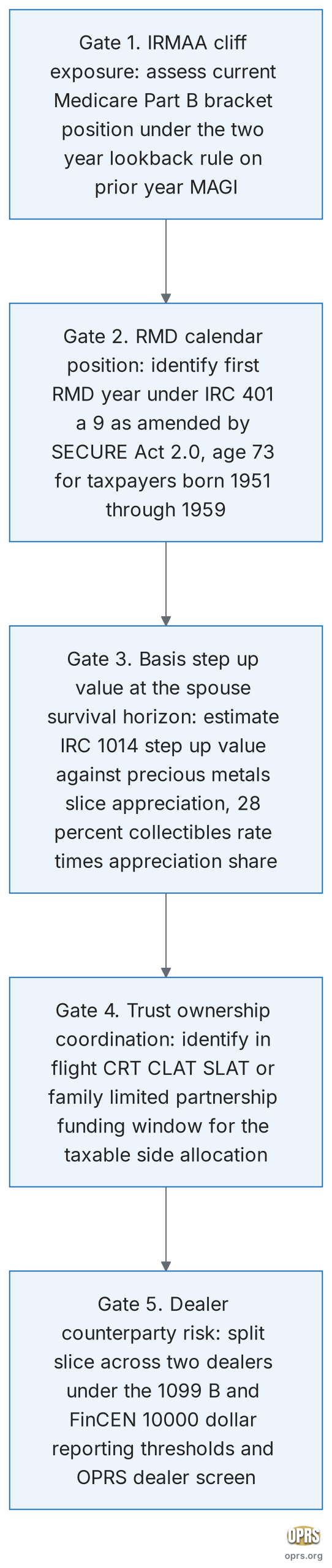
Gate 1. IRMAA cliff exposure. Determine the household’s current Medicare Part B IRMAA bracket position from the prior-year MAGI under the two-year-lookback rule. A household sitting one bracket below the next cliff has different gain-staging room than a household already at the top bracket. The IRMAA exposure pushes deferred recognition (IRA wrapper) when the calendar runs near the cliff.
Gate 2. RMD calendar position. Identify the first RMD year under IRC Section 401(a)(9) as amended by SECURE Act 2.0 (age 73 for taxpayers born 1951 through 1959). The pre-RMD years allow IRA-side deferral; the post-RMD years already run the IRMAA AGI calendar through the IRA distribution stream, so the marginal precious-metals slice is more efficient on the taxable side.
Gate 3. Basis step-up value at the spouse-survival horizon. Estimate the basis step-up value at the projected first-death year under IRC Section 1014 against the precious-metals slice. The step-up value on the taxable side at a 60-percent appreciation horizon equals 16.8 percent of slice value (28 percent collectibles rate times 60 percent appreciation) of taxes avoided at sale. The IRA-side beneficiaries inherit at the IRA basis (no step-up under §1014(c)). The step-up value sets the taxable-side weight in the split.
Gate 4. Trust-ownership coordination. Identify any in-flight CRT, CLAT, SLAT, or family limited partnership that the precious-metals slice can fund or sit inside. The trust-ownership coordination only runs through the taxable side; the IRA cannot be retitled inside a non-qualified-trust ownership structure without distribution. Households with an active estate-exemption-sunset calendar generally tilt the split toward the taxable side at the funding window.
Gate 5. Dealer counterparty risk under the 1099-B and FinCEN thresholds. The HNW tier above $1 million on either side runs two-counterparty diversification as the operational default. The 1099-B reporting on the taxable side activates at the dealer thresholds; the FinCEN cash-transaction rules activate at the $10,000 single-counterparty annual threshold. Check both dealers against the 2026 OPRS list before any custodian or vault paperwork is signed; the dealer screen applies at both wrappers.
When neither wrapper fits
Two HNW-tier cases push the household out of both wrappers and into a different structural answer.
The exposure is operating-business concentration, not asset diversification. A household whose $5 million to $15 million net worth runs through a closely-held operating business already carries balance-sheet exposure to real-asset risk through the business’s working capital and real-estate footprint. Adding a precious-metals slice on top of a concentrated operating-business position raises rather than reduces total household risk. The structural answer is operating-business-side diversification (partial sale, ESOP, recapitalization) before any precious-metals slice is sized.
The household has no liquid-asset buffer outside the precious-metals slice and the IRA wrapper. Sizing a precious-metals slice into the IRA wrapper while the household carries no emergency reserve outside both vehicles creates a liquidity trap. The IRA distribution triggers a tax event; the precious-metals slice spread is illiquid relative to a Treasury reserve. The structural answer is a Treasury or money-market reserve sized at twelve to twenty-four months of household expenses before the precious-metals slice question is opened.
Frequently asked questions
Can a SLAT or CLAT hold IRC Section 408(m) eligible bullion inside an IRA?
No. A SLAT or CLAT is a non-qualified trust and cannot serve as the IRA beneficiary in a way that preserves the IRA’s tax-deferred character. Naming such a trust triggers the SECURE Act 10-year payout under IRC Section 401(a)(9)(H).
The precious-metals slice that the household wants to coordinate with a SLAT or CLAT must sit on the taxable side from the funding step. The IRA-side slice runs the SECURE Act 10-year payout to the beneficiary trust if the IRA is named.
What is the federal collectibles capital gains tax rate on physical bullion held in a taxable account?
28 percent federal under IRC Section 1(h)(5) on long-term gains from collectibles, which includes physical gold and silver bullion. The 28 percent applies on top of the household’s marginal income-tax bracket and is subject to the 3.8 percent Net Investment Income Tax under the NIIT rules for high-income households. The total federal rate on physical bullion gains for a top-bracket HNW household sits at 31.8 percent before state tax.
Do I get a basis step-up at death on a gold IRA?
No. The IRA balance, including the precious-metals slice, is income-in-respect-of-decedent property under IRC Section 1014(c). Beneficiaries inherit at the IRA basis. The SECURE Act 10-year payout runs the distributions out at ordinary income rates over the post-death period. The basis step-up is one of the structural reasons HNW households allocate a portion of the precious-metals slice to the taxable side for estate coordination.
Does an IRA-held bullion sale trigger a 1099-B?
No, the sale inside the IRA wrapper does not trigger a 1099-B to the IRA owner. The custodian books the sale inside the wrapper. The owner sees no 1099-B for the in-wrapper trade. The 1099-R appears at distribution from the IRA; the 1099-B activates only on the taxable side when the dealer reports the sale under the IRS reporting thresholds. The IRMAA AGI calendar consequently runs differently across the two wrappers.
What dealer counterparty concentration limit applies above $1 million on the taxable side?
There is no statutory single-counterparty limit, but the operational default at the HNW tier is two-counterparty diversification. The 1099-B reporting at the major dealers runs through the IRS Form 1099-B aggregation; the FinCEN cash-transaction reporting under the FinCEN regulatory guidance activates at the $10,000 cash single-counterparty annual threshold.
The buy-back spread at a single counterparty above $1 million also runs wider as the single-trade liquidity profile changes. Splitting the slice across two dealers smooths both the reporting and the buy-back execution.
The HNW precious-metals allocation rarely lands as a wrapper-versus-wrapper binary. The five-gate sequence identifies the IRMAA cliff, the RMD calendar, the basis step-up value at the spouse-survival horizon, the trust-ownership coordination, and the dealer counterparty risk. Each gate moves the split between the IRA wrapper and the taxable bullion brokerage allocation by a quantifiable amount.
The OPRS desk runs the sequence against the household’s current-year tax and estate calendar before any custodian, vault, or dealer paperwork is signed. Companion pieces on gold IRA allocation in the pre-RMD window and the NUA election and gold IRA destination cover two of the most common adjacent decisions at this tier.
Sources cited
- IRC Section 408 (Individual retirement accounts): wrapper authority and §408(m)(3) approved-metals rules.
- IRC Section 1014 (Basis of property acquired from a decedent): basis step-up at death; §1014(c) carves out income-in-respect-of-decedent (IRA) property.
- IRC Section 1(h)(5) (Capital gains tax rate on collectibles): 28 percent federal rate on physical bullion gains.
- IRC Section 401(a)(9) (Required minimum distributions): RMD calendar including SECURE Act 2.0 age-73 trigger.
- CMS Medicare Part B premiums and IRMAA brackets: IRMAA cliff exposure and two-year lookback rule.
- IRS Net Investment Income Tax (3.8 percent NIIT): additional surcharge on HNW gain recognition.
- IRS Estate Tax guidance: federal exemption schedule and sunset calendar.
- FinCEN regulatory guidance: cash-transaction reporting threshold for dealer purchases.