

Updated: July 30, 2026
OPRS may receive compensation when readers open an account through partner links on this page. Our analysis is based on independent research, BBB data, and IRS publications.
30-second verdict
- A gold IRA opens under IRC Section 408 and IRC Section 408(m). The federal framework asks for three counterparties (custodian, dealer, depository) and never for a paid financial advisor.
- The DIY route saves the typical advisor fee of 0.5 to 1.5 percent of assets per year. On a $100,000 balance, that is $500 to $1,500 per year of recurring cost the saver keeps.
- Going DIY shifts five decisions onto the saver: custodian pick, funding route, dealer pick, product mix, and depository tier. Each decision has a clean default that lowers risk.
- The single largest DIY risk is dealer markup on the order ticket. The custodian and the depository are federally supervised. The dealer is not.
- An advisor adds value when the household balance, the tax situation, or the rollover paperwork is complex. For a straight transfer of an existing IRA into bullion, the DIY route is the common path.
Opening a self-directed gold IRA does not require a financial advisor at any step. The Internal Revenue Code names three counterparties: a non-bank trustee custodian, a precious metals dealer, and an IRS-approved depository. None of them is a registered investment adviser. The saver can sign each agreement directly and keep the advisor fee inside the account.
Element I of this guide covers what a DIY gold IRA setup actually means. Element II maps the five decisions the saver makes alone. Element III lists the costs the DIY route removes and the costs it does not. Element IV is the vetting checklist for each counterparty. Element V is the FAQ on edge cases. Element VI is the broader retirement context.
Element I starts here. Before signing any custodian agreement or wiring funds, the saver can cross-check the 2026 OPRS list of dealers we clear and the ones we warn against. The dealer choice is where most DIY gold IRA setups drift off course, and the federal framework will not rescue a balance from a markup that was signed off by the account owner.
Vet the dealer before signing the order ticket
Without an advisor in the room, the saver carries the full vetting load on the dealer. The custodian and the depository operate inside federal supervision. The dealer chooses the markup, the product mix, and the fulfillment cycle. A bad dealer can quietly drain 20 to 30 percent of the funded balance before the depository ever logs the metal.
3 of 27+ gold IRA dealers reviewed by OPRS make the 2026 trusted list. Updated July 2026.
Why a financial advisor is not required to open a gold IRA
The Internal Revenue Code defines what a self-directed gold IRA is and who has to sign off on each step. Section 408 names the non-bank trustee custodian as the legal account holder. Section 408(m)(3) lists the precious metals and the purity standards. Section 4975 lists the prohibited transactions. None of these provisions mention a registered investment adviser.
The custodian is a trust company supervised by federal banking law. The depository carries Lloyd’s of London or equivalent insurance and is subject to state vault regulation. The dealer is a precious metals broker subject to ordinary consumer protection law, including the Federal Trade Commission rules on advertising and the state-level licensing of bullion dealers.
The saver is the IRA owner. The owner picks the asset, the funding source, and the product mix. That choice is the legal definition of self-directed under SEC investor.gov on individual retirement accounts. An advisor can be hired to help, but no IRS rule asks for one.
What the DIY route actually removes from the cost stack
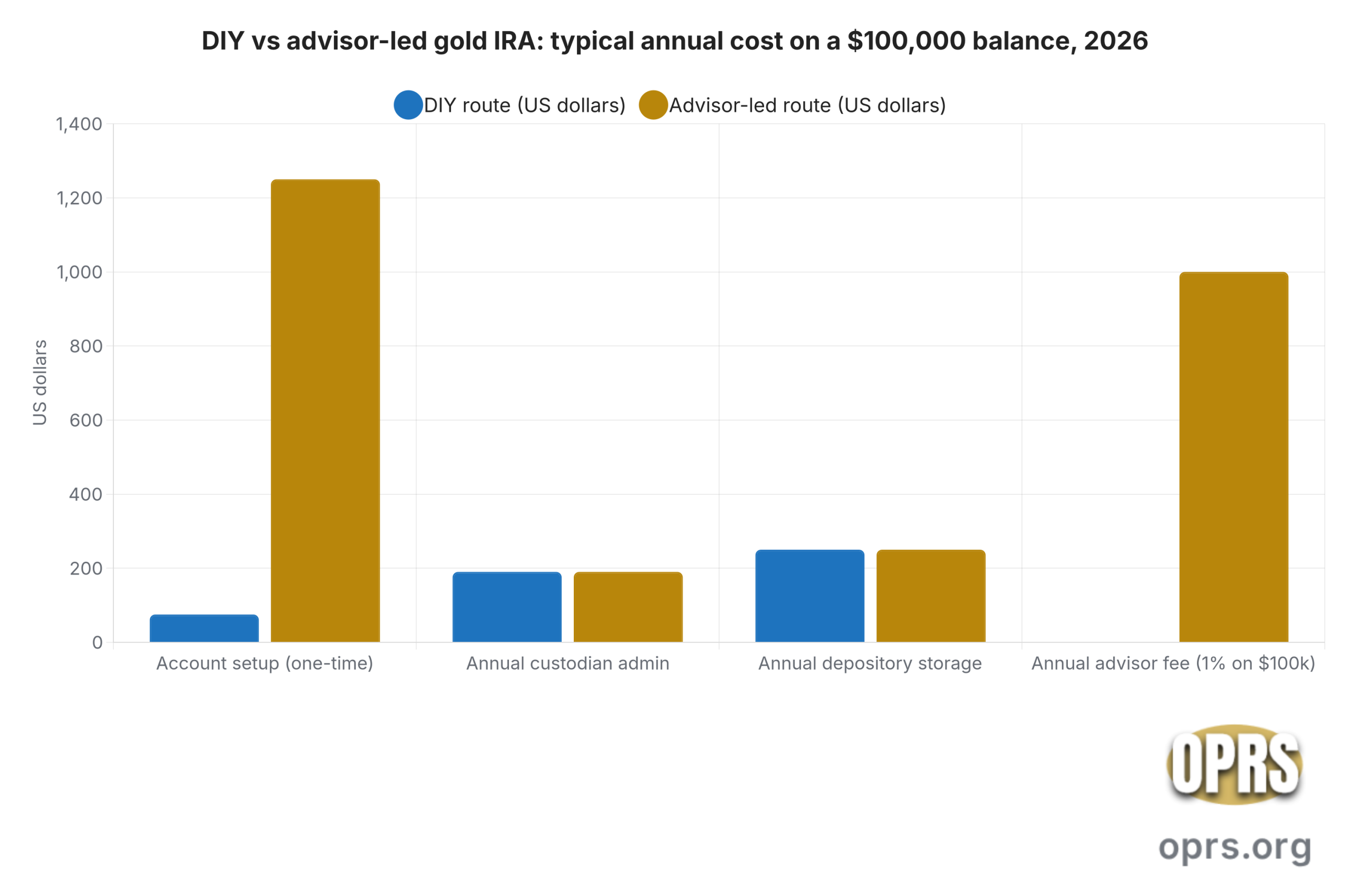
The DIY gold IRA route removes the advisor fee and the advisor markup. The custodian fee, the depository fee, and the dealer markup stay in place because those are the operating counterparties. The fee math below uses industry-reported ranges for 2026.
Can you roll your account into a precious metals IRA? Eligibility checker
Most retirement money can move into a precious metals IRA once it qualifies as an eligible rollover distribution. Pick your account type and situation for a general answer. Always confirm specifics with your plan administrator or custodian.
General guidance only, not tax or financial advice. Eligibility depends on your specific plan document and IRS rules; confirm with your plan administrator and a tax advisor. A direct trustee-to-trustee transfer avoids the 60-day rule and 20% mandatory withholding.
The right dealer explains every fee up front. Get Augusta's free precious metals IRA company checklist.
The advisor fee on a managed retirement account is usually billed as a percentage of assets under management. The industry-reported range is 0.5 to 1.5 percent per year. A $100,000 gold IRA balance carries an advisor fee of $500 to $1,500 per year on that schedule, plus a one-time setup fee of $500 to $2,000 when the advisor steers the rollover.
The DIY route pays the same custodian fee, the same depository fee, and the same dealer markup. The total annual fee stack lands at $230 to $900 per year per account before any advisor layer, per OPRS industry surveys. Removing the advisor layer keeps that gap inside the IRA, where it can compound tax-deferred for the rest of the account life.
The savings are not the only consideration. The DIY route also removes the second pair of eyes on the dealer order ticket. A saver who skips vetting in step 3 can lose more to a high-premium proof coin pitch than the advisor fee would have cost over five years. The decision is a trade between cost and review burden, not a free lunch.
The 5 decisions you make alone going DIY
Five decisions sit on the saver’s desk on the DIY path. Each one has a clean default that lowers risk for the first-time gold IRA owner. The flowchart below shows the order. The text after the flowchart walks through each decision and the default the OPRS editorial team uses as the starting point.
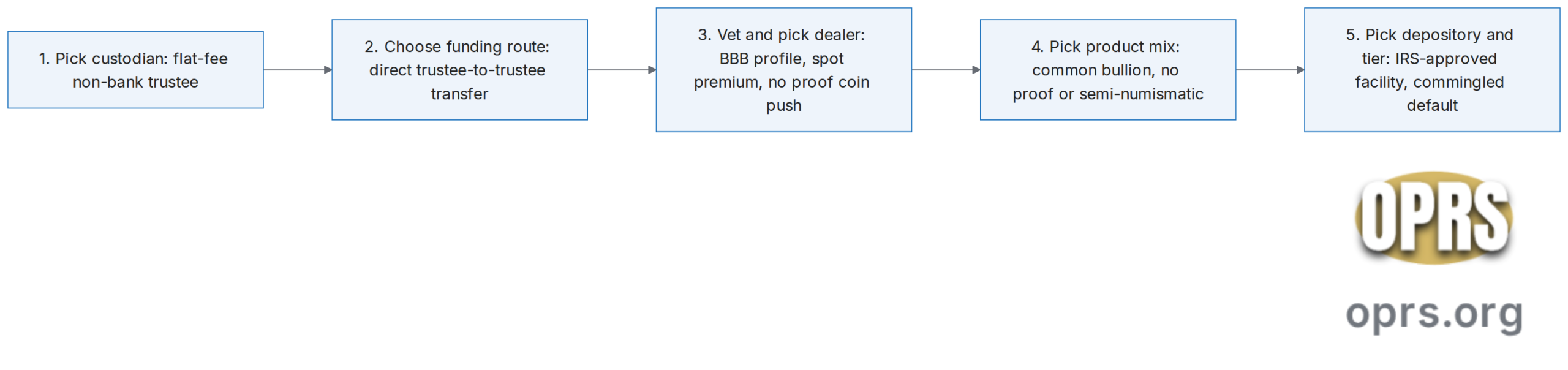
Decision 1: pick the self-directed IRA custodian
The custodian is the legal account holder. The default for a DIY setup is a flat-fee non-bank trustee with a published fee schedule, an A or A plus BBB rating, and at least ten years of operating history. The annual administration fee should sit between $80 and $300 per year on a flat schedule. Skip tiered fee structures that scale with account value until the saver has a balance over $250,000.
Decision 2: choose the funding route
The default is the direct trustee-to-trustee transfer between two IRAs of the same tax type. The funds move custodian to custodian with no withholding, no 60 day clock, and no 1099-R taxable event. The IRS describes the route in IRS Publication 590-A. Reserve the 60 day indirect rollover for situations where the prior trustee does not support a direct transfer.
Decision 3: vet and pick the precious metals dealer
The dealer choice is the single largest variable on the DIY path. The custodian holds title. The dealer sources and ships the metal at a markup that is not regulated by the IRS. A first-time DIY saver should verify the Better Business Bureau profile, the years in operation, the Trustpilot or Google reviews aggregate, the published spot premium on common bullion, and the depository delivery options.
A small set of operators carry the strongest external signal stack. One operator on the current OPRS shortlist holds an A plus Better Business Bureau accreditation dating to 2014, with no complaints on file.
The same operator has been named Money magazine Best Overall Gold IRA Company every year from 2022 through 2026. It also holds the Investopedia Most Transparent Gold IRA Company listing across the same span. Its Education-First process (Learn, Talk, Decide) walks the federal IRA framework before any product pitch. That stack is rare across the 27 plus dealers OPRS reviews.
Decision 4: pick the product mix
The product mix sits inside the IRS-approved list under IRC Section 408(m)(3). The default for a first-time DIY saver is common bullion: 1 oz American Gold Eagles or American Gold Buffalos for gold, 1 oz American Silver Eagles or 1 oz Canadian Maple Leafs for silver. Avoid proof coins, semi-numismatic coins, and rare-date issues. Those products carry premiums of 20 to 60 percent over spot and trade like collectibles, not bullion.
Decision 5: pick the depository and storage tier
The depository sits on the IRS-approved list. Common picks include Delaware Depository, Brink’s, and International Depository Services. The default storage tier for a new DIY account is commingled (sometimes called non-segregated). The IRA owner has title to a specific quantity, not specific bars, at a typical cost of $100 to $250 per year. Segregated storage attaches serial numbers to the account at the top of the $150 to $400 range.
The vetting checklist for each counterparty
The table below packs the DIY vetting checklist into one row per counterparty. The custodian and depository checks are quick because federal supervision does most of the work. The dealer check is the longest because that is where DIY savers see the most cost variance.
| Counterparty | Vetting checklist | Federal supervision | Status label |
|---|---|---|---|
| Custodian | Non-bank trustee status, A or A plus BBB, ten plus years operating, flat fee schedule, written prohibited-transaction policy | Trust company law, state banking regulator, IRS non-bank trustee list | Federally supervised |
| Dealer | BBB profile, years in operation, Trustpilot aggregate, spot premium on common bullion, no high-pressure script, IRS-approved product list discipline | FTC advertising rules, state bullion-dealer licensing, no IRS pricing oversight | Saver-vetted only |
| Depository | IRS-approved list, Lloyd’s of London or equivalent insurance, segregated tier available, audited annual reports | State vault regulation, IRS-approved facility list, third-party audit cycle | Federally supervised |
A saver who spends two hours on the dealer vetting and twenty minutes each on the custodian and the depository hits the right effort allocation. The dealer call should sound like an education session, not a sales script. A first call that pushes for a same-day decision or pivots to high-premium coins is a clear signal to call a second dealer.
The dealer is the one counterparty without federal pricing oversight
On the DIY path, the saver is the only check on the dealer markup. A 30 percent premium on a proof coin is legal, disclosed (sometimes faintly), and final once the order ticket clears. The IRS framework cannot reverse the markup, and the custodian will not flag a price that is technically inside the IRS-approved product list.
Cross-check the dealer against the 2026 OPRS warn-list before signing the buy direction. A two-minute lookup at the vetting stage can save thousands at the depository confirmation stage.
When the DIY route is the wrong call
The DIY route is not the right answer for every saver. A licensed financial advisor adds value in three situations: a complex household tax picture, a rollover from a plan with restrictive paperwork, and a balance large enough that asset-location decisions matter more than the advisor fee. A 1 percent advisor fee on a $50,000 balance is $500 per year. The same 1 percent on a $1 million balance is $10,000 per year. The math changes with size.
Households with high-income years approaching retirement may need a tax projection before the rollover. The decision between traditional and Roth, between a partial and a full conversion, and between current-year and future-year contributions is the kind of analysis a Certified Financial Planner can document. A DIY saver who has not run those projections is taking on a tax risk that is not on the gold IRA disclosure page.
Federal employees with a Thrift Savings Plan should read the plan paperwork carefully before any rollover. The TSP G Fund has properties no commercial annuity replicates. Map the TSP rollover trade-offs first if that is the source plan. Private-sector workers with a 401(k) facing an employer plan with restrictive in-service rules may also need outside help to clear the rollover.
Common mistakes DIY gold IRA savers make
Mistake 1: signing the order ticket on the first dealer call
Same-day order tickets are the most common DIY error. A dealer that quotes a price, asks for a wire authorization, and books the order on the first call leaves the saver no room to compare premiums. The fix is to take the quote in writing, call a second dealer with the exact same product list, and book the order on the lower offer 48 hours later.
Mistake 2: switching to proof or semi-numismatic coins mid-call
Bullion proof coins carry premiums of 20 to 60 percent over the spot price. They are technically IRS-approved when the underlying coin is on the listed series. The premium is the trap. The fix is to write the product list before the call, repeat it back to the dealer, and refuse any swap that adds a higher premium. The product list is the saver’s only price discipline tool.
Mistake 3: taking home delivery during the accumulation years
A saver who lets the dealer ship to a personal address triggers a deemed distribution under IRC Section 408(m). The full shipment value becomes ordinary income. Owners under age 59 and a half also owe the 10 percent additional tax under IRC Section 72(t). The fix is to keep the depository address on every order ticket from step 4 onward.
Mistake 4: missing the 60 day window on an indirect rollover
An indirect rollover starts a 60 day clock. The full distribution amount, including any 20 percent withholding the prior plan sent to the IRS, must arrive in the new IRA by day 60. Missing the deadline strips the tax shelter from the whole rollover. The fix is to use a direct trustee-to-trustee transfer wherever the prior plan supports it.
Mistake 5: skipping the depository confirmation
The depository delivery receipt is the only document that proves the IRA actually owns the metal. A DIY saver who never opens the first inventory statement may not catch a wrong product, a wrong storage tier, or a missing serial number for months. The fix is to review the first statement within seven days of receipt and reconcile every line against the original order ticket.
Frequently asked questions on the DIY gold IRA setup
Do I need any license to open a gold IRA without an advisor?
No. The IRA owner is the account holder of record. The Internal Revenue Code does not require the owner to hold a securities license, an insurance license, or any other credential. The custodian and the dealer carry their own regulatory standing. The saver only signs the account agreement and the order ticket.
How long does a DIY gold IRA setup take end to end?
The full setup typically clears in two to four weeks. The custodian application takes two to five business days. The funding leg takes five to fifteen business days. The order ticket and wire take five to ten business days. The depository confirmation arrives two to seven business days after the wire releases.
What is the minimum to open a gold IRA on the DIY path?
The IRS sets no minimum. The dealer typically does. Industry-reported dealer minimums range from $2,000 to $50,000 depending on the operator and the product mix. One privileged operator on the current OPRS list sits at an industry-reported minimum around $50,000 for gold IRA accounts. The custodian minimum is usually below the dealer minimum, often $0 to $1,000.
Can I add a financial advisor later if I start DIY?
Yes. A self-directed gold IRA can be reviewed by an advisor at any later date. The custodian and dealer relationships do not lock the saver out of advice. The advisor can be hired hourly, by project, or on a recurring percentage. Adding an advisor after the rollover keeps the setup cost lower and lets the saver pick the advisor type that fits.
Is the dealer or the custodian the riskier counterparty for a DIY saver?
The dealer carries more variance on the DIY path. The custodian sits inside federal trust-company law and is audited regularly. The dealer prices the order ticket and chooses the markup. A bad dealer call costs a DIY saver more in the first week than a bad custodian call usually costs in a year.
Can a Roth gold IRA be opened DIY too?
Yes. The same five-decision flow runs for a Roth gold IRA. The differences sit on the contribution side and on the distribution side. A Roth gold IRA reports contributions on the Roth side of Form 5498 and skips the lifetime RMD for the original owner under IRC Section 408A(c)(5).
How the DIY setup fits the broader retirement plan
A DIY gold IRA is one allocation slice inside a broader retirement plan. The decision to fund the new account from a 401(k), 403(b), TSP, or brokerage IRA is upstream of the five-decision flow. That choice depends on the household income picture, the source plan eligibility, and the planned distribution sequence in retirement.
Private-sector workers with a 401(k) can map the funding leg through the 401(k) to gold IRA rollover playbook. A saver who already holds a traditional IRA can complete the funding leg through the IRA to gold IRA conversion process. Both paths route through the same five DIY decisions once the funds arrive at the new custodian.
Broader education on the IRA framework sits at FINRA on individual retirement accounts. Dealer background checks sit at BBB.org. The IRS contribution and distribution rules sit in Publication 590-A.
The DIY gold IRA path is a real option for any saver willing to read a fee schedule, call two dealers, and check a BBB profile. The Internal Revenue Code does not require an advisor at any setup step. The custodian, the dealer, and the depository do the operating work. The saver does the picking.
The single largest DIY risk is the dealer markup on the order ticket. OPRS reviews 27 plus gold IRA dealers each year and keeps the trusted list public. One operator on the current list holds an A plus BBB accreditation dating to 2014, with no complaints on file.
The same operator has been named Money magazine Best Overall Gold IRA Company every year from 2022 through 2026. It also holds the Investopedia Most Transparent Gold IRA Company listing across the same span. Its Education-First process explains the federal IRA framework before any product pitch. That stack is rare and worth a careful look before signing any order ticket on the DIY path.
Sources cited
- IRC Section 408, Individual Retirement Accounts (Legal Information Institute, Cornell)
- IRC Section 408(m), Investment in Collectibles Treated as Distributions (Legal Information Institute, Cornell)
- IRC Section 408(m)(3), Exception for Certain Coins and Bullion (Legal Information Institute, Cornell)
- IRC Section 4975, Prohibited Transactions in IRAs (Legal Information Institute, Cornell)
- IRC Section 72(t), 10 Percent Additional Tax on Early Distributions (Legal Information Institute, Cornell)
- IRS Publication 590-A, Contributions to Individual Retirement Arrangements (IRS.gov)
- IRS Retirement Topics, IRA Contribution Limits (IRS.gov)
- SEC investor.gov, Individual Retirement Account (IRA) Glossary Entry
- FINRA, Individual Retirement Accounts Investor Education (FINRA.org)
- Better Business Bureau, Business Profile Search (BBB.org)