

Updated: July 30, 2026
OPRS may receive compensation when readers open an account through partner links on this page. Our analysis is based on independent research, BBB data, and IRS publications.
30-second verdict
- A funded revocable living trust wins by default when land or other illiquid real property sits in two or more states. Ancillary probate is avoided in every state where a parcel is re-titled into the trust during life. A will alone forces a separate probate in each state where a parcel is owned individually.
- A will is sufficient when the estate is small, in one state, and the single parcel qualifies under a state simplified probate procedure. Roughly half of states permit an affidavit or summary administration for estates below a small-estate threshold (typically $50,000 to $200,000 of personal property, with separate rules for real estate). Land-heavy estates rarely qualify.
- The IRA designation always passes outside both the will and the trust. The IRA beneficiary form controls under the contract, not the will or the trust, and that contract operates regardless of which structure the rest of the estate uses. The land-versus-cash mismatch in a land-heavy estate is what makes the IRA designation a structural decision rather than a paperwork formality.
- The dealer choice is upstream of the trust-versus-will question. A custodian that cannot handle a trust as IRA beneficiary, code a Form 1099-R after death, or coordinate with an estate attorney across a multi-state probate turns a routine designation question into a forced sale of land to pay estate-administration costs.
A household whose estate is most land and only partly cash and retirement faces an estate-planning decision that an attorney drafting a generic will pattern often gets wrong on the first pass.
The will-only pattern works for households whose assets are interchangeable: brokerage, IRA, primary residence, and life insurance roughly comparable in size, with cash liquid enough to cover administration costs and estate tax. No forced sale is needed. The land-heavy household is structurally different.
Roughly 83 cents of every dollar in a working-farm balance sheet sits in land and operating real property. Only 17 cents sits in cash, retirement accounts, and life insurance, per the recurring USDA Economic Research Service farm-balance-sheet data series.
Rural retiree households, timber-tract owners, ranch families, and multi-parcel rental landlords sit on similar concentration. See the dealers OPRS warns against before any beneficiary form is signed.
An operator that cannot code a trust beneficiary, run an inherited IRA across a multi-state estate, or reconcile a Form 1099-R against the estate’s Form 1041 turns a routine designation into a forced sale.
Element I is the legal distinction between a will and a funded revocable living trust as the primary instrument for transferring real property at death. Element II is the multi-state ancillary probate problem that land-heavy estates run into under a will-only pattern.
Element III is the interaction between the IRA beneficiary designation and the rest of the estate, including the SECURE Act 10-year rule under IRC Section 401(a)(9)(H).
Element IV is the federal estate tax exemption sunset on January 1, 2026, under IRC Section 2010(c)(3), and the state-level estate tax thresholds that often bind earlier than the federal threshold for a land-heavy estate.
Element V is the verdict per household profile and where Augusta sits in the dealer landscape for a household coordinating a land-heavy estate plan with a retirement account.
Screen the dealer before the IRA gets pulled into the land estate plan
A trust or estate named on the gold IRA beneficiary form is only as good as the custodian behind it. That custodian must code the inherited account, accept the trust certification by October 31 of the year after death, and reconcile the Form 1099-R against the estate’s Form 1041.
A land-heavy household needs a custodian that already handles multi-state probate coordination, not one that learns it on the inherited account.
3 of 27+ gold IRA dealers reviewed by OPRS make the 2026 trusted list. Updated July 2026.
What a will actually does (and does not do) for land
A last will and testament is a written declaration that takes legal effect only at death and only after a court accepts it for probate. The will identifies the personal representative (executor), names beneficiaries, and directs the distribution of property that the decedent owned individually at death.
The will does not move title; the court does, through letters testamentary issued to the executor after the will is admitted to probate. Real property titled in the decedent’s name alone (or as a tenant in common) passes through probate in the state where the parcel sits.
A parcel in a second state requires a separate proceeding in that second state, called ancillary probate. A parcel in a third state requires a third proceeding. Each probate process has its own filing fees, executor bond requirements, attorney fees, notice publication costs, and timeline.
The American Bar Association’s estate planning consumer guide documents the basic mechanics. The dealer screen applies before the will or the trust is finalized: the custodian’s ability to handle the trust beneficiary documentation survives the structural choice between will and trust.
Wills work well for households with limited and in-state real estate, no complex blended-family arrangements, and assets below the federal and state estate tax thresholds.
A surviving spouse can typically administer a small estate using a state simplified procedure when total personal property falls below the state threshold (commonly $50,000 to $200,000). Real property is usually outside that threshold, which pulls the estate into full probate.
Wills also work when the entire real-property portfolio is held jointly with right of survivorship (JTWROS), or as community property with right of survivorship in community property states. Those titles transfer at death by operation of law, not under the will.
The land-heavy household whose parcels are titled individually or as tenants in common does not get that benefit.
What a funded revocable living trust does for land
A revocable living trust is a written agreement that creates a legal entity, names the grantor as the initial trustee and primary beneficiary, and identifies successor trustees and remainder beneficiaries. Those successors take over at the grantor’s death or incapacity.
The grantor transfers title to real property and other assets into the trust during life by signing and recording a deed from the individual grantor to the grantor as trustee of the trust. The trust then owns the property; the grantor continues to control it as trustee and use it as beneficiary.
At death, the successor trustee steps in and distributes (or continues to hold) the trust assets per the trust instrument, without court involvement. No probate is required in any state where a parcel is held in the trust, because the legal owner (the trust) did not die.
The funded trust pattern requires that every parcel intended to pass outside probate be re-titled into the trust during the grantor’s life. A common drafting mistake is to execute a trust instrument and a pour-over will that funnels assets to the trust at death, but never actually move the deeds.
The pour-over will captures missed assets, but it does so through probate, which defeats the structural reason for the trust.
The IRS Form 706 instructions reference the trust-funding mechanics indirectly through the general instructions for Form 706. Those instructions require the executor to identify all trust assets at death, whether or not probate is opened. The same obligation applies to state estate-tax returns in states that impose them.
The multi-state ancillary probate problem
A household that owns farmland in one state, a hunting tract in a second state, and a vacation cabin in a third state faces three separate probate proceedings. That applies when the parcels are titled individually and the estate is administered under a will.
Each state requires a domiciliary executor in the home state and an ancillary executor in the second and third states. Filing fees apply in each county where a parcel sits.
Separate attorney representation, creditor notices, heir notices, inventory filings, accounting filings, and closing certificates are required in each state.
The aggregate cost is often two to three times the cost of a single-state probate, and the timeline frequently exceeds two years before the last state closes. The funded revocable living trust eliminates every ancillary proceeding, because the legal owner of each parcel is the trust, not the individual grantor.
The ancillary probate problem compounds when one of the states has a state-level estate or inheritance tax that the home state does not. Twelve states and the District of Columbia impose a state estate tax in 2025, with thresholds well below the federal exemption. Six states impose a separate inheritance tax on heirs other than the surviving spouse.
A parcel in one of those states drags the estate into that state’s estate or inheritance tax even when the home state has none. The chart below shows the 2025 state estate tax exemption thresholds for the twelve states (plus DC) that impose one, along with the federal exemption for comparison.

Precious metals IRA early-withdrawal penalty estimator
Taking money out of a precious metals IRA before age 59 and a half triggers a 10% federal additional tax on top of ordinary income tax. State add-on taxes vary; check your state. The federal penalty is estimated below.
Estimate only, not tax advice. The 10% federal additional tax applies to early distributions before age 59 and a half; specific exceptions exist. Your state may add its own tax, and ordinary income tax applies separately. Source: IRS Publication 590-B. Consult a tax advisor.
The right dealer explains every fee up front. Get Augusta's free precious metals IRA company checklist.
Side-by-side: will vs funded revocable living trust for land
The table below compares the structural features that drive the will-versus-trust decision for a land-heavy estate. The Status column flags which side typically wins for the canonical land-heavy profile (combined estate above $2 million, parcels in two or more states, IRA held alongside the land).
| Feature | Will only | Funded revocable living trust | Status (land-heavy estate) |
|---|---|---|---|
| Probate in home state for real property | Required when parcel titled individually or as tenant in common | Avoided when parcel re-titled into trust during life | (Trust wins) |
| Ancillary probate in second and third states | Separate proceeding in each state where a parcel sits | Avoided for every parcel re-titled into trust | (Trust wins) |
| Time to distribute land to heirs | 9 to 24 months per state on average; longer when contested | Days to weeks after death, at successor trustee discretion | (Trust wins) |
| Privacy of estate | Will and inventory become public records in each probate file | Trust instrument and asset list remain private | (Trust wins) |
| Upfront drafting and re-titling cost | Lower (a simple will is typically $500 to $1,500 with an attorney) | Higher (trust + pour-over will + deeds typically $2,500 to $7,500) | (Will wins on cost only) |
| Operational discipline during life | Sign and forget; no re-titling required | Every new parcel must be deeded into the trust | (Will simpler operationally) |
| Incapacity management before death | Power of attorney handles, but real estate often blocked at county recorder | Successor trustee steps in seamlessly under trust instrument | (Trust wins) |
| Federal estate tax exemption use | Available under IRC Section 2010(c)(3); portability requires Form 706 | Available identically; trust can hold credit-shelter language | (Equal at law) |
| State estate tax in non-home state where parcel sits | Triggers full state estate tax return where parcel was titled | Generally avoided when title is held by trust at death | (Trust wins) |
| IRA beneficiary designation | Passes outside the will under the contract | Passes outside the trust unless trust is named as beneficiary | (Equal, designation is the controlling document) |
| Creditor protection during life | Standard state homestead and exemption rules apply | Revocable trust offers no additional creditor protection during grantor’s life | (Equal during life) |
| Contestability by disinherited heirs | Higher (will contests are common in probate court) | Lower (trust contests are harder to bring and to win) | (Trust wins) |
| Coordination with IRA beneficiary form for liquidity at death | Estate is the residual liquidity source; IRA may be pulled into probate | Trust can be drafted to coordinate IRA pass-through to fund administration | (Trust wins) |
How the IRA interacts with a land-heavy estate
The IRA beneficiary form is a contract that passes the account directly to the named beneficiary outside the will and outside the trust, unless the trust itself is named as the beneficiary.
For a land-heavy household, the IRA is often the only liquid asset available. It may need to fund administration costs, pay estate tax, equalize a non-land-taking heir, or cover the surviving spouse’s living expenses while the land is being settled.
Naming the spouse as the primary IRA beneficiary preserves the spousal rollover under IRC Section 402(c)(9). That provision lets the surviving spouse treat the deceased spouse’s IRA as their own, with the survivor’s own required beginning date and life expectancy.
Naming children, grandchildren, or a non-see-through trust attaches the SECURE Act 10-year rule under IRC Section 401(a)(9)(H), which forces full distribution by December 31 of the tenth year after death.
Two other rules collide here as well. A 10-year forced IRA distribution to a child heir conflicts with a multi-year estate-tax installment payment plan under IRC Section 6166. That provision allows up to 14 years for a closely held farm or business interest. It also conflicts with the special-use valuation under IRC Section 2032A, which requires 10 years of material participation by the qualifying heir to avoid recapture.
And it collides with the timeline of an ongoing farm operation that needs the IRA distribution to fund operating expenses rather than to be liquidated upfront.
The will-versus-trust decision does not control these IRC provisions, but the trust pattern gives the household flexibility to coordinate the IRA pass-through with the land succession plan. Our deeper analysis of land-rich cash-poor IRA estate planning walks through the 2032A and 6166 elections and the IRA designation in sequence.
Federal estate tax exemption sunset 2026
The IRC Section 2010(c)(3) federal estate tax exemption is set at $13.99 million per individual for 2025 (or $27.98 million per married couple after portability), per the IRS annual inflation-adjustment release.
Absent congressional action, the exemption is scheduled to revert on January 1, 2026 to roughly half of that level, putting the per-spouse exemption near $7 million and the joint exemption near $14 million.
For a land-heavy household with combined assets between $7 million and $14 million, the will-versus-trust decision interacts with federal estate tax planning. The credit-shelter funding mechanics that capture both spouses’ exemptions are cleaner to draft inside a trust.
Below the post-sunset per-spouse exemption (under roughly $7 million in combined assets), the federal estate tax is generally not the binding constraint for a married couple.
State estate tax thresholds, shown in Figure 1, often bind earlier than the federal threshold. A parcel in Massachusetts, Oregon, Washington, or Minnesota can force a different structural decision even when total assets are well below the federal exemption.
The dealer screen applies regardless of which estate tax threshold binds: the IRA designation is the contract that carries the inherited account, and the custodian behavior controls.
How to choose between a will and a funded living trust
The choice between a will-only structure and a funded revocable living trust is a five-step decision sequence. It pulls in the number of states where parcels sit, the combined estate value, the home state’s probate procedures, blended-family status, and the IRA-versus-cash liquidity ratio.
The Mermaid flowchart below documents the canonical sequence.
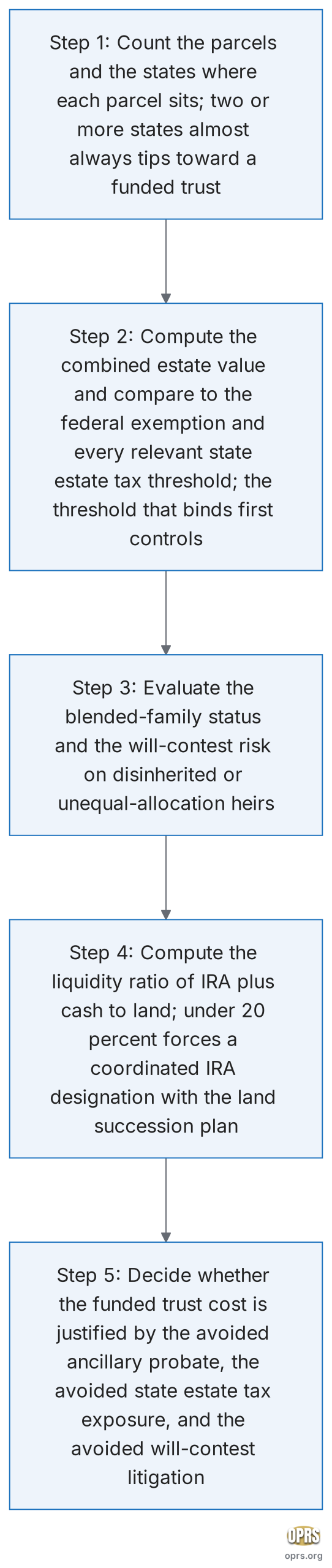
Five steps to set the structure before any beneficiary form is signed
Step 1. Count the parcels and the states where each parcel sits. Pull every deed for every real-property interest the household owns: primary residence, farmland, timber tract, ranch acreage, rental tracts, vacation cabin, mineral interests, and any partial-ownership interests in family compounds. Tabulate the state where each parcel is recorded. Two or more states almost always tips toward a funded living trust because of ancillary probate avoidance.
Step 2. Compute the combined estate value and compare it to the federal and state estate tax thresholds. Sum the fair market value of all real property, the IRA and other retirement accounts, the brokerage and bank balances, the life-insurance face amount on policies the household owns, and any business interests.
Compare against the federal exemption of $13.99 million per individual for 2025 (or roughly $7 million per individual post-2026 sunset) and against the state estate tax threshold in every state where a parcel sits. The threshold that binds first controls the planning.
Step 3. Evaluate the blended-family status and contestability risk. A household with children from a prior marriage, an estranged adult child, a disinherited heir, or an unequal land allocation across siblings has a higher will-contest risk under the will-only pattern.
The trust pattern reduces contest exposure because trust contests are procedurally harder to bring and the trust instrument is not filed publicly. The dealer screen applies whether the structure ends up as will or trust: the custodian’s ability to record the trust as beneficiary survives the structural decision.
Step 4. Compute the liquidity ratio of IRA and cash to land. A household whose IRA and cash together total less than 20 percent of the combined estate cannot pay estate administration costs and any binding state or federal estate tax without selling land.
That ratio creates the structural reason why the IRA designation has to be coordinated with the land succession plan, not signed in isolation. The funded trust pattern gives the household the planning flexibility to direct the IRA distribution to a conduit trust or to an heir who can use the distribution to buy out a non-land-taking sibling.
Step 5. Decide whether the trust effort is justified by the combined avoided-cost value. The funded trust pattern costs $2,500 to $7,500 in upfront drafting and deed re-titling.
The avoided cost includes multiple ancillary probates ($5,000 to $25,000 per state on average), state estate tax exposure where a parcel sits in a low-threshold state, will-contest litigation, and the IRA-as-emergency-liquidity outcome.
For a land-heavy estate above $2 million combined with parcels in two or more states, the avoided-cost value almost always justifies the funded trust.
Verdict per household profile
Profile A: rural widower, 72, single farmland parcel in one state, $410,000 traditional IRA, $1.8 million working farm, no blended family. Funded revocable living trust.
The single parcel is in one state, but the IRA is the only liquid asset. The working farm cannot absorb a forced sale to fund administration. A will-based probate adds 12 to 18 months to the timeline at a moment when the operating tempo of the farm matters.
The trust holds the land; the IRA names the qualifying-heir child directly with the spouse already deceased; the conduit-trust language is reserved for the SECURE Act 10-year window on the inherited IRA.
Profile B: married couple, 65 and 62, primary residence in Ohio, timber acreage in Pennsylvania, hunting tract in West Virginia, $750,000 combined IRA, $2.4 million combined real property. Funded revocable living trust.
Three states means three potential probate proceedings under the will-only pattern, and Pennsylvania imposes an inheritance tax that pulls the timber acreage into a separate Pennsylvania tax return regardless of which structure is used. The trust eliminates ancillary probate in Pennsylvania and West Virginia and holds the timber acreage outside the Pennsylvania inheritance probate file.
Profile C: single landlord, 68, six rental tracts across three states, $1.2 million IRA, $4.5 million combined real property, two adult children. Funded revocable living trust with conduit IRA pass-through language. Multi-state ancillary probate across three states would consume 30 to 60 months and a high five-figure administration cost under the will-only pattern.
The trust holds all six rentals. The IRA names the children directly as primary beneficiaries to preserve the SECURE Act 10-year stretch outside the trust. The trust handles the rentals through a successor trustee with operating authority.
Profile D: married couple, 67 and 64, single in-state primary residence, $400,000 combined IRA, no other real property, no blended family. Will only is reasonable. The single in-state parcel passes under the will to the surviving spouse and the residual passes to the children. The state’s simplified probate procedure may apply, and the IRA designation handles the retirement balance outside probate. The funded-trust effort offers limited marginal value for the in-state single-parcel pattern at this asset level.
When the default structural choice flips
The funded-trust default flips when the household is unwilling or unable to execute the re-titling discipline during life. An unfunded trust (one that exists on paper but never receives the deeds) is worse than a will alone because it adds drafting cost without delivering the ancillary probate avoidance.
Older grantors who cannot organize the re-titling, or households whose parcels are mid-acquisition with active loans that prohibit transfer without lender consent, should not adopt the trust pattern until the funding can be completed. The will, with a pour-over trust waiting if and when the funding happens, is the cleaner sequence.
The will-only default flips for a household with a single in-state parcel when that parcel sits in a state with a low estate tax threshold. Oregon, Massachusetts, and Washington are the key examples. The flip applies when the combined estate exceeds that threshold.
Even without ancillary probate, the trust pattern reduces state estate tax exposure for the parcel and can pair with credit-shelter trust language at the first spouse’s death to capture both per-spouse state exemptions. The dealer screen applies regardless of which structural choice the household lands on: the IRA passes outside both the will and the trust under its own contract, and the custodian behavior is the constant.
Where Augusta sits in the dealer landscape for this scenario
Augusta Precious Metals sits on the OPRS three-dealer shortlist.
The industry-reported minimum of around $50,000 fits a typical land-heavy household’s retirement balance. The published Learn-Talk-Decide process is run by salaried, non-commissioned educators. That format accommodates the slower-tempo conversation an estate-planning question across multiple parcels and an IRA designation requires.
The IRA Processing Department handles trust-as-beneficiary documentation with the custodian and reconciles the Form 1099-R distribution coding on inherited accounts. That operational capability is the disqualifier for most of the dealer landscape outside the trusted shortlist.
Compare the 4-award stack on a company-comparison checklist
The free company-comparison checklist walks through the custodian, depository, trust-beneficiary documentation, and Form 1099-R distribution-code mechanics that a land-heavy estate has to coordinate when the IRA designation is signed alongside the will or trust. The checklist is the higher-intent asset for screening any single dealer against the four-marker trust-signal stack at the estate-planning decision moment.
OPRS may receive compensation when readers proceed. Editorial selection is independent. Updated July 2026.
Does a funded living trust avoid all probate, or only ancillary probate?
A funded revocable living trust avoids all probate (home-state and ancillary) for every asset that has been re-titled into the trust during the grantor’s life. Assets that remain titled in the grantor’s individual name at death still pass through probate in the state where each asset sits, picked up by the pour-over will if one exists.
The structural value of the trust is captured only to the extent the re-titling discipline is executed; an unfunded or partly funded trust delivers partial avoidance and full drafting cost.
Can the IRA be named to the trust to fund estate liquidity?
Yes, the IRA can name the trust as the primary beneficiary. The trust must qualify as a see-through trust under Treasury Regulation Section 1.401(a)(9)-4 to preserve any beneficiary’s life expectancy stretch. Naming the trust also forecloses the surviving spouse’s direct rollover under IRC Section 402(c)(9).
The cleaner pattern for a land-heavy household is to name the surviving spouse directly as the primary IRA beneficiary, with the trust as the contingent beneficiary catching the balance only if both spouses die. The funded trust pattern coordinates the land succession plan; the IRA designation preserves the spousal rollover.
Does a land-heavy household need both a trust and a will?
Yes, the standard structure is a funded revocable living trust plus a pour-over will that captures any assets that were not re-titled into the trust during life. The pour-over will routes those missed assets through probate to the trust at death, so the trust ends up holding everything the grantor intended.
The household also needs durable powers of attorney for finance and health care, a HIPAA authorization, and an advance health-care directive. The trust does not replace the powers of attorney for incapacity that occurs before death.
What happens to the IRA designation if the grantor moves states?
The IRA designation is a contract between the account owner and the custodian, governed primarily by federal tax law and the custodian agreement, not by the state of residence.
A move from a common-law state to a community property state can affect the spousal-consent requirement on the beneficiary form. Community property states often require written spousal consent to name anyone other than the spouse as primary beneficiary.
A move into a state with an estate tax can affect the estate-side planning, but the IRA contract itself does not change.
The trust may need amendment in the new state for state-specific provisions (homestead, community property allocation), and the will should be re-executed under the new state’s witness and notary requirements.
Sources cited
- IRC Section 2010(c)(3), Federal Estate Tax Applicable Exclusion Amount
- IRC Section 2010(c)(5), Portability of Deceased Spousal Unused Exclusion (DSUE)
- IRC Section 2032A, Valuation of Certain Farm and Closely Held Business Real Property
- IRC Section 6166, Extension of Time for Payment of Estate Tax (Closely Held Interest)
- IRC Section 401(a)(9)(H), SECURE Act 10-Year Rule for Designated Beneficiaries
- IRC Section 402(c)(9), Rollover Where Spouse Receives Distribution After Death of Employee
- Treasury Regulation Section 1.401(a)(9)-4, Determination of the Designated Beneficiary (See-Through Trust Tests)
- IRS, Instructions for Form 706 (United States Estate Tax Return)
- IRS, About Publication 559 (Survivors, Executors, and Administrators)
- IRS, Tax Inflation Adjustments for Tax Year 2026
- USDA Economic Research Service, Farm Balance Sheet and Financial Ratios
- American Bar Association, Estate Planning Consumer Guide
- SEC investor.gov, Required Minimum Distribution Calculator
More on OPRS
- Land-rich cash-poor IRA estate planning for the IRC Section 2032A and 6166 elections and how the IRA designation interacts with the land succession plan.
- Joint vs separate trust for gold IRA beneficiary for the trust-structure decision when the IRA is named to a trust rather than directly to the surviving spouse.
- Gold IRA estate tax exemption sunset 2026 for the federal exemption reversion and the planning steps for households between $7 million and $14 million combined.
- Inherited IRA asset protection: trust as beneficiary mechanics for the see-through tests and the four mandatory drafting requirements.