

Updated: July 28, 2026
OPRS may receive compensation when readers open an account through partner links on this page. Our analysis is based on independent research, BBB data, and IRS publications.
A surviving spouse who suspects a deceased spouse held one or more old 401(k) accounts from former employers faces a procedural search problem with a tight rollover window once a plan is located.
The federal framework runs through IRC Section 402(c)(9) for the surviving-spouse rollover right. ERISA Section 404(a)(1) covers the plan administrator’s fiduciary duty to locate beneficiaries. And SECURE Act 2.0 Section 303 establishes the new federal Lost and Found Database that consolidates plan-administrator filings into a searchable registry.
The 2026 OPRS reality check on the gold IRA dealers we warn surviving spouses against sits underneath the rollover destination question if a precious-metals sleeve enters the picture for a recovered balance. Updated July 28, 2026.
This guide is written for a widow or widower who knows or suspects that the late spouse held 401(k), 403(b), 457(b), or pension balances at former employers that did not surface during the estate inventory.
The procedural answer has three steps done in order. First, build the employer history using three sources. Second, run the federal and quasi-federal lookup registries against that history. Third, present a spousal documentation packet to each located plan administrator: one packet, five documents.
A located 401(k) becomes a Path 1 direct trustee-to-trustee rollover into the surviving spouse’s own IRA, which preserves the full balance with zero federal withholding.
Note for surviving spouses: before signing any rollover destination paperwork on a recovered 401(k) balance, read our 2026 reality check on the gold IRA dealers we warn widows against. Every OPRS dealer review opens with Element I, the BBB Business Profile public record, and surviving-spouse cases are where that filter matters most.
Before any rollover paperwork is signed on a found 401(k)
Once a deceased spouse’s old 401(k) is located, the plan administrator codes the 1099-R based on the signed surviving-spouse election form. Twenty percent mandatory federal withholding under IRC Section 3405(c) attaches to any eligible rollover distribution paid to the surviving spouse rather than to a destination trustee.
A dealer who walks the surviving spouse through an indirect rollover on a freshly located balance is recommending the highest procedural failure path. our audit of US gold IRA operators before signing any destination paperwork.
3 of 27+ gold IRA dealers reviewed by OPRS make the 2026 trusted list.
Why surviving-spouse 401(k) locator work differs from the participant’s own lost-plan search
The participant’s own lost-plan search is the well-trodden path documented across the personal-finance press: the participant logs into the prior employer’s recordkeeper portal, recovers the account, and either consolidates or leaves it in place. The surviving-spouse search is structurally different. The deceased participant is no longer available to authenticate to portals, recall employer dates, or confirm enrollment elections.
The plan administrator must now interact with the surviving spouse through the ERISA spousal-beneficiary framework. That requires a death certificate and either a marriage certificate or letters testamentary from the probate court before any account access is granted.
Procedurally this changes two things. First, the surviving spouse cannot use the standard portal-based lookup paths that the participant could have used directly. Every plan-administrator interaction begins with a written letter or phone call referencing the deceased participant’s full legal name, Social Security number, and approximate dates of employment, followed by a documentation packet.
Second, the rollover destination math is different. Under IRC Section 402(c)(9), the surviving spouse can roll the balance into the spouse’s own IRA (not just an inherited IRA). That preserves the full retirement-system shelter and the spouse’s own RMD timing rules under the SECURE Act 2.0 framework.
Worth knowing: the spousal rollover right under IRC Section 402(c)(9) applies whether the deceased participant had separated from the employer, was still employed at death, or had reached normal retirement age before death. The right is absolute as long as the surviving spouse is the named beneficiary on the plan, or, if no beneficiary was named, the default ERISA spousal beneficiary under ERISA Section 205.
Building the deceased spouse’s employer history: the source document trio
The surviving spouse cannot search registries effectively without first constructing a documented employer history for the deceased participant. The three primary sources below cover the federal employment record back through the deceased spouse’s working career, including employers the surviving spouse may never have heard discussed at home.
Source 1. Form W-2 archive. The IRS retains W-2 transcript data for ten years and provides Wage and Income Transcripts to authorized representatives of a decedent. The surviving spouse files IRS Form 4506-T with appropriate spousal authorization (death certificate, marriage certificate, and proof of personal representative status if applicable) to request the late spouse’s Wage and Income Transcripts.
Box 12 of each W-2 shows retirement plan participation: code D indicates 401(k) elective deferrals, code E indicates 403(b), code G indicates 457(b), and codes AA and BB indicate Roth 401(k) and Roth 403(b) contributions. A W-2 showing any of these codes confirms the participant held an account at that employer for the corresponding tax year.
Source 2. Social Security Administration earnings statement. The SSA holds the participant’s complete reported earnings history back to the start of covered employment. A surviving spouse can request the deceased participant’s earnings record by filing Form SSA-7050-F4 (Request for Social Security Earnings Information) with a certified death certificate and proof of spousal relationship.
The SSA record lists every employer that filed wage reports for the participant, with year-by-year wages reported. This source typically extends further back than the IRS Wage and Income Transcript ten-year window and is the most reliable single source for the deceased participant’s full employer history.
Source 3. Personal records review. The deceased participant’s personal records (filing cabinets, email archive, USB drives, online portal bookmarks, prior tax-return folders) often hold quarterly account statements from former employers’ recordkeepers (Fidelity, Empower, Vanguard, Principal, Voya, Schwab, Alight, TIAA, T. Rowe Price, John Hancock are the largest providers).
A statement dated within the past ten years with the deceased participant’s name, an account number, and a recordkeeper logo identifies both the plan administrator and the recordkeeper for follow-up.
Statements older than ten years are still useful: the recordkeeper may have rolled balances to an automatic rollover IRA under SECURE 2.0 Section 304, which the surviving spouse can then trace.
The three federal and quasi-federal lookup registries
Once the employer history is documented, three registries cover the major search paths for plans the deceased participant may have lost track of, especially after corporate mergers, bankruptcies, plan terminations, or recordkeeper consolidations.
Registry 1. DOL EBSA Retirement Savings Lost and Found Database. Authorized under SECURE Act 2.0 Section 303 and launched by the Department of Labor on December 28, 2024, the federal Lost and Found Database is a searchable registry of qualified plans. Plan administrators report balances owed to participants and beneficiaries into this system.
The database is queryable by the deceased participant’s Social Security number after surviving-spouse authentication at the DOL EBSA portal. A registry hit returns the plan administrator’s current contact information, which the surviving spouse uses to initiate a written outreach with the spousal documentation packet.
Registry 2. PBGC Missing Participants Program. The Pension Benefit Guaranty Corporation operates a missing participants program for terminated defined-benefit plans (mandatory) and terminated defined-contribution plans (voluntary). If the deceased participant held a pension or 401(k) at an employer whose plan was later terminated, the PBGC may have received the balance as the placeholder of last resort.
The PBGC search portal accepts queries by participant name and Social Security number; a hit returns the original plan name, termination date, and current balance held by the PBGC. Surviving-spouse claims follow the same ERISA spousal-beneficiary framework as a live plan.
Registry 3. National Registry of Unclaimed Retirement Benefits. The National Registry is an industry-operated, free search service started in 2003 that holds reports from participating recordkeepers about unclaimed balances. Coverage is voluntary and uneven across recordkeepers, so the Registry is a complement to the federal sources rather than a substitute.
A surviving spouse runs the Registry as a final pass after the DOL EBSA and PBGC searches have been documented. State unclaimed property offices (the consolidated portal at unclaimed.org) also hold escheated retirement balances from each state of residence the participant maintained.
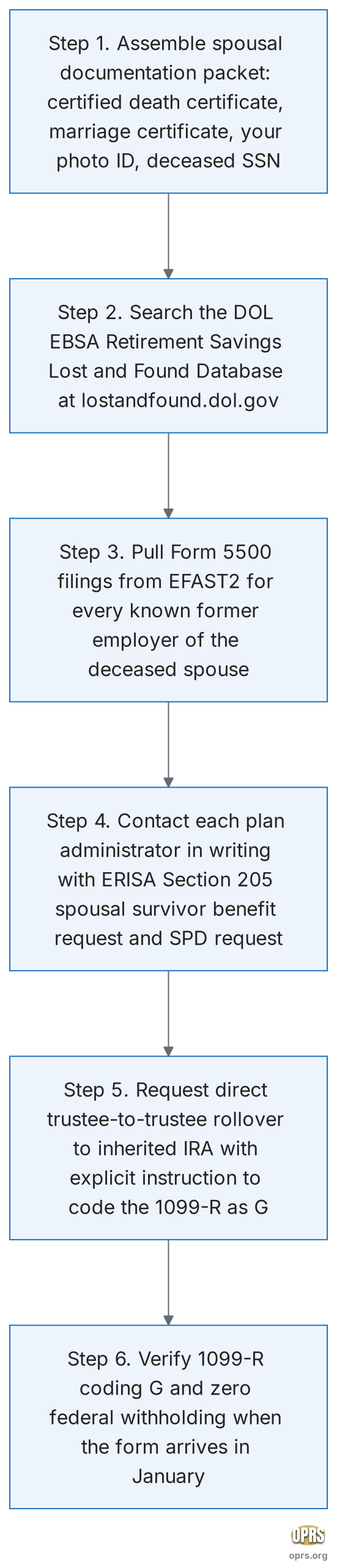
The six-step locator workflow
The procedural sequence below documents the six steps a surviving spouse executes to move from suspected old 401(k) balances to a confirmed recovery and direct rollover. Each step produces a paper deliverable retained in the estate file. The workflow runs serially because Step 2 outputs (employer history) feed Step 3 inputs (registry queries).
Can you roll your account into a precious metals IRA? Eligibility checker
Most retirement money can move into a precious metals IRA once it qualifies as an eligible rollover distribution. Pick your account type and situation for a general answer. Always confirm specifics with your plan administrator or custodian.
General guidance only, not tax or financial advice. Eligibility depends on your specific plan document and IRS rules; confirm with your plan administrator and a tax advisor. A direct trustee-to-trustee transfer avoids the 60-day rule and 20% mandatory withholding.
The right dealer explains every fee up front. Get Augusta's free precious metals IRA company checklist.
Step 1 builds the spousal documentation packet. You need a certified death certificate (multiple copies) and a marriage certificate. Also required: letters testamentary or proof of personal representative status, the surviving spouse’s own ID, and the deceased participant’s Social Security number on a separate page for plan-administrator outreach.
Step 2 constructs the employer history from the source document trio (W-2 archive via Form 4506-T, SSA earnings statement via Form SSA-7050-F4, personal records review). Step 3 runs the DOL EBSA Lost and Found Database, the PBGC Missing Participants Program, and the National Registry of Unclaimed Retirement Benefits against the employer history.
Step 4 mails the spousal documentation packet to each located plan administrator with a written request for the surviving-spouse beneficiary balance and the plan’s rollover election forms. Step 5 selects the destination IRA before signing any plan-side paperwork, so the trustee name and account number can be written on the plan’s direct-rollover form on the first pass.
Step 6 verifies the 1099-R coding G and zero federal withholding when the form arrives in January, before the 60-day rollover window under IRC Section 402(c)(3) is even relevant.
The spousal documentation packet: what every plan administrator will ask for
Plan administrators interact with surviving spouses on a standardized documentation pattern. Building the packet once and photocopying as needed cuts the round-trip cycle with each plan administrator from weeks to days. The five components below cover the documentation request that every major recordkeeper sends to a surviving-spouse caller.
- Certified death certificate. Order at least six copies from the vital-records office in the state of the participant’s death. Each plan administrator typically requires a fresh certified copy and will not return it. Multistate vital-records ordering is available through VitalChek, the federally accredited intermediary.
- Marriage certificate. Certified copy from the county or municipality where the marriage was solemnized. Establishes the surviving-spouse beneficiary right under ERISA Section 205 when the deceased participant did not file a current beneficiary form with the plan.
- Letters testamentary or small-estate affidavit. If the surviving spouse is the executor or personal representative of the deceased participant’s estate, the probate court issues letters testamentary. If the estate qualifies for a small-estate affidavit under state law (typical thresholds vary, commonly under fifty thousand to one hundred fifty thousand dollars), the affidavit substitutes for letters testamentary at the plan administrator’s discretion.
- Surviving spouse government-issued photo ID. Driver’s license or passport, both sides photocopied. Required for the plan administrator’s identity-proofing of the surviving spouse as the claimant.
- Deceased participant’s Social Security number, full legal name, date of birth, and date of death. Plan administrators key the participant search on Social Security number; the surviving spouse provides this on a separate documentation page rather than verbally over the phone.
After you find the plan: the three rollover paths under IRC Section 402(c)(9)
Once a located plan administrator confirms the surviving-spouse beneficiary balance, federal law gives the surviving spouse three procedural rollover paths under IRC Section 402(c)(9). Each path produces a different 1099-R code and a different after-tax outcome on the same underlying balance. The choice is procedural, not financial-planning advice: the underlying decision is which form code lands on the 1099-R for the rollover year.
The figure below models a representative one hundred eighty-five thousand dollar found 401(k) balance. That is a midpoint for a deceased participant who held a private-employer 401(k) for ten to fifteen years. The illustration uses the surviving spouse’s 22 percent federal marginal bracket. The result scales linearly for higher or lower marginal rates.

Path 1. Direct trustee-to-trustee rollover. The plan administrator transfers the located 401(k) balance directly to the trustee of a destination IRA. The 1099-R is coded G, the gross distribution is reported, the taxable amount is zero for the year, and no federal withholding attaches.
Path 1 preserves the full one hundred eighty-five thousand dollars inside the retirement system with zero immediate tax. This is the cleanest path procedurally; nothing the surviving spouse does after the transfer can trigger an unintended tax event in the rollover year itself.
Path 2. Indirect rollover within 60 days. The plan administrator pays the distribution to the surviving spouse personally and withholds 20 percent under IRC Section 3405(c). On a 185,000 dollar balance, that is 37,000 dollars withheld. The surviving spouse then has 60 days to deposit the full pre-withholding amount into a destination IRA.
To preserve the full balance, the surviving spouse makes up the 37,000 withheld from other funds within the 60-day window. The withheld 37,000 returns as a federal tax refund at filing, not in the rollover window itself.
A Path 2 executed without the make-up converts the 37,000 to a taxable distribution, costing roughly 8,140 in federal tax at the 22 percent bracket.
Path 3. Cash distribution with no rollover. The plan administrator pays the full distribution, withholds 20 percent, and the gross amount is reported as taxable ordinary income on the surviving spouse’s federal return.
The 10 percent additional tax under IRC Section 72(t) does not apply because the distribution is made on account of the deceased participant’s death (the IRC Section 72(t)(2)(A)(ii) death exception).
On a 185,000 dollar balance at the 22 percent bracket, the federal tax cost is 40,700 dollars and the net cash to the surviving spouse is 144,300 dollars, with zero remaining inside the retirement-system shelter.
Common mistakes surviving spouses make on the 401(k) locator process
The mistakes below recur in the OPRS reading of surviving-spouse intake forms and dealer cold-call transcripts. Each mistake is correctable inside the same rollover window if the surviving spouse catches it before the plan administrator generates the 1099-R.
Mistake 1. Skipping the SSA earnings statement. The most common gap is relying only on the deceased participant’s recent W-2s, which capture the last ten years. The Social Security Administration record extends further back and surfaces employer names the surviving spouse may not recognize. Filing Form SSA-7050-F4 takes weeks but is the highest-yield single document for the employer history.
Mistake 2. Accepting an indirect rollover at a recovered plan administrator. Plan administrators often default to the eligible-rollover-distribution form (Path 2 or Path 3) rather than the direct-rollover form (Path 1). The surviving spouse must affirmatively request the direct-rollover form, with the destination IRA trustee name and account number written on the first pass. Check this dealer against the 2026 OPRS list before any destination IRA is opened on a recovered balance.
Mistake 3. Missing the 60-day window after an unintended indirect distribution. The 60-day rollover window under IRC Section 402(c)(3) starts on the date the surviving spouse receives the distribution, not the date the 1099-R is generated. A delayed deposit converts the full distribution to ordinary income in the rollover year. Hardship waivers under Revenue Procedure 2020-46 exist but are not automatic and require documented qualifying circumstances.
Mistake 4. Confusing the spousal rollover with the inherited-IRA election. Under IRC Section 402(c)(9), a surviving spouse can roll a found 401(k) into the spouse’s own IRA, which preserves the spouse’s own RMD timing rules. The alternative inherited-IRA election under IRC Section 408(d)(3)(C) is procedurally different and applies the deceased participant’s RMD timing.
For most surviving spouses, the own-IRA rollover is the cleaner default; the inherited-IRA election is reserved for narrow age-arbitrage situations the surviving spouse’s CPA should run the math on first.
Mistake 5. Signing rollover destination paperwork on a dealer cold call within ninety days of the death notice. The first ninety days after a spouse’s death are the highest-pressure dealer-call window.
When a surviving spouse agrees to a self-directed IRA rollover destination on a cold call, they often lock in fees and a custodian relationship that a deliberate vendor-comparison process would have rejected. That decision typically gets made before the deceased spouse’s CPA or estate attorney is consulted. Our flagged list documents each dealer we have identified for this cold-call pattern.
When the located 401(k) intersects with a gold IRA destination
Once the surviving spouse has executed a Path 1 direct rollover and the recovered 401(k) balance sits inside a destination IRA, asset allocation becomes a separate decision. If a precious-metals sleeve fits the household, the destination is a self-directed IRA at an IRS-approved custodian, with bullion stored at an IRS-approved depository under IRC Section 408(m).
Home storage was rejected in McNulty v. Commissioner, 157 T.C. No. 10 (2021); any dealer who proposes home storage on a recovered balance is a disqualifying red flag.
Sleeve sizing on a recovered balance follows the FINRA concentration framework. A precious-metals allocation typically falls in the 5 to 15 percent range of total retirement assets for a surviving spouse focused on preservation rather than growth. The OPRS dealer rubric applies before any sleeve-size conversation. The dealers we currently consider acceptable for surviving-spouse rollovers are listed alongside the operators we warn against.
Three procedural steps, in order. First, order six certified death certificates and request the deceased participant’s Form 4506-T Wage and Income Transcripts and SSA-7050-F4 earnings statement; these two documents anchor the employer history and take the longest to arrive.
Second, run the DOL EBSA Retirement Savings Lost and Found Database, the PBGC Missing Participants Program, and the National Registry of Unclaimed Retirement Benefits against the documented employer history. Record every hit on a single tracking sheet.
Third, mail the spousal documentation packet to each located plan administrator with a written request for the direct-rollover election form, and select the destination IRA before any plan-side paperwork is signed.
If a gold IRA destination is on the table for a recovered balance, the dealer-vetting process applies before the destination paperwork is signed. The Augusta Precious Metals education evaluation, with an industry-reported around fifty thousand dollar minimum-funding threshold, includes a Company Comparison Checklist that the surviving spouse can request before any IRA-opening commitment.
The checklist evaluates four institutional signals. First, BBB A+ accredited since 2014 with no complaints on file. Second, Money Magazine’s Best Overall Gold IRA Company recognition 2022 through 2026. Third, Investopedia’s Most Transparent Gold IRA Company 2022 through 2026.
Fourth, Augusta’s salaried non-commissioned educators in the Education-First Learn-Talk-Decide process. The full OPRS 2026 dealer list for surviving spouses sits underneath the dealer-vetting layer.
The Company Comparison Checklist
Augusta Precious Metals publishes a Company Comparison Checklist for any gold IRA dealer on a recovered 401(k) balance. It walks a surviving spouse through four institutional signals to require: BBB rating and accreditation history, third-party publisher recognition (Money Magazine, Investopedia), educator compensation structure, and published fee schedule. The checklist is the highest-quality lead asset Augusta offers. It suits a surviving spouse who is still in the dealer-vetting stage, not the immediate-purchase stage.
Affiliate link. OPRS may earn a commission if a qualifying account is opened. This page is informational; it is not financial or tax advice.
Frequently asked questions on locating old 401(k) accounts after spousal inheritance
How far back does the SSA earnings statement go for a deceased participant?
The Social Security Administration retains complete reported earnings records from the start of the participant’s covered employment under the Social Security Act. For most participants who entered the workforce in the 1970s or later, this extends back to age 14 or 15 with reported wages.
The full record is requested via Form SSA-7050-F4 with a certified death certificate and proof of spousal relationship; processing typically takes 60 to 120 days. The SSA record is the single highest-yield document for surfacing employers the surviving spouse did not know about.
What happens if a former employer’s plan was terminated before the surviving spouse runs the search?
The Pension Benefit Guaranty Corporation steps in as trustee for terminated underfunded single-employer defined-benefit plans under ERISA Title IV and accepts voluntary transfers of unclaimed balances from terminated defined-contribution plans. The PBGC Missing Participants Program search portal returns hits keyed on the deceased participant’s Social Security number with the original plan name and termination date. Surviving-spouse claims follow the same ERISA spousal-beneficiary framework as a live plan, with the same spousal documentation packet required.
Can a surviving spouse roll a found 401(k) into her own existing IRA rather than open a new one?
Yes. Under IRC Section 402(c)(9), you can roll the eligible rollover distribution into any IRA you own. That includes a pre-existing traditional IRA, a Roth IRA (treated as a taxable conversion), or a self-directed IRA. The destination IRA does not need to be newly opened. The plan administrator’s direct-rollover form requires the destination trustee name, account number, and IRA type. The 1099-R is coded G regardless of whether the destination IRA is new or existing.
Does the DOL EBSA Lost and Found Database cover plans terminated before December 2024?
Partially. The federal Lost and Found Database authorized under SECURE Act 2.0 Section 303 went live on December 28, 2024 and is populated by ongoing plan-administrator filings. Coverage of pre-2024 terminations depends on whether the legacy plan administrator filed retroactive information.
The PBGC Missing Participants Program is the better source for plans terminated before 2024, and the National Registry of Unclaimed Retirement Benefits captures some pre-2024 balances from voluntarily participating recordkeepers. A complete search runs all three registries in sequence rather than relying on the Lost and Found Database alone.
Does the surviving spouse owe the 10 percent early-withdrawal penalty on a found 401(k) distribution before age 59 and a half?
No. The 10 percent additional tax under IRC Section 72(t) does not apply when the distribution is made on account of the participant’s death, under the death exception at IRC Section 72(t)(2)(A)(ii).
A surviving spouse who is younger than 59 and a half can take a cash distribution from a recovered 401(k) without triggering the penalty, although the distribution remains fully subject to ordinary income tax. For surviving spouses choosing the Path 1 direct rollover, the penalty question is moot because no taxable distribution occurs in the rollover year.
Sources cited
- IRC Section 402(c)(9): Rollover where spouse receives distribution after death of employee
- IRC Section 3405(c): 20 percent mandatory withholding on eligible rollover distributions
- IRC Section 72(t)(2)(A)(ii): Death exception to the 10 percent additional tax on early distributions
- IRC Section 408(d)(3)(C) and Section 408(m): Surviving-spouse IRA rollover and IRS-approved precious metals
- ERISA Section 205 (29 U.S.C. Section 1055): Spousal survivor benefit rights under qualified plans
- ERISA Section 404(a)(1) (29 U.S.C. Section 1104): Fiduciary duty to plan participants and beneficiaries
- Public Law 117-328 (SECURE Act 2.0 of 2022, including Section 303 authorizing the DOL Retirement Savings Lost and Found Database)
- Department of Labor EBSA: Retirement Savings Lost and Found Database portal
- Pension Benefit Guaranty Corporation: Missing Participants Program search portal
- National Registry of Unclaimed Retirement Benefits: industry-operated search service
- National Association of Unclaimed Property Administrators: consolidated state unclaimed property portal
- IRS Form 4506-T: Request for Transcript of Tax Return including Wage and Income Transcripts
- SSA Form 7050-F4: Request for Social Security Earnings Information
- IRS Publication 575: Pension and Annuity Income (rollover treatment of qualified plan distributions)
- IRS Form 1099-R Instructions: Distributions From Pensions, Annuities, Retirement or Profit-Sharing Plans