

Updated: July 28, 2026
OPRS may receive compensation when readers open an account through partner links on this page. Our analysis is based on independent research, BBB data, and IRS publications.
30-second verdict
- For a HNW household age 65 to 70 with $5 million to $15 million tax-deferred, a multi-year partial Roth conversion ladder run across the 5 to 8 year pre-RMD window is the structural play that prevents the age 73 RMD from forcing the household into the 32 or 35 percent federal bracket against its will.
- Bracket-filling the 24 percent MFJ bracket ($394,600 ceiling in 2025) each pre-RMD year converts roughly $1.2 million to $1.8 million of tax-deferred balance to Roth basis over 5 to 8 years at a known federal cost, instead of a forced RMD draw at a higher marginal rate later.
- The IRMAA tier 4 or tier 5 surcharge on Medicare Part B and Part D under 42 USC 1395r is the binding non-bracket constraint at HNW scale. Tier 5 sits at $750,000-plus MFJ modified AGI in 2025 and the surcharge stacks $400-plus per month per spouse for the year the conversion drives modified AGI past the tier ceiling.
- The dealer choice precedes the ladder mechanics. A self-directed gold IRA conversion that runs across 6 separate annual transactions requires a custodian that codes Form 1099-R Box 7 correctly each year, supports the trustee-to-trustee election under IRC Section 408A(d)(3), and handles the inherited-IRA service infrastructure that the surviving spouse and SECURE Act 10 year beneficiaries will eventually need.
The HNW Roth conversion question is rarely whether to convert.
The real question is how to sequence a known multi-year ladder across the narrow pre-RMD window. Each annual increment should land inside a federal bracket the household can absorb today, while the surrounding income picture, the Medicare premium overlay, and the future estate-side beneficiary plan all stay coordinated.
See the 2026 OPRS dealer list before any pre-RMD conversion paperwork. The custodian that receives the rolled balance becomes the operational floor on how many separate conversion transactions the ladder can run cleanly across the 5 to 8 year window without paperwork drift.
Element I is the bracket-filling strategy, sized to the 24, 32, or 35 percent MFJ bracket ceiling each pre-RMD year under IRC Section 408A. Element II is the IRMAA tier overlay under 42 USC 1395r, which constrains how high modified AGI can go before the Medicare premium surcharge stacks on top of the marginal tax.
A $5 million to $15 million tax-deferred balance becomes a SECURE Act 10-year rule problem for the next generation if it is not pre-paid into Roth before death. The federal estate exemption sunset structure shifts the calculation further for households near the threshold.
Element IV is the dealer screen on the receiving Roth gold IRA.
Screen the dealer before the ladder runs
A multi-year ladder running 5 to 8 separate conversion transactions through a self-directed gold IRA is a paperwork operation that compounds drift if the custodian books the conversions inconsistently. Once the ladder year n is booked, the 5 year clock on that converted basis runs independently under IRC Section 408A(d)(2)(B).
The dealer screen is the operative step before any custodian receives the first conversion. The operators OPRS currently trusts handle the trustee-to-trustee election and the 1099-R distribution coding. They also provide the inherited-IRA service infrastructure that the surviving spouse and SECURE Act 10-year beneficiaries will need at the end of the plan.
3 of 27+ gold IRA dealers reviewed by OPRS make the 2026 trusted list. Updated July 2026.
What a multi-year Roth conversion ladder actually means in the pre-RMD window
The pre-RMD window is the planning band between the retirement year and the year the household must take a first required minimum distribution under IRC Section 401(a)(9). The SECURE Act 2.0 set the RMD start age at 73 for participants born between 1951 and 1959, and at age 75 for participants born in 1960 or later.
For a HNW household where one or both spouses retired in their early to mid 60s, the pre-RMD window typically runs 5 to 10 years.
That window is the only stretch when ordinary income is low and Social Security may be deferred to 70 for the higher earner. The household can also choose which federal bracket to fill each year.
A multi-year partial Roth conversion ladder under IRC Section 408A uses that window to convert a sized portion of tax-deferred balance to Roth basis each year. Each conversion is a taxable rollover included in gross income in the conversion year.
The structural payoff is two-sided. Every dollar converted now is a dollar that will not generate a future RMD under IRC Section 401(a)(9). Converted Roth balances are also not subject to RMDs during the original owner’s lifetime under IRC Section 408A(c)(5).
The HNW arithmetic: why $5M to $15M makes the math different
At a $5 million tax-deferred balance growing at a 6 percent assumed compound rate, the balance at age 73 sits near $8 million if no conversion is run. The first-year RMD divisor under the IRS Uniform Lifetime Table for age 73 is 26.5, which produces a forced distribution near $302,000 for the year alone.
That forced draw lands on top of Social Security, pension or annuity income, and any taxable interest the household earns.
For a MFJ household, the 24 percent bracket ceiling sits at $394,600 in 2025. A forced RMD of $302,000 combined with Social Security and pension income often pushes total taxable income across the 32 percent boundary at $501,050 and into the 35 percent band that ends at $751,600. IRS Revenue Procedure 2024-40, 2025 Inflation Adjustments documents the bracket thresholds.
At a $10 million balance the same compounding math drives an age 73 first-year RMD near $604,000, which lands the household squarely in the 35 percent MFJ bracket before counting Social Security. At $15 million the first-year RMD nears $906,000 and pushes the household into the 37 percent bracket.
The structural feature: the RMD divisor falls each year, so the forced draw rises against an aging balance.
A household that does nothing during the pre-RMD window watches the RMD percentage of total income climb across the 70s and 80s. The surviving spouse eventually files single and is compressed into a tighter bracket schedule the year after the first spouse passes.
Where this matters: the bracket arbitrage during the pre-RMD window is the only structural lever a HNW household has. A 6 year ladder filled to the top of the 24 percent MFJ bracket converts approximately $1.5 million to $1.8 million of tax-deferred balance to Roth at a known marginal rate of 24 percent.
A 6 year ladder filled to the top of the 32 percent MFJ bracket converts $3 million to $3.5 million at a known 32 percent rate. Both approaches lock in today’s bracket schedule before the post-2025 statutory framework subject to TCJA sunset reauthorization risk takes effect.
The IRMAA at scale overlay: tiers 4 and 5 for HNW conversions
The Income-Related Monthly Adjustment Amount under 42 USC 1395r(i) stacks an additional Medicare Part B and Part D premium on top of the standard premium when modified AGI exceeds tier thresholds. The 2025 MFJ tier 5 threshold sits at $750,000 modified AGI, with the surcharge running on the SSA-published Part B and Part D add-on schedule.
At HNW scale, the ladder bracket choice and the IRMAA tier choice are coupled. Filling the 32 percent MFJ bracket ceiling at $501,050 lands the conversion year in IRMAA tier 3 or tier 4, depending on baseline income. Filling the 35 percent ceiling at $751,600 lands the conversion year in IRMAA tier 5. SSA guidance on Medicare IRMAA documents the per-tier surcharge schedule.
The 2 year lookback feature applies to every conversion year on the ladder. A conversion executed in 2025 drives the 2027 IRMAA tier; a 2026 conversion drives 2028. A 6 year ladder therefore drives 6 consecutive years of elevated IRMAA premiums on each Medicare-enrolled spouse two years later.
The compounded IRMAA premium across a 6 year ladder at tier 4 sits near $30,000 to $40,000 cumulative for the couple when the household sustains tier 4 modified AGI each conversion year.
That cost is real and should be priced into the ladder choice. It is rarely the binding constraint at HNW scale, though, because the alternative is a forced post-RMD distribution that lands in tier 5 anyway, with a higher federal marginal rate stacked on top.
How a self-directed gold IRA fits the conversion ladder
A traditional IRA holder can elect a partial Roth conversion to a brokerage Roth IRA, a separate partial conversion to a self-directed gold Roth IRA, or both in the same tax year. This is permitted under IRC Section 408A(d)(3).
The total converted amount is the sum across destinations and is reported on Form 1099-R with distribution code 2 from the originating custodian, then on Form 5498 by each receiving Roth custodian. The 5 year conversion clock under IRC Section 408A(d)(2)(B) starts on January 1 of each conversion year and runs independently against each transaction.
A 6 year ladder therefore runs 6 separate 5 year clocks in parallel against each converted basis bucket.
The chart below shows the cumulative federal tax cost of three ladder strategies across a 6-year pre-RMD window. The scenario assumes a $10 million tax-deferred starting balance, a 6 percent compound rate, and $200,000 MFJ baseline income before any conversion.
Three strategies are compared here. (1) No conversion: all RMD pressure deferred to age 73. (2) A 24 percent bracket-fill ladder over 6 years, converting approximately $1.7 million cumulative. (3) A 32 percent bracket-fill ladder over 6 years, converting approximately $3.5 million cumulative.
The chart prices federal tax on conversions during the ladder plus a 10 year projection of federal tax on the resulting RMD stream from age 73 to 82 at then-current bracket assumptions.

Precious metals IRA required minimum distribution (RMD) estimator
Once required minimum distributions begin (age 73 now, 75 starting 2033), you divide the prior year-end balance by an IRS life-expectancy factor. The result is taxed as ordinary income on your federal return and, in most states, your state return. You can take a precious metals IRA RMD in cash or in metal.
Estimate only, not tax advice. Uses the IRS Uniform Lifetime Table (most owners). A spouse more than 10 years younger and sole beneficiary uses a different table. Roth IRAs have no lifetime RMD. Sources: IRS Publication 590-B (Table III); IRS RMD FAQs. Consult a tax advisor.
The right dealer explains every fee up front. Get Augusta's free precious metals IRA company checklist.
The pattern that emerges is structural: doing nothing across the pre-RMD window pushes the largest cumulative federal tax burden into the post-RMD years at the highest marginal brackets the household will ever face. The 24 percent ladder captures meaningful bracket arbitrage at controlled IRMAA exposure.
The 32 percent ladder captures more conversion at a higher annual marginal rate but compresses the future RMD base aggressively. The chart understates the legacy benefit: each ladder strategy moves balance to Roth basis that the SECURE Act 10 year rule under 26 USC 401(a)(9)(H) inherits income-tax-free for the next generation.
Estate exemption sunset coordination
For a HNW household sitting near the federal estate tax exemption, the Roth ladder choice interacts with the estate plan. The 2025 federal estate and gift tax exemption sits at $13.99 million per individual under the TCJA framework that is statutorily scheduled to sunset at the end of 2025.
The post-sunset exemption reverts to the pre-TCJA inflation-adjusted base, projected near $7 million per individual at the time of writing, subject to congressional reauthorization. A household with $5 million to $10 million in IRA balance and additional taxable brokerage or trust assets is at meaningful risk of estate-side exposure under the post-sunset framework if no ladder is run.
See our deep dive on gold IRA and the 2026 estate exemption sunset for the side-by-side estate math.
The mechanics: a Roth conversion is a tax payment from outside the IRA in the conversion year, which reduces the gross estate by the dollar amount of federal tax paid.
A 6 year ladder filled to the 32 percent MFJ bracket pays roughly $1.1 million of federal tax across the ladder window, which is $1.1 million removed from the gross estate before the exemption test.
The converted Roth balance still belongs to the household, but it now sits in a vehicle that the SECURE Act 10-year rule will deliver income-tax-free to a non-spouse beneficiary. Check this dealer against the 2026 OPRS list before the first conversion lands inside a self-directed gold IRA structure.
The inherited gold IRA service infrastructure is the operational chokepoint when the surviving spouse and the next-generation beneficiaries inherit the account.
Side-by-side specs: ladder strategy attributes
The table below compares the structural attributes that drive the multi-year ladder decision across the three pre-RMD strategies available to a $5 million to $15 million HNW household. The Status column flags which strategy wins on each row at the HNW scale band.
| Spec | No conversion | 24% bracket-fill ladder | 32% bracket-fill ladder | Status (HNW $5M-$15M) |
|---|---|---|---|---|
| Primary tax statute | IRC Section 401(a)(9) RMD only | IRC Section 408A conversion | IRC Section 408A conversion | (Neutral) |
| Annual federal marginal rate during pre-RMD window | Lowest (no conversion income) | 24 percent on each conversion increment | 32 percent on each conversion increment | (No conversion wins each pre-RMD year) |
| Cumulative 6 year converted balance ($10M starting balance) | Zero | $1.5M to $1.8M cumulative | $3M to $3.5M cumulative | (32% ladder wins on conversion scale) |
| Forced RMD base at age 73 | $8M-plus tax-deferred | $6.5M-plus tax-deferred | $5M-plus tax-deferred | (32% ladder wins on RMD compression) |
| IRMAA tier exposure during ladder years | Tier 0 to 1 (lowest) | Tier 2 to 3 typical | Tier 4 to 5 typical | (No conversion wins on IRMAA each year) |
| Surviving spouse single-filer bracket compression | Highest forced compression at the first death | Reduced | Lowest | (32% ladder wins on widow/widower compression) |
| SECURE Act 10 year rule legacy | Beneficiary draws full balance in 10 years at beneficiary marginal rate | Reduced traditional IRA legacy | Largest Roth basis transferred income-tax-free | (32% ladder wins on legacy) |
| Estate gross reduction from conversion tax paid | Zero | $400K to $500K cumulative | $1M to $1.2M cumulative | (32% ladder wins on estate-side) |
| QCD eligibility at age 70 and a half | Preserved on full traditional IRA balance up to $108,000 per spouse (2025) | Preserved on residual traditional IRA balance | Reduced on residual traditional IRA balance | (No conversion wins on QCD if charitable plan is active) |
| TCJA bracket sunset hedge | None (future brackets unknown) | Partial bracket lock-in | Largest bracket lock-in at today’s rates | (32% ladder wins if rates rise) |
| Reversibility | Strategy adjustable each year | Each ladder year is final once executed; ladder pause is allowed any year | Same as 24% ladder | (No conversion wins on optionality) |
| Self-directed gold IRA compatibility | Existing gold IRA continues to compound tax-deferred | Roth gold IRA possible via ladder slice each year | Same, at larger annual slice | (Both ladders enable Roth gold IRA structure) |
The decision sequence: how to size each ladder year
The decision sequence below is the procedural framework most HNW households can run before the first ladder year executes, and re-run at the start of each subsequent ladder year. Tax counsel and estate counsel involvement becomes useful at step 4 when the conversion target lands near a bracket or IRMAA tier ceiling and the marginal stacked cost shifts.
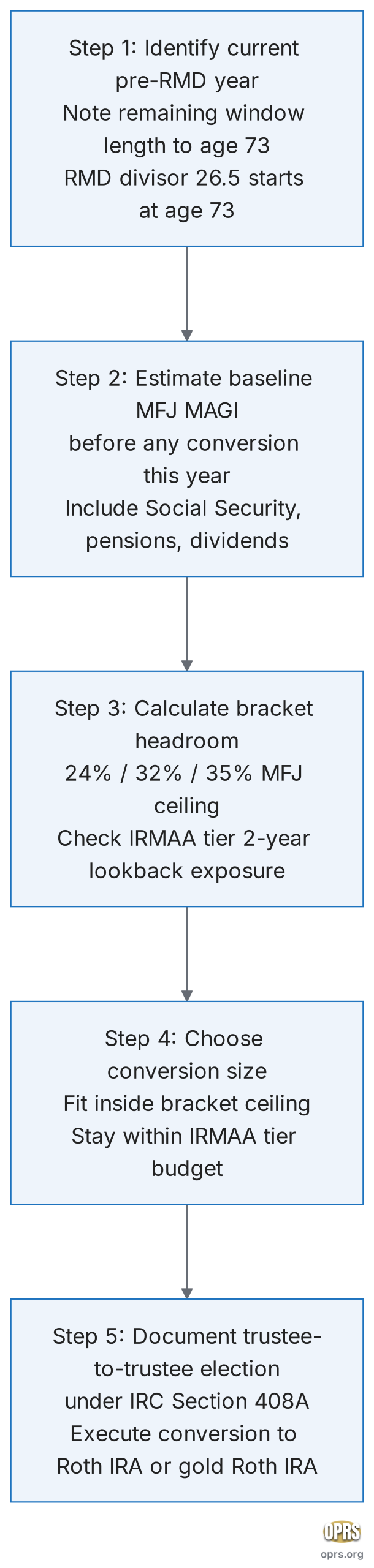
Step 1. Identify the pre-RMD year and the remaining window length. Confirm the RMD start age for each spouse under SECURE Act 2.0 (73 for participants born 1951 to 1959, 75 for participants born 1960 or later). Subtract the current year from the RMD start year for the spouse with the larger tax-deferred balance to size the available ladder runway.
Step 2. Estimate baseline household MFJ MAGI before any conversion. Sum Social Security if claimed, pension or annuity income, taxable interest and dividends, taxable capital gains, and any earned income still flowing. The baseline anchors every threshold calculation in steps 3 and 4.
Step 3. Calculate the bracket headroom and the IRMAA tier exposure. Document headroom to the 24 percent MFJ ceiling at $394,600 (2025), the 32 percent ceiling at $501,050, and the 35 percent ceiling at $751,600. Cross-reference the 2025 MFJ IRMAA tier thresholds at $212,000, $266,000, $334,000, $400,000, and $750,000. The 2 year lookback means the current-year conversion drives the year-plus-2 IRMAA premium.
Step 4. Choose the conversion size at the threshold that fits the household ladder target. Most HNW households running a 5 to 8 year ladder pick a single target bracket (24, 32, or 35 percent) and bracket-fill each year. The marginal cost calculation runs against three conversion sizes for the year: bracket-filling, partial-bracket, and pause. See the dealers OPRS clears and the ones we warn against for the receiving Roth gold IRA before the first year executes.
Step 5. Execute the trustee-to-trustee conversion election under IRC Section 408A(d)(3). Elect direct trustee-to-trustee transfer to avoid the mandatory 20 percent withholding on indirect rollovers under IRC Section 3405(c). Document the conversion year, the federal withholding election, and the destination Roth account at the custodian. The 5 year clock under IRC Section 408A(d)(2)(B) starts on January 1 of the conversion year for that increment.
Verdict per HNW household profile
Profile A: HNW household age 65 to 67, $5M to $7M tax-deferred, both spouses retired, Social Security not yet claimed, baseline MFJ MAGI under $150,000. The 32 percent bracket-fill ladder run over 6 to 8 years is typically the right primary path.
The pre-RMD window is the longest in this profile. The household can absorb tier 3 to tier 4 IRMAA exposure each ladder year in exchange for converting $2.5M to $3.5M of basis at known marginal rates.
The legacy upside is largest in this profile because each ladder year delivers the full Roth basis to the SECURE Act 10 year rule beneficiary plan.
Profile B: HNW household age 67 to 69, $7M to $12M tax-deferred, both spouses retired and on Medicare, household MFJ MAGI baseline $180,000 to $250,000. The 24 percent bracket-fill ladder run across the shorter remaining window is the conservative path that captures meaningful bracket arbitrage without sustained tier 4 or tier 5 IRMAA exposure.
A 4 to 5 year ladder at this band converts $1M to $1.4M to Roth basis. The household trades smaller legacy upside for substantially lower IRMAA premium exposure across the ladder window. This keeps the account clean for your spouse and heirs.
Profile C: HNW household age 65 to 70, $10M to $15M tax-deferred plus active CRT or CLAT charitable trust structure. The charitable structure changes the calculation because the CRT income stream and the CLAT lead interest occupy bracket space the household cannot also fill with conversion income.
The 24 percent ladder is typically the right ceiling, with the charitable income stream consuming the lower bracket bands. Coordinate with estate counsel before sizing each ladder year because the CRT or CLAT distribution schedule interacts with the conversion-year MAGI in non-obvious ways.
Profile D: HNW household with an active SLAT or estate exemption sunset hedge plan in place. The ladder choice shifts toward the 32 percent or 35 percent bracket-fill path because the estate-side urgency is highest in this profile. The conversion tax paid reduces the gross estate dollar for dollar, which the SLAT structure may not replicate. The legacy benefit of the converted Roth basis compounds against the SECURE Act 10 year rule for non-spouse beneficiaries.
Common stalls and how to avoid them
- Stalling on the first ladder year because the IRMAA tier feels high. The alternative is a forced RMD draw at age 73 that lands in IRMAA tier 5 anyway with a higher marginal federal rate stacked on top. Each ladder year of inaction makes the future RMD year harder, not easier.
- Sizing the ladder too small to avoid the IRMAA tier 4 or 5 surcharge. A $30,000 to $50,000 annual conversion against a $10M tax-deferred balance barely moves the needle on the age 73 RMD base. The IRMAA surcharge is real cost but typically small relative to the marginal tax saved at the post-RMD bracket on the same converted dollar.
- Concentrating the entire ladder into a single conversion year. A single $2M conversion year drives the household into the 37 percent bracket and IRMAA tier 5 with a 2 year lookback that hits both spouses. A 6 year ladder of $300K to $400K conversions captures the same total at lower stacked marginal cost in most cases.
- Forgetting the IRC Section 408A(d)(2)(B) 5 year clock on each conversion year. Each ladder year starts its own 5 year clock against the converted basis. Withdrawals from converted basis before that 5 year window can trigger the 10 percent early withdrawal penalty under IRC Section 72(t) on the converted amount even though the original participant is over 59 and a half.
- Picking a self-directed gold IRA custodian without verifying conversion election support. Not every self-directed custodian books the trustee-to-trustee conversion election cleanly. The 1099-R distribution code error on a $300K conversion can take 6 to 9 months to resolve with the originating custodian during peak filing season.
Where Augusta sits in the dealer landscape for this scenario
Augusta Precious Metals sits on the OPRS three-dealer shortlist.
The dealer minimum is industry-reported around $50,000, which is comfortably below the per-year ladder slice a HNW household would direct toward a self-directed gold Roth IRA. The published Learn-Talk-Decide process, run by salaried, non-commissioned educators, fits a planning conversation that brings both spouses and the household tax and estate counsel into the same room before the first ladder year executes.
Compare the 4-award stack on a company-comparison checklist
The free company-comparison checklist walks through the custodian, depository, 1099-R distribution coding, and Roth conversion mechanics that a 5- to 8-year ladder must coordinate. That coordination spans multiple conversion transactions, two spouses, and an eventual SECURE Act 10-year beneficiary plan. The checklist is the higher-intent asset for screening any single dealer against the four-marker trust-signal stack at the multi-year conversion-allocation moment.
OPRS may receive compensation when readers proceed. Editorial selection is independent. Updated July 2026.
How many years should a HNW pre-RMD Roth conversion ladder typically run?
Five to eight years is the typical band, anchored on the RMD start age under SECURE Act 2.0. A household where the older spouse retired at 65 and the RMD start age is 73 has 8 ladder years available.
The ladder can pause any year without forfeiture under IRC Section 408A; recharacterization was permanently repealed by TCJA in 2017, so each executed year is final, but skipping a year is allowed.
Most HNW households running the ladder pick a single target bracket (24, 32, or 35 percent MFJ) and bracket-fill each year the household is in the pre-RMD window. IRS guidance on rollovers of retirement plan and IRA distributions documents the conversion mechanics.
Does a Roth conversion ladder reduce RMDs across both spouses or only the converting spouse?
The Roth conversion election is an individual account holder action under IRC Section 408A(d)(3). Conversions from spouse A traditional IRA reduce spouse A future RMD base; they do not affect spouse B RMD base.
For a HNW household where both spouses hold large traditional IRAs, the ladder typically runs in parallel on both accounts each year, with each spouse executing their own trustee-to-trustee conversion against their own IRA balance. The household-level federal tax cost is the sum across both spouse conversions in the joint return.
Can a multi-year ladder split between a brokerage Roth IRA and a self-directed gold Roth IRA?
Yes. Each conversion year can split between multiple receiving Roth accounts under IRC Section 408A(d)(3), and the total conversion year amount is the sum across destinations. A household running a $400,000 conversion year can direct $300,000 to a brokerage Roth IRA and $100,000 to a self-directed gold Roth IRA.
The originating traditional IRA custodian issues a single Form 1099-R for the year, and each receiving Roth custodian issues its own Form 5498. The 5 year clock under IRC Section 408A(d)(2)(B) runs against the conversion year, not against each destination.
How does the ladder interact with QCD eligibility after age 70 and a half?
Qualified charitable distributions under IRC Section 408(d)(8) are available only from traditional IRAs, not from Roth IRAs, at up to $108,000 per year per spouse in 2025. A ladder that converts the bulk of the traditional IRA balance to Roth basis reduces the remaining QCD-eligible balance.
For households with an active charitable plan, the ladder choice should preserve enough traditional IRA balance to fund the planned QCD across the post-70 and a half years. The trade-off is between converting more basis to Roth for legacy purposes versus preserving traditional balance for QCD-driven RMD offset.
Sources cited
- IRC Section 408A, Roth IRAs
- IRC Section 408A(d)(2)(B), Five Year Period for Roth Conversion Basis
- IRC Section 408A(d)(3), Rollovers from an Eligible Retirement Plan Other Than a Roth IRA
- IRC Section 408A(c)(5), Minimum Distribution Requirements Inapplicable to Roth IRA Owner
- IRC Section 401(a)(9), Required Distribution Rules
- IRC Section 408(d)(8), Distributions for Charitable Purposes (QCD)
- IRC Section 3405(c), Twenty Percent Mandatory Withholding on Eligible Rollover Distributions
- 42 USC 1395r(i), Reduction in Premium Subsidy Based on Income (IRMAA)
- IRS Revenue Procedure 2024-40, 2025 Inflation Adjustments
- IRS, Rollovers of Retirement Plan and IRA Distributions
- IRS, Retirement Topics, Required Minimum Distributions
- SSA, Medicare Premium Income-Related Monthly Adjustment Amount
More on OPRS
- Gold IRA and the 2026 estate exemption sunset for the side-by-side estate-math deep dive that pairs with the ladder choice.
- Gold IRA allocation for pre-RMD HNW for the allocation framework that sits one layer above the conversion ladder choice.
- Partial Roth conversion to reduce future RMDs for the single-year sizing detail under the multi-year ladder.
- QCD from a gold IRA, mechanics and 105k limit for the charitable-distribution coordination that interacts with the ladder.