
Updated: July 30, 2026
OPRS may receive compensation when readers open an account through partner links on this page. Our analysis is based on independent research, BBB data, and IRS publications.
For a dual-income couple living in Northern Virginia and approaching retirement, the family home is usually the single largest asset on the balance sheet, often larger than either spouse’s workplace retirement plan.
According to U.S. Census Bureau QuickFacts for Fairfax County, Virginia, the median value of an owner-occupied housing unit there is roughly four times the national median reported by the same source. A 25-year resident with a paid-down mortgage typically holds six to eight hundred thousand dollars in unrealized equity, sometimes more.
That equity is the variable that changes everything about the rollover-rebalance question. A couple with $1.2 million in workplace retirement plans and $700,000 in NoVA home equity is not rebalancing a $1.2 million portfolio. They are rebalancing a $1.9 million portfolio in which 37% sits in one zip code, in one asset, with one exit (the eventual sale).
This guide walks through the NoVA-specific math for a couple where one spouse is 62 (federal contractor with a private-sector 401(k)) and the other is 58 (hospital RN with a 403(b)). The sequencing question is not abstract: most dealer outbound calls to this profile treat the rollover as the rebalancing event, ignoring the home sale entirely.
The home sale, when it happens, is often the larger event by dollar volume and the one with the harshest tax interaction. See the cross-coordination companion at dual-income couples gold IRA coordination for the rollover-only side of this decision.
Why the NoVA downsize lands harder than a national-median downsize
The Internal Revenue Code §121 home sale exclusion lets a married couple filing jointly exclude up to $500,000 of gain from the sale of a principal residence, provided ownership and use tests are met. The statute is documented at 26 U.S.C. §121 (Legal Information Institute) and the procedural rules at IRS Publication 523.
For a national-median household selling a national-median home (around $420,000 in 2025), the exclusion typically covers the full gain. The transaction has no federal income tax footprint, and the rollover-rebalance question proceeds independently.
For a NoVA family that bought a Fairfax or Arlington home in the late 1990s or early 2000s for $300,000 and watched it appreciate to $1.0 million, the math runs differently. The realized gain after selling expenses (typically 5% to 7% on the gross sale) often lands between $550,000 and $750,000.
Subtract the $500,000 MFJ exclusion and the couple has a taxable long-term capital gain of $50,000 to $250,000 reported on Schedule D. That gain stacks on top of wage income from the still-working younger spouse and any rollover-related conversions. It can push the joint return into a higher long-term capital gains bracket.
The 2025 long-term capital gains brackets for MFJ break at $96,700 (0%/15% boundary) and $600,050 (15%/20% boundary), per IRS data tables. The 3.8% Net Investment Income Tax under IRC §1411 attaches above $250,000 MAGI for MFJ.
The IRMAA Medicare surcharge adds a second layer. The Social Security Administration’s POMS HI 01101.010 sets the two-year lookback rule. Modified adjusted gross income at age 63 sets the Medicare Part B and Part D premium tiers at age 65 for each enrolled spouse.
A home sale in the year either spouse turns 63, layered with a Roth conversion or a rollover that includes taxable amounts, can lift the IRMAA tier by one or two notches. That adds hundreds of dollars per month per spouse to Medicare premiums for the following year.
The cross-coordination companion at dual IRMAA bracket management covers the per-spouse coordination separately.
The four downsize options and how the proceeds differ
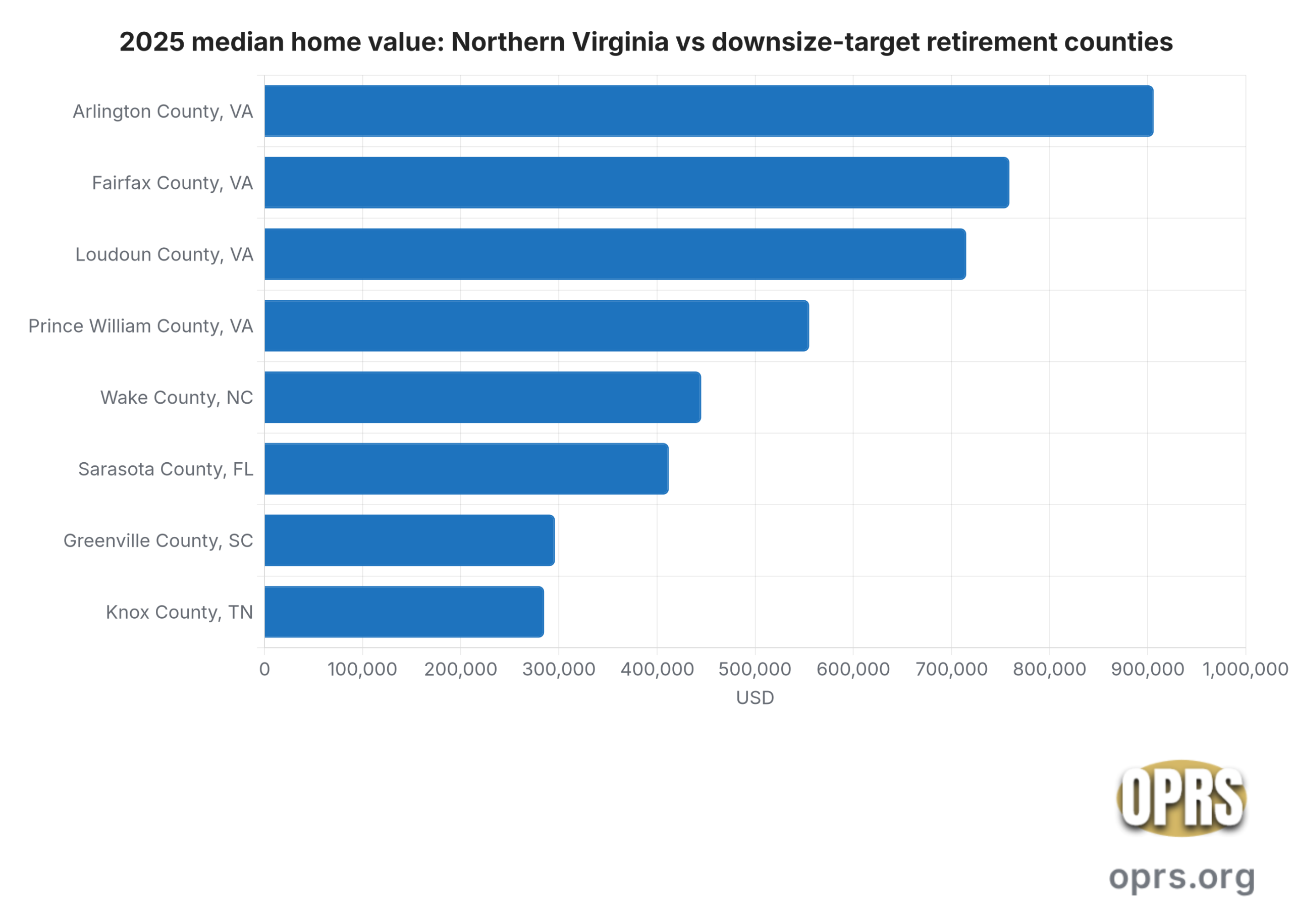
The NoVA family considering a downsize has four practical options, ranked by net cash extracted from the home sale. The chart below compares 2025 median sale price data from Census Bureau ACS five-year estimates for the relevant jurisdictions. Each option produces a different cash residual after buying the replacement residence, and that residual is what the rollover-rebalance plan should target, not the gross sale price.
Can you roll your account into a precious metals IRA? Eligibility checker
Most retirement money can move into a precious metals IRA once it qualifies as an eligible rollover distribution. Pick your account type and situation for a general answer. Always confirm specifics with your plan administrator or custodian.
General guidance only, not tax or financial advice. Eligibility depends on your specific plan document and IRS rules; confirm with your plan administrator and a tax advisor. A direct trustee-to-trustee transfer avoids the 60-day rule and 20% mandatory withholding.
The right dealer explains every fee up front. Get Augusta's free precious metals IRA company checklist.
Option 1, stay in NoVA, downsize to a condo. The family sells the single-family home and buys a two-bedroom condo in Arlington, Reston, or Tysons. Net cash extracted is typically $200,000 to $350,000 after replacement purchase, closing costs, and a moving allowance. The lifestyle continuity is high (same county, same friends, same medical network) and the tax footprint is moderate because the post-exclusion gain is the same regardless of where the replacement is bought.
Option 2, move to outer DMV, exurban Virginia or West Virginia panhandle. Selling the NoVA home and buying in Spotsylvania, Stafford, or Berkeley County, West Virginia, typically extracts $400,000 to $550,000. The cost-of-living drop is moderate and the family keeps reasonable access to the DMV medical and federal employment ecosystem. This option is the most common for couples where one spouse is still working and needs occasional DMV access.
Option 3, relocate to a no-income-tax or low-cost state. Selling NoVA and buying in Wake County NC, Greenville SC, Knoxville TN, or Sarasota FL typically extracts $500,000 to $800,000 of net cash.
The state tax landscape changes with this option. Florida and Tennessee have no state income tax. North Carolina taxes retirement income at a flat 4.25% (2026) per the North Carolina Department of Revenue. South Carolina exempts a portion of retirement income up to age-graded caps.
The relocation companion at Florida to North Carolina relocation gold IRA tax covers the state-residency mechanics for couples doing this move.
Option 4, rent post-sale, defer the buy decision. Selling the NoVA home and renting for one to three years extracts the full equity to cash and defers the location decision. It lets the couple stress-test retirement geography before committing. The downside is that the entire post-tax sale proceeds sit in cash or a money-market position. That leaves them exposed to inflation and to the temptation to over-allocate to the next investment idea pitched by a dealer or advisor.
Once the option is chosen, the calendar matters more than the dollar amount. The home sale gain, the federal contractor’s 401(k) rollover, and any Roth conversion all land on the same Form 1040 if executed in the same calendar year. For a Bob (62, federal contractor) and Carol (58, hospital RN/403(b)) profile, the typical year-of-sale joint return stacks the following items:
- Carol’s wages (still working): $90,000 to $130,000
- Bob’s last partial-year wages or severance: $30,000 to $80,000
- Schedule D long-term capital gain on home sale (post-exclusion): $50,000 to $250,000
- Bob’s 401(k) rollover taxable component if any after-tax mix or Roth conversion: $0 to $200,000
- Carol’s 403(b) elective deferrals reduce AGI (still working)
A joint MAGI in the $250,000 to $400,000 range pulls the couple into the 24% federal income tax bracket. It may also trigger the 3.8% NIIT under IRC §1411 on the capital gain portion above the $250,000 MAGI threshold. Two years later, that same MAGI sets the IRMAA tier when each spouse enrolls in Medicare.
The Centers for Medicare and Medicaid Services published the 2025 IRMAA Medicare Part B premium structure in their 2025 Medicare Parts A and B Premiums and Deductibles fact sheet. That document covers the exact tier breakpoints and per-tier surcharges.
The practical conclusion is that home sale and rollover almost never both belong in the same calendar year for a NoVA-priced equity. The IRS does not penalize a one-year gap between the two; the joint return absorbs each event in a lower-bracket year.
Couples who sign rollover paperwork in March and list the house in October sometimes discover at tax-prep time that they pushed themselves into a 32% bracket. A Tier 4 IRMAA tier they did not anticipate can come with it.
Before you size the gold IRA allocation against the home equity
Most NoVA couples planning a downsize plus a gold IRA rollover do not know that 24 of 27+ gold IRA dealers OPRS has reviewed pitch the same package regardless of household size. They will make the same pitch to a $1.9 million household as to a $400,000 household. The dealers we currently clear screen for couples, age gap, home equity, and joint-bracket headroom before the call moves past discovery.
3 of 27+ gold IRA dealers reviewed by OPRS make the 2026 trusted list. Updated July 30, 2026.
The five-step downsize-and-rebalance sequence
The five-step sequence below matches the typical Bob and Carol profile and assumes the couple has decided the downsize will happen but has not yet committed to a destination or a rollover schedule. The order is what matters; deviating from it usually creates one of the tax stacking problems described above.
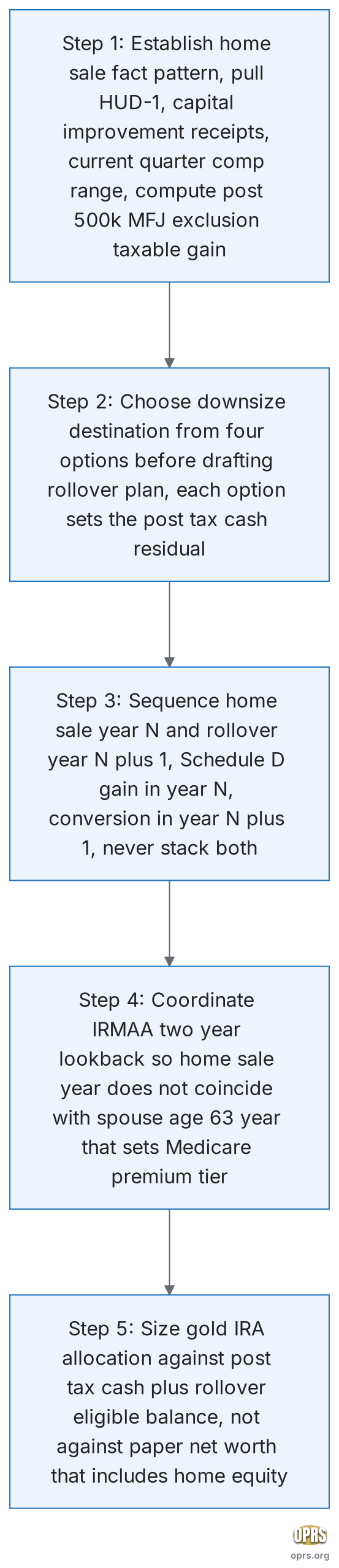
- Establish the home sale fact pattern. Pull the purchase HUD-1, all qualifying capital improvements (with receipts) that adjust basis upward, and the projected sale-comp range for the current quarter. Compute the estimated taxable gain after the $500,000 MFJ exclusion. If the post-exclusion gain is under $20,000, the sequencing constraints relax significantly. If it is $100,000 or more, treat the home sale as the dominant tax event of the year it lands.
- Choose the destination before the rollover plan. Pick one of the four downsize options. Each option implies a different post-tax cash residual, which sets the upper bound on the gold IRA allocation discussion. A couple expecting a $250,000 residual after Option 1 plans a different rebalance than a couple expecting a $700,000 residual after Option 3.
- Sequence the home sale and the rollover one calendar year apart. The conventional pattern for a Bob-and-Carol profile is to list and close the home in Year N, then execute Bob’s federal contractor 401(k) rollover (and any Roth conversion portion) in Year N+1, while Carol’s 403(b) continues to receive contributions. The home sale year carries the Schedule D capital gain; the rollover year carries any taxable conversion amount. Each year stays in a lower bracket than if both events stacked.
- Coordinate the IRMAA lookback for Carol. Carol turns 63 in the year she would otherwise file Medicare paperwork to take effect at 65. The MAGI from her year-63 joint return sets her IRMAA tier at Medicare enrollment. If Carol turns 63 in the home sale year, the Schedule D gain pushes her tier up. If the couple can land the home sale in a non-year-63 year, the IRMAA exposure stays lower.
- Size the gold IRA allocation against post-tax cash, not paper net worth. The gold IRA dealer outbound call sometimes anchors on the household net worth (the $1.9 million figure including home equity). The relevant number for the rollover allocation is the post-tax cash residual after the home sale plus the rollover-eligible 401(k) balance, minus any cash retained for the bridge years before Carol’s Social Security and Bob’s pension or RMD income kicks in. An allocation appropriate to a $1.2 million liquid portfolio is not appropriate to a $1.9 million on-paper portfolio when 37% of the paper is illiquid until the sale closes.
The HELOC bridge: what to use it for and what to avoid
Some NoVA couples cannot list the home in the desired calendar year. A spouse may still be working out of a DMV office, a school-aged dependent may still be at home, or a parent-care arrangement may depend on the current residence. The home equity line of credit (HELOC) is a common bridge instrument for these situations. The Consumer Financial Protection Bureau publishes a HELOC consumer guide at consumerfinance.gov that covers the basic mechanics.
The legitimate use of a HELOC for this profile is short-term liquidity to cover a 12 to 24 month delay between the rollover decision and the home sale. The HELOC funds living expenses, a renovation that improves marketability before listing, or a Roth conversion tax bill in the rollover year, all repaid from the home sale proceeds when the sale closes. Interest-only payment structures keep the carry cost low for a defined window.
The use to avoid is using HELOC funds to acquire investment assets, including a gold IRA contribution. Per IRS guidance on home equity loan interest, the interest on a HELOC used for investment purposes is not deductible under post-TCJA rules. The use also creates a leveraged precious-metals position that defeats the purpose of an IRA-held diversification trade. A gold IRA funded from a HELOC is not a downsize-and-rebalance; it is a leveraged speculation.
Common mistakes specific to NoVA downsize-plus-rollover couples
The five mistakes below show up repeatedly in dealer-pitched NoVA couples who arrive at OPRS with paperwork already partially signed. Each mistake compounds with the others.
Mistake 1, treating the rollover as the rebalancing event. The dealer pitch frames the gold IRA decision as the diversification trade. For a couple with 37% of net worth in one NoVA zip code, the diversification trade is the home sale, not the rollover. The rollover is a secondary instrument that operates inside the retirement account wrapper after the bigger geographic concentration is resolved.
Mistake 2, executing the rollover and the home sale in the same calendar year. Both events stack on the joint return and push the couple into a higher long-term capital gains bracket. They may trigger the 3.8% NIIT under IRC §1411, and may raise IRMAA two years later if the year-of-sale is also a year-63 year for either spouse.
Mistake 3, sizing the gold IRA allocation against the paper net worth. A 10% precious metals allocation against $1.9 million paper net worth implies a $190,000 trade. The same 10% against the post-tax post-sale cash plus rollover-eligible balance might be $130,000. The dealer outbound script often uses the larger anchor because it produces a larger commission-bearing trade.
Mistake 4, ignoring the IRC §121 ownership and use tests after a HELOC-funded renovation. The home sale exclusion requires that the couple own and use the home as principal residence for two of the five years before sale. A renovation period during which the family relocates temporarily can break the use test if it lasts long enough. IRS Publication 523 covers the edge cases.
Mistake 5, using HELOC funds for the gold IRA contribution. Covered above. The interest is not deductible; borrowing against home equity to fund an IRA-held position is inappropriate; the post-TCJA tax treatment under IRS guidance is unfavorable.
If selling in NoVA is not realistic this year
A NoVA couple constrained by either job continuity, family obligations, or local-market conditions may have to delay the downsize by two to five years. In that case the rollover-rebalance question proceeds on the pre-sale balance sheet, and the home equity is treated as a future liquidity event rather than a current one.
The practical adjustments are three. First, the gold IRA allocation is sized against the current rollover-eligible balance only, without including future home equity.
Second, the rollover plan should still be sequenced one calendar year apart from any planned future home sale. If the sale is targeted for Year N+3, the rollover should land in Year N+2 or earlier, never in Year N+3.
Third, the couple should track NoVA capital improvements with receipts during the pre-sale years to raise the basis and reduce the eventual post-exclusion gain. A $40,000 kitchen renovation in Year N raises basis and may convert $40,000 of taxable Schedule D gain into excluded gain at sale, depending on the §121 exclusion headroom at sale time.
The cross-coordination companion at federal contractor 401(k) vs spouse 403(b) rollover order covers the rollover sequencing on the pre-sale balance sheet for couples in this exact constraint.
Your next step
Frequently asked questions about NoVA downsize and retirement rebalance
Does the $500,000 home sale exclusion apply if only one spouse meets the use test?
The IRC §121 exclusion of up to $500,000 for MFJ requires that either spouse meet the two-of-five-year ownership test and both spouses meet the two-of-five-year use test as a principal residence. If only one spouse used the home as a principal residence for the required period (because the other relocated for work), the exclusion drops to $250,000 (the single-filer cap), even though the couple files jointly. IRS Publication 523 covers the partial-use cases including military service exceptions.
Can the federal contractor 401(k) be rolled over before the spouse separates from the hospital 403(b) plan?
Yes. Each plan’s eligibility is per-spouse, not joint. Bob’s federal contractor 401(k) can be rolled over to an IRA at any time after he separates from service or reaches 59½ if his plan permits in-service distributions. Carol’s 403(b) continues to receive contributions and remains intact at the hospital. The two plans are independent rollover candidates with independent timing.
Does relocating to a no-income-tax state before the home sale help with state tax on the gain?
Generally no for the gain itself. Virginia taxes capital gains on the sale of Virginia real property as Virginia-source income regardless of the seller’s residency at the time of sale. A pre-sale move to Florida or Tennessee does not avoid Virginia tax on the home sale gain.
The state-residency change does affect the taxation of subsequent rollover income, pension distributions, and capital gains on non-Virginia-source assets sold after the move. The relocation companion guide covers the state-residency mechanics for retirement income.
How does a HELOC affect the home sale closing in NoVA?
The HELOC is a lien on the property and is paid off at closing from the sale proceeds, the same way a first mortgage is. The presence of a HELOC does not block the sale or change the IRC §121 exclusion calculation. It does reduce the net cash to the seller by the outstanding HELOC balance.
A couple that drew $80,000 from a HELOC for living expenses during a one-year delay receives $80,000 less in net cash at closing, plus the accrued interest paid during the carry period.
Sources cited
- 26 U.S.C. §121, Exclusion of gain from sale of principal residence (Legal Information Institute)
- IRS Publication 523, Selling Your Home
- 26 U.S.C. §1411, Net Investment Income Tax
- U.S. Census Bureau QuickFacts, Fairfax County, Virginia
- SSA POMS HI 01101.010, Medicare Part B Income-Related Monthly Adjustment Amount
- CMS, 2025 Medicare Parts A and B Premiums and Deductibles fact sheet
- Consumer Financial Protection Bureau, What is a home equity line of credit (HELOC)?
- IRS, Interest on home equity loans often still deductible under new law
- North Carolina Department of Revenue