

Updated: July 28, 2026
OPRS may receive compensation when readers open an account through partner links on this page. Our analysis is based on independent research, BBB data, and IRS publications.
30-second verdict
- If you do not need your RMD income, the QCD is the cleanest way to redirect it: the cash goes IRA-to-charity directly, never hits your AGI, and still counts toward the RMD.
- The age trigger is 70.5 (the half-year, not 70 and not the RMD start age of 73). So you can begin the QCD program two and a half years before the RMD is even required.
- The yearly cap is around $108,000 per person (indexed up from the 2024 figure of $105,000). Married couples can each run their own cap from their own IRAs.
- Eligible destinations are public 501(c)(3) charities, broadly defined: your church or local faith group, a volunteer fire department, the FFA chapter, a 4-H club, the county hospital foundation, a food bank, an animal shelter, a scholarship endowment, a veterans group. The IRS calls the whole category “tax-exempt organizations”; there is no rule that it must be religious.
- Off limits: donor-advised funds, supporting organizations under IRC section 509(a)(3), and private foundations. Statute IRC section 408(d)(8) excludes those three by name.
If you are 73 and your traditional IRA pushes a five-figure Required Minimum Distribution every year, and you do not need that money to live on, you are not alone.
A retiree with a paid-off house, Social Security covering the grocery bill, and an IRA built over forty years often finds the RMD is the tax bill they did not want, not income they wanted.
The Qualified Charitable Distribution (QCD) is the IRS-blessed way to redirect the RMD to a tax-exempt organization (a charity, in plain English) and keep the dollars out of taxable income. This page walks through how the mechanic works, what counts as an eligible charity, the numbers, the reporting steps, and the common errors that break the QCD.
A separate note before any sales call: if a dealer brings up the QCD or a charitable angle in the same pitch that ends with a bullion purchase, slow down. The charitable architecture and the dealer-vetting step are two different jobs. See our running list of gold IRA dealers we currently warn rollover savers against before any consultation that mixes a giving plan with a metals purchase.
Before you sign
The QCD is a tax-architecture decision you make with your IRA custodian and your CPA, not a feature you buy from a precious-metals dealer. Vet the dealer first on the same questions the OPRS desk runs through before any six-figure rollover.
3 of 27+ gold IRA dealers reviewed by OPRS make the 2026 trusted list.
Why this matters when you do not need the RMD
A Required Minimum Distribution is the amount the IRS makes you pull out of a traditional IRA every year starting at age 73 (SECURE 2.0). The number is your December-31 IRA balance divided by a life-expectancy factor from the Uniform Lifetime Table. At 73 the divisor is 26.5, so a $500,000 IRA produces an RMD around $18,868. At 80 the divisor drops to 20.2 and the same balance produces a $24,752 RMD.
Whether or not you spend the dollars, the RMD is treated as ordinary income on your 1040. Two downstream effects matter more than the tax line: the higher AGI can push you into a higher Medicare IRMAA tier and can make more of your Social Security taxable.
The QCD breaks that chain. The cash goes straight from the IRA to a public charity. The IRA owner never has constructive receipt, so the dollars never appear as taxable income. AGI does not move. The IRMAA tier does not jump. And the gift counts toward the RMD up to the annual cap.
Of every charitable tool in the tax code, the QCD is the only one that does all four things at once. Statute: IRC section 408(d)(8).
What counts as a “tax-exempt organization” (it is not just churches)
The IRS phrase is “eligible organization,” and the legal test is whether the receiving entity is a public charity under IRC section 170(b)(1)(A). That covers a lot more than houses of worship. The IRS Tax-Exempt Organization Search tool is the place to confirm any specific charity in advance; if the organization is listed as a public charity there, the QCD is valid. Examples the OPRS desk sees rural retirees pick most often:
- A church, synagogue, mosque, or local faith group (the “classic” QCD recipient).
- A volunteer fire department or volunteer ambulance service organized as a 501(c)(3) (most are; a few are units of local government, which also qualify).
- A county hospital foundation or rural health clinic.
- A 4-H or FFA chapter, an agricultural extension foundation, or a scholarship endowment at the state land-grant university.
- A food bank, a community food pantry, or a Meals on Wheels chapter.
- An animal shelter, humane society, or wildlife rehabilitation group.
- A veterans group such as a VFW post or American Legion auxiliary organized as a 501(c)(3) (the “social” club 501(c)(19) version generally does not qualify; check the listing).
- A youth-sports league or a community library foundation.
Off limits no matter how charitable it feels: donor-advised funds, supporting organizations under IRC section 509(a)(3), and private foundations. The statute names those exclusions directly. Trying to QCD to a DAF voids the exclusion and turns the transfer into a taxable distribution. IRS Publication 590-B spells out the disqualified destinations.
The numbers: what the QCD saves at three common RMD levels
Three scenarios make the savings concrete. Each assumes a single filer, age 73, taking the standard deduction (about $17,000 for an over-65 single in 2026), with $30,000 of other taxable income from Social Security and a small farm-rent or pension stream. The IRA balance varies; the RMD is what the IRS forces out.
The retiree directs the full RMD to a public charity. The federal tax savings show what the QCD avoids that a cash distribution would have triggered, at a 22% marginal bracket.

Precious metals IRA required minimum distribution (RMD) estimator
Once required minimum distributions begin (age 73 now, 75 starting 2033), you divide the prior year-end balance by an IRS life-expectancy factor. The result is taxed as ordinary income on your federal return and, in most states, your state return. You can take a precious metals IRA RMD in cash or in metal.
Estimate only, not tax advice. Uses the IRS Uniform Lifetime Table (most owners). A spouse more than 10 years younger and sole beneficiary uses a different table. Roth IRAs have no lifetime RMD. Sources: IRS Publication 590-B (Table III); IRS RMD FAQs. Consult a tax advisor.
The right dealer explains every fee up front. Get Augusta's free precious metals IRA company checklist.
The federal tax savings line is the direct benefit. The IRMAA tier line is the indirect benefit that shows up on the Medicare premium notice the next year. IRMAA surcharges in 2026 start at a MAGI of about $106,000 single and stair-step up to about $443 per month at the top tier. A QCD that keeps an RMD out of MAGI for a retiree close to an IRMAA threshold can be worth more in premium savings than in income-tax savings.
How the QCD works step by step
The QCD is a five-step procedure handled by you, your IRA custodian, the receiving charity, and your tax preparer the next spring.
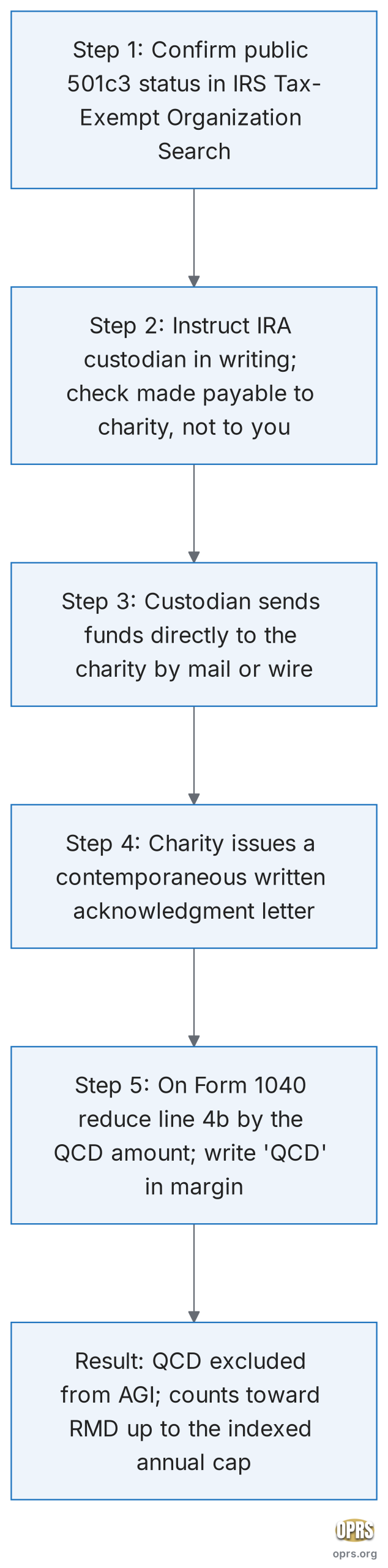
Step 1: Confirm the charity. Run the receiving organization through the IRS Tax-Exempt Organization Search. Print the listing showing the EIN, the public-charity status, and the date you checked. Most custodians do not vet the charity for you; the responsibility lands on the IRA owner.
Step 2: Tell the custodian, in writing, to make a QCD. Call your IRA custodian (Fidelity, Schwab, Vanguard, Equity Trust, STRATA, Kingdom Trust, or whoever holds your IRA) and ask for the QCD form.
Every major custodian has one; some call it “Charitable Distribution” or “Direct Charitable Transfer.” Specify the receiving charity, its EIN, the mailing address, and the dollar amount. Critically, request the check be made payable to the charity, not to you.
If the check is made payable to you and you endorse it to the charity, the QCD is broken and the full amount becomes a taxable distribution. Publication 590-B calls this the “direct trustee-to-charity transfer” requirement.
Step 3: The custodian sends the funds. The custodian mails the check directly to the charity (or wires the funds). If the IRA is a self-directed gold IRA fully invested in bullion, the custodian must first liquidate enough metal at the dealer bid that day. That re-introduces the bullion bid-ask spread. FINRA’s investor insight on precious metals notes that the spread is rarely transparent and is borne by the seller.
Step 4: Get a written acknowledgment from the charity. The charity must give you a contemporaneous written letter stating the amount and that no goods or services were received in exchange. Keep it with your tax records for at least three years.
Step 5: Flag the QCD on your Form 1040. The custodian will report the gross distribution on Form 1099-R with the full amount taxable in Box 2a; the custodian does not adjust the form to reflect the QCD. The exclusion is a taxpayer-side election.
On Form 1040 line 4a (IRA distribution), you write the gross amount; on line 4b (taxable), you reduce it by the QCD amount and write “QCD” in the margin. Without that adjustment, the IRS matching system will assess tax on the full distribution. The line numbers and current instructions live on the IRS Form 1040 instructions page.
The timing rule that breaks half of all DIY QCDs
The QCD only counts toward the RMD if it goes out of the IRA before any other distribution that satisfies the RMD. The IRS “first dollars out” rule treats the first dollars distributed in a calendar year as RMD dollars.
If you take your RMD as cash in February and make a QCD in November, the November QCD is still valid (the AGI exclusion applies). But it does not refund the income tax already paid on the February cash.
The fix: if you plan to use the QCD against the RMD, do the QCD first, in January or February, before any other IRA distribution. If you have a custodian automatic-distribution plan set up for the RMD, turn it off for the year or reset it to fire after the QCD has cleared.
The 70.5-to-73 gap: the planning window most retirees miss
SECURE 2.0 (2022) raised the RMD start age to 73 (and to 75 for retirees born in 1960 or later). Congress did not raise the QCD age. That creates a 30-month planning gap from age 70.5 to 73 where the QCD is available but no RMD is yet required.
A retiree who starts the QCD program at 70.5 can pull two and a half years of IRA balance out at the AGI-excluded rate before the RMD machinery kicks in.
For a $500,000 IRA and a $20,000-per-year charitable plan, that is $50,000 shifted to charity at zero AGI cost during the gap, plus a smaller RMD when 73 arrives because the underlying balance is lower. See what to do with an RMD you do not need for the sequencing decision against Roth conversions.
Common errors that break the QCD
Five mistakes turn a planned QCD into a taxable distribution. Each is fixable in advance; none is fixable after the fact.
- The check is made payable to the IRA owner. If you receive the check and endorse it to the charity, the IRS treats the full amount as a taxable distribution. The check must be made out to the charity directly by the custodian.
- The receiving charity is not a public 501(c)(3). Private foundations, donor-advised funds, supporting organizations, and political action committees are disqualified. So is a 501(c)(4) civic-league or 501(c)(6) trade association.
- The retiree is under 70.5 on the distribution date. The actual half-year birthday must be in the past on the date the custodian processes the QCD.
- The QCD is taken after the RMD has already been satisfied. Late-year QCDs still get the AGI exclusion but do not replace the earlier RMD distribution.
- The 1040 does not show the QCD adjustment. Without the line 4b adjustment, the IRS matching system charges tax on the full distribution.
QCD versus other ways to handle an unwanted RMD
Three other paths come up: the after-tax direct gift, the Donor Advised Fund, and the Roth conversion. None matches the QCD for AGI efficiency at the same dollar level, but each fits a different planning gap.
| Approach | Age trigger | Counts toward RMD? | AGI impact | Best use |
|---|---|---|---|---|
| QCD | 70.5 | Yes, up to the annual cap | Excluded from AGI | RMD-redirect for any standard-deduction retiree from 70.5 forward. |
| After-tax direct gift | None | No | Itemized deduction only if itemizing | Retirees who itemize because of high state-tax or medical-expense deductions. |
| Donor Advised Fund (DAF) | None | No | Itemized deduction only if itemizing | Pre-RMD high-income years for “bunching” multiple years of giving into one tax year. See DAF vs QCD for gold IRA retiree. |
| Roth conversion | None | No (the conversion is taxable, not the gift) | Raises AGI in the conversion year; lowers future RMDs. | Pre-RMD gap years when bracket capacity exists below an IRMAA threshold. |
For a retiree past 70.5 taking the standard deduction, the QCD wins at every level the others compete on. The decision becomes interesting when the charitable plan exceeds the QCD cap (a DAF can top up). It is also interesting when the retiree is still in the gap years before 73, and Roth conversion competes for the same IRA dollar.
Self-directed gold IRA plus a worked rural example
A self-directed gold IRA is a traditional IRA for tax purposes. The QCD rules apply identically: same age 70.5 trigger, same annual cap, same direct trustee-to-charity transfer, same 1040 reporting on lines 4a and 4b. The custodian (Equity Trust, STRATA, Kingdom Trust, or another self-directed custodian) signs the QCD check, not the metals dealer that sold the bullion.
If the gold IRA holds only bullion and no cash, the custodian must liquidate metal at the day’s dealer bid. A 3% spread on a $10,000 QCD is a $300 cost that disappears if you keep some cash in the IRA.
Worked example: a widowed retiree at 73 with a paid-off house, a tenant farming 80 acres on Schedule F rent, $30,000 in combined Social Security and rent income, and a $500,000 traditional IRA. The RMD is roughly $18,868. The retiree does not need it; bills are paid.
The retiree directs four QCDs in January: $5,000 to the volunteer fire department, $5,000 to the county hospital foundation, $5,000 to a state ag-extension scholarship, and $3,868 to the church operating fund. AGI for the year stays at $30,000 instead of $48,868.
On a 22% bracket, the federal tax saved on the redirected RMD is approximately $4,150, plus a meaningful drop in the taxable share of Social Security. See QCD from a gold IRA mechanics and the indexed cap and land-rich cash-poor IRA estate planning for the broader rural retirement context.
FAQ
Can I do a QCD from a Roth IRA?
Technically yes, but it almost never makes sense. A qualified Roth IRA distribution is already tax-free, so the QCD exclusion adds no tax benefit. The QCD mechanic is built for traditional IRAs (and inherited and SEP IRAs once no further employer contributions are being made), where the distribution would otherwise be ordinary income.
Does the charity have to be local?
No. The QCD works for any public 501(c)(3) charity in the United States. Out-of-state colleges, national health-research charities, large faith-based relief organizations, and small-town community foundations all qualify equally. Use the IRS Tax-Exempt Organization Search to confirm any specific recipient.
Can my spouse and I each do a QCD up to the cap?
Yes. The cap is per person, not per couple. A married couple at age 73 with both spouses owning separate traditional IRAs can each direct up to roughly $108,000 (the 2026 indexed cap) per year for a combined household QCD of roughly $216,000. Each QCD must come from the spouse’s own IRA; you cannot QCD from a spouse’s IRA.
What if I want to give more than the QCD cap?
Run the QCD up to the cap, then make any remaining giving from after-tax money or through a Donor Advised Fund. The QCD is annual; the cap does not carry forward.
How does the QCD interact with the SECURE 2.0 split-interest election?
SECURE 2.0 added a one-time election allowing up to roughly $54,000 (indexed from the 2024 figure of $53,000) of a QCD to fund a Charitable Remainder Trust or Charitable Gift Annuity. This pays the retiree (or spouse) an income stream for life with the remainder going to the named charity. The election is one-time per lifetime and is most often used at age 75 or later.
The QCD is paperwork that takes about an hour the first year and twenty minutes every year after. Two pieces matter before the IRA produces an RMD you do not want: the custodian relationship (does your IRA custodian offer a QCD form?
Most do; some self-directed custodians require a custom letter of instruction) and the charity vetting (does each receiving organization show up as a public 501(c)(3) in the IRS Tax-Exempt Organization Search?).
With both handled, the annual cycle is straightforward: tell the custodian in January, collect acknowledgment letters within a few weeks, file the 1040 with the QCD adjustment on line 4b.
The gold IRA dealer conversation, if any, belongs after this is in place; a dealer who introduces charitable framing on the same call as a bullion pitch is conflating two different decisions.
Affiliate disclosure: OPRS may receive compensation when readers open an account through partner links on this page. The QCD mechanics, the eligible-destination rules, the timing rules, and the reporting requirements above are based on IRC section 408(d)(8), IRS Publication 590-B, IRS Publication 526, and the SECURE 2.0 Act. They also draw on the IRS Form 1040 instructions and FINRA investor alerts, not on any partner relationship.
Augusta Precious Metals: company comparison checklist
If a gold IRA is somewhere on the same retirement timeline as a QCD plan, the dealer-vetting step should run first.
Request the Augusta company comparison checklist to vet a dealer on the same criteria the OPRS desk uses. Those criteria are Money Magazine Best Overall Gold IRA Company 2022 to 2026, Investopedia Most Transparent Gold IRA Company 2022 to 2026, and BBB A+ accredited since 2014 with zero complaints. The fourth is 4,000+ verified 5-star ratings across Trustpilot, Google, and Consumer Affairs.
Industry-reported minimum around $50,000. Current terms reviewed during the free consultation.
Pre-call homework: re-read our list of operators we currently rule out for six-figure rollovers before any consultation. The QCD plan and the dealer choice are independent decisions; do not let one sales call bundle them.
Sources cited
- IRS Publication 590-B, Distributions from Individual Retirement Arrangements (QCD mechanics, age 70.5 trigger, eligible destinations, Form 1040 reporting)
- 26 U.S. Code section 408(d)(8), Qualified Charitable Distribution statute (Cornell Legal Information Institute)
- 26 U.S. Code section 170(b)(1)(A), Public charity definition (Cornell Legal Information Institute)
- IRS Publication 526, Charitable Contributions (eligible organizations, written acknowledgment requirement)
- IRS Tax-Exempt Organization Search (formerly Select Check), the official tool to confirm a charity’s 501(c)(3) status
- SECURE 2.0 Act of 2022, section 307 (annual indexing of QCD cap and one-time split-interest carve-out)
- IRS Form 1040 and Instructions (line 4a/4b reporting, QCD margin note)
- FINRA, Investing in Precious Metals (dealer-pricing transparency, bid-ask spread)