

Updated: July 28, 2026
OPRS may receive compensation when readers open an account through partner links on this page. Our analysis is based on independent research, BBB data, and IRS publications.
30-second verdict
- Step-up basis under IRC section 1014 resets the cost basis of capital assets to fair market value at the date of death. It applies to the deceased spouse’s share of taxable brokerage, real estate, and closely-held interests. It does not apply to IRAs, 401(k)s, or 403(b)s, including any precious-metals sleeve held inside one of those wrappers.
- The spousal rollover is the IRA-side election. The step-up is the brokerage-side election. They are filed in different places with different custodians and on different forms, but they share the same first 90 days after the death certificate is issued.
- The single most expensive procedural error is treating the gold IRA as if it inherits basis. It does not. The pre-tax character of the Traditional IRA carries forward to the surviving spouse, and ordinary income tax applies to every distribution at the survivor’s marginal rate.
- For an estate above $7 million per spouse in 2026, the post-sunset estate exemption posture changes the order in which the surviving spouse should approve trust funding, IRA rollover paperwork, and brokerage basis claims. The order of operations is a CPA and estate attorney question, not a dealer question. We are not financial or tax advisors. Consult a licensed advisor before making retirement account decisions.
This page works through the spousal rollover and step-up basis interaction for a surviving spouse who inherits a high-net-worth estate. The estate is split across a Traditional IRA, a Roth IRA, a taxable brokerage account, real estate, and a precious-metals sleeve held inside one of the retirement wrappers.
Four sources govern the mechanics: Internal Revenue Code section 1014, IRS Publication 590-B on inherited IRA distributions, IRS Publication 559 on survivors and executors, and the SECURE 2.0 Act provisions on spousal elections.
Before any conversation with a metals dealer about a deceased spouse’s gold IRA balance, see the dealers OPRS currently warns surviving HNW spouses against. The estate settlement window for accounts above $1 million is the highest-pressure point for unsolicited sales scripts targeted at recently widowed households.
Before you sign
A self-directed IRA dealer who calls the surviving spouse in the first 60 days after the death and recommends a “fresh start” or a “new custodian” is inverting the planning sequence. The titling election and the brokerage basis triage belong with the CPA, the estate attorney, and the existing custodian. The dealer conversation comes last. It belongs after the retitling has been logged and the basis reset has been documented at the brokerage.
3 of 27+ gold IRA dealers reviewed by OPRS make the 2026 trusted list.
The step-up basis rule, and why IRAs are excluded
Internal Revenue Code section 1014 sets a single rule for capital assets acquired from a decedent. The recipient’s cost basis becomes the fair market value on the date of death, or the alternate valuation date six months later if the executor so elects under IRC section 2032.
The practical consequence is straightforward. A $5 million taxable brokerage portfolio with a $1 million original basis becomes a $5 million basis in the hands of the surviving spouse. The $4 million embedded capital gain disappears from the tax base. The same rule applies to real estate, closely-held business interests, and partnership interests held outside a retirement wrapper.
The exclusion list is short but consequential. Internal Revenue Code section 691 carves out what the law calls income in respect of a decedent. That provision captures every dollar inside a Traditional IRA, a 401(k), a 403(b), a 457(b), and any deferred compensation arrangement the decedent had not yet recognized for tax purposes.
There is no cost basis to reset because there was never an after-tax cost basis to begin with. The surviving spouse, the inherited IRA, the spousal rollover IRA, and the eventual distribution stream all carry the pre-tax character forward. Every dollar withdrawn is ordinary income at the survivor’s marginal rate.
A Roth IRA is different. The Roth has no cost basis to reset because the entire balance is already after-tax under IRC section 408A. The surviving spouse inherits the Roth tax-free under the qualified distribution rules, provided the five-year holding period had been satisfied by the deceased. The step-up question is moot, but the rollover paperwork still matters for RMD timing.
A precious-metals sleeve held inside a Traditional IRA is treated as part of the IRA balance for all federal income tax purposes. The metals at the IRS-approved depository are valued at fair market value on December 31 each year and reported on IRS Form 5498.
Precious metals held inside a Traditional IRA do not receive a step-up at the first spouse’s death, because they are inside a Traditional wrapper. A precious-metals position held in a taxable brokerage as a closed-end fund or as direct allocated bullion outside any IRA does receive a step-up under IRC section 1014. That is a different account architecture and a different planning conversation.
The distinction is the first thing the CPA verifies before any retitling paperwork is filed.
Account-by-account step-up treatment for the surviving spouse
| Account type at decedent’s death | Step-up under IRC 1014? | Mechanism after the surviving spouse takes over | Federal tax character of future distributions |
|---|---|---|---|
| Taxable brokerage, jointly held with right of survivorship | Half basis step-up | Decedent’s 50 percent share resets to date-of-death FMV. Survivor’s own 50 percent share retains original basis. | Capital gain on future sale measured against blended basis |
| Taxable brokerage, decedent’s separate account | Full basis step-up | Entire balance resets to date-of-death FMV when retitled to the survivor. | Capital gain on future sale measured against new FMV basis |
| Community property taxable brokerage (CA, TX, AZ, NV, WA, ID, LA, NM, WI) | Full basis step-up | Both halves reset to FMV at first spouse’s death under IRC 1014(b)(6). | Capital gain on future sale measured against new FMV basis on entire balance |
| Traditional IRA, decedent’s account | No step-up | Spousal rollover into survivor’s own IRA, or inherited IRA election. Pre-tax character carries forward. | Ordinary income at survivor’s marginal rate on every distribution |
| Roth IRA, decedent’s account | Not applicable | Spousal rollover into survivor’s own Roth, or inherited Roth IRA election. After-tax character carries forward. | Tax-free if five-year holding satisfied by decedent |
| Gold IRA inside Traditional wrapper | No step-up | Metals retitled at the same depository. Custodian updates account name. No physical movement required. | Ordinary income on distribution (in-kind metals or cash) |
| Gold IRA inside Roth wrapper | Not applicable | Metals retitled at the same depository under inherited Roth or rolled Roth structure. | Tax-free if qualified Roth distribution rules met |
| Real estate, decedent’s separate name | Full basis step-up | Title transfers via probate or trust to survivor. Basis becomes FMV at date of death. | Capital gain on future sale measured against new FMV basis |
| Closely-held business interest, decedent’s name | Full basis step-up | Buy-sell, operating agreement, and partnership documents govern transfer. Basis becomes FMV at date of death. | Capital gain on future sale measured against new FMV basis |
Can you roll your account into a precious metals IRA? Eligibility checker
Most retirement money can move into a precious metals IRA once it qualifies as an eligible rollover distribution. Pick your account type and situation for a general answer. Always confirm specifics with your plan administrator or custodian.
General guidance only, not tax or financial advice. Eligibility depends on your specific plan document and IRS rules; confirm with your plan administrator and a tax advisor. A direct trustee-to-trustee transfer avoids the 60-day rule and 20% mandatory withholding.
The right dealer explains every fee up front. Get Augusta's free precious metals IRA company checklist.
Sources: 26 U.S.C. section 1014 on basis of property acquired from a decedent, 26 U.S.C. section 691 on income in respect of a decedent, IRS Publication 590-B, and IRS Publication 559.

The dollars in the chart above are not abstract. A surviving spouse who treats a Traditional IRA balance as if it inherited basis can underpay quarterly estimated taxes by tens of thousands of dollars in the first survivor year. That mistake can trigger an underpayment penalty under IRC section 6654.
The CPA’s first triage memo separates the accounts that get basis from the accounts that do not. Only after that triage does the rollover paperwork begin.
How the spousal rollover paperwork interacts with the basis question
The spousal rollover paperwork at the IRA custodian and the basis step-up at the taxable brokerage are filed on different forms with different counterparties. They share two practical pressure points: the timing of the first distribution from any inherited account, and the executor’s election under IRC section 2032 to use the alternate valuation date six months after death.
The first distribution timing rule
A distribution taken from the deceased spouse’s IRA before the custodian has formally retitled the account can lock the surviving spouse into the spousal rollover path by default. This is the same procedural trap that drives the choice between a spousal beneficiary rollover and an inherited IRA election, and it is independent from the brokerage basis question.
A surviving spouse under age 59 and a half who pulls cash from the inherited IRA before the retitling can lose the 10 percent penalty exception under IRC section 72(t)(2)(A)(ii). The result is tax paid twice: once at ordinary income and once as a 10 percent additional tax.
The alternate valuation date election
For estates large enough to file Form 706, the executor can elect under IRC section 2032 to value the assets six months after the date of death rather than at the date of death itself. The election is binary and applies to the entire gross estate.
It changes both the estate tax base and the cost basis of every asset that receives step-up. The IRA balances do not change because they were never inside the basis calculation, but the taxable brokerage, real estate, and closely-held interests revalue.
The alternate valuation election can move tens of thousands of dollars in basis depending on market movement during the six-month window, which in turn changes the survivor’s future capital gain exposure on any sale.
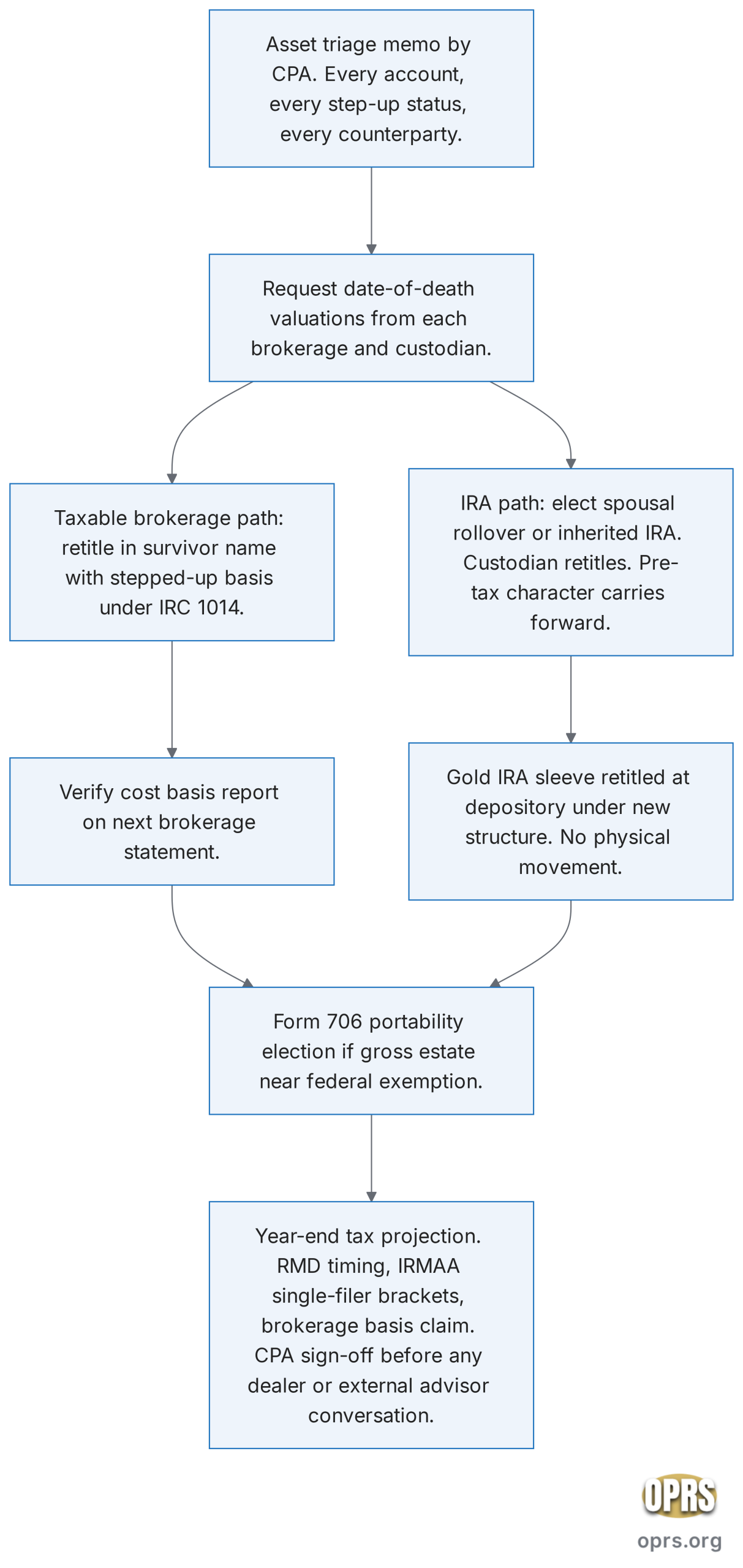
The procedural sequence the CPA enforces
- Asset triage memo. Within the first 30 days, the CPA produces a one-page memo listing every account, its account type, whether step-up applies, and which counterparty handles the retitling. This is the master document the surviving spouse refers to before signing anything.
- Date-of-death valuations. The CPA requests date-of-death balances from each custodian and each brokerage. The brokerage values become the candidate new basis for taxable accounts. The IRA balances are recorded for future RMD calculations but do not enter the basis calculation.
- Trust funding posture review. If the household had a credit shelter trust, a marital deduction trust, or a Charitable Remainder Trust planned in the documents, the estate attorney verifies that the funding directions still match the surviving spouse’s post-death cash flow plan.
- Form 706 decision. If the gross estate is near the federal estate exemption, the CPA and estate attorney decide whether to file Form 706 to elect portability under IRC section 2010(c)(5), even if no tax is due. Portability preserves the deceased spouse’s unused exemption for the survivor’s lifetime.
- Brokerage retitling and basis claim. The brokerage opens a successor account in the survivor’s name with date-of-death basis on the affected lots. The CPA verifies the cost basis report on the next statement.
- IRA spousal election filed. The IRA custodian retitles the inherited IRA as either a spousal rollover into the survivor’s own IRA or an inherited IRA election. The procedural choice and its trade-offs are unchanged by the basis triage on the brokerage side.
- Gold IRA sleeve retitled at the depository. The custodian updates the account name on the same metals lots. No physical movement is required. The depository receipt continues under the new structure.
- Year-end tax projection. The CPA models the first survivor year’s tax under the new structure, including the RMD impact from the IRA election and the IRMAA bracket exposure on the survivor’s single-filer status.
The HNW coordination layer, exemption sunset, and trust funding
For an estate above $7 million per spouse, the basis step-up interacts with the federal estate exemption posture in a way that lower-net-worth households do not face. The 2017 Tax Cuts and Jobs Act roughly doubled the federal estate and gift tax exemption, with the increase scheduled to sunset at the end of 2025.
As of 2026, the exemption is set by current statute and indexed for inflation, but the planning conversation for surviving spouses who inherited under the higher exemption window remains unsettled. The portability election preserves the deceased spouse’s unused exemption regardless of the sunset trajectory, which makes the Form 706 filing decision more consequential than the headline tax-due question suggests.
Three trust structures commonly used in the $5 million to $15 million estate planning range interact with the spousal rollover and basis question.
Charitable Remainder Trust (CRT). A CRT funded with appreciated taxable brokerage receives the step-up at the first spouse’s death only if the trust was funded after death from estate assets, not before death.
A CRT funded during life with appreciated assets does not receive a step-up at the first spouse’s death because the assets are no longer in the gross estate. The CRT’s own income beneficiary rules are independent from the spousal IRA rollover, but the planning conversation often happens in the same meeting because the cash flow streams interact.
Charitable Lead Annuity Trust (CLAT). A CLAT structured as a grantor trust during the deceased spouse’s life terminates at death, and the remainder passes to the named beneficiaries with the step-up if the assets were inside the gross estate. A non-grantor CLAT’s remainder does not receive the step-up. The surviving spouse’s first procedural question is whether the trust’s existing tax classification still matches the household’s post-death plan.
Spousal Lifetime Access Trust (SLAT). A SLAT funded by the deceased spouse for the benefit of the surviving spouse and descendants generally does not receive the step-up. The assets were already removed from the deceased spouse’s gross estate when the SLAT was funded during life.
This is one of the intended trade-offs of the SLAT structure under the higher exemption window. The surviving spouse may have access to the SLAT income but cannot rely on a basis reset for the underlying assets.
A captive insurance arrangement common in HNW retirement plans has its own basis and step-up rules that are outside the scope of this page. The general principle is that captive insurance interests held inside a Traditional IRA or 401(k) follow the IRA rules and do not receive step-up. Captive interests held outside retirement wrappers follow the brokerage rules. The estate attorney and a specialized captive consultant are the decision points, not the IRA custodian.
For high-net-worth couples who plan during life rather than after death, our walkthrough of the post-sunset exemption posture covers lifetime gifts, portability elections, and the order in which the survivor should approve trust funding paperwork. The basis triage on the brokerage and the spousal rollover at the IRA custodian are two of the more procedurally straightforward elements of the package.
How a gold IRA sleeve survives the retitling
A precious-metals position held inside the deceased spouse’s Traditional IRA is treated as part of the IRA balance throughout the retitling. The depository does not ship the metals. The custodian updates the account name on the same metals lot.
The fair market value of the metals at the next reporting date appears on the next IRS Form 5498 under the survivor’s structure. The metals continue to be valued at depository receipt for RMD and tax purposes, and the survivor’s distribution choices (in-kind versus cash) follow the standard IRA rules.
The procedural simplicity at the depository is in deliberate contrast to the basis triage at the brokerage. The metals do not need basis because the wrapper handles tax timing. The same metals positioned in a taxable account would face the brokerage basis question, but inside the Traditional IRA wrapper, the question does not arise.
Augusta Precious Metals is part of the OPRS-reviewed dealer shortlist.
The company holds a BBB A+ accreditation since 2014 with zero complaints currently on file. It has been named Money Magazine Best Overall Gold IRA Company from 2022 through 2026 and Investopedia Most Transparent Gold IRA Company across the same span. It also carries more than 4,000 5-star ratings across Trustpilot, Google, and Consumer Affairs.
For a high-net-worth surviving spouse whose inherited gold IRA sleeve sits well above that threshold, the dealer conversation belongs after the CPA has signed off on the asset triage. The retitling election should also be logged at the custodian first.
Common mistakes HNW surviving spouses make on the interaction
- Treating the Traditional IRA as if it inherited basis. The single most expensive error. A survivor who underpays quarterly estimates on the assumption that distributions will be capital gain rather than ordinary income can owe tens of thousands of dollars in underpayment penalties under IRC section 6654.
- Selling appreciated taxable brokerage positions before the retitling. The basis step-up only attaches to the surviving spouse after the brokerage retitles the account into the survivor’s name with date-of-death basis. A sale executed under the joint account number with stale basis records can lock in capital gain that the step-up would have erased.
- Skipping the Form 706 filing because no tax is due. Portability under IRC section 2010(c)(5) preserves the deceased spouse’s unused exemption for the survivor’s lifetime. For an estate that is below the current exemption today but might exceed half the current exemption after future appreciation, the portability election can be the most valuable filing the estate makes.
- Funding a credit shelter trust with IRA assets. A trust funded with IRA assets is treated as a non-spouse beneficiary for SECURE Act purposes and is forced into the 10-year drawdown rule, eliminating the spousal rollover’s RMD-deferral advantage. The trust funding should come from taxable brokerage or real estate that received step-up, not from the IRA.
- Coordinating the rollover and the dealer conversation in the same meeting. Even at the HNW level, the gold IRA dealer is not a tax advisor. The basis triage, the Form 706 election, the trust funding posture, and the spousal rollover are CPA and estate attorney questions. The dealer conversation belongs after those are settled. A dealer who insists on a “right now” call during the estate settlement window is selling, not advising.
Each error compounds with time. The basis step-up cannot be retroactively claimed once a sale has been executed at the old basis. The portability election cannot be filed late without a Private Letter Ruling. The spousal rollover treatment cannot be unwound once a distribution has been processed under the survivor’s name.
Frequently asked questions
Does my Traditional IRA get a step-up in basis when my spouse dies?
No. A Traditional IRA is excluded from the step-up rule under 26 U.S.C. section 691 because the entire balance is treated as income in respect of a decedent. There is no after-tax cost basis inside a Traditional IRA to reset.
The surviving spouse takes the balance under either the spousal rollover or the inherited IRA election, and every future distribution is ordinary income at the survivor’s marginal federal rate, plus any applicable state income tax. The same rule applies to 401(k), 403(b), 457(b), and other pre-tax retirement accounts. Consult the rules in IRS Publication 590-B for the distribution mechanics.
What about a gold IRA: do the metals get a step-up?
The metals inside a Traditional gold IRA do not receive a step-up because the wrapper is a Traditional IRA. The fair market value of the metals at the date of death is recorded for IRS Form 5498 reporting under the new structure. Every dollar of future distribution is ordinary income to the surviving spouse.
Metals held outside a retirement wrapper receive the step-up under 26 U.S.C. section 1014. This applies to direct allocated bullion in a depository under the survivor’s personal name or to a closed-end fund in a taxable brokerage account. The architecture matters, and the determination is documented in the asset triage memo before any retitling.
In a common-law state, a jointly held taxable brokerage account with right of survivorship receives a step-up only on the deceased spouse’s 50 percent share. The surviving spouse’s own 50 percent retains its original cost basis.
In a community property state (Arizona, California, Idaho, Louisiana, Nevada, New Mexico, Texas, Washington, Wisconsin), IRC section 1014(b)(6) provides that both halves of community property receive the step-up at the first spouse’s death. For HNW couples who relocated between states during life, the CPA verifies the property characterization on the brokerage account before claiming basis on the next sale.
Does the IRMAA bracket math change because of the step-up election?
Indirectly, yes. The step-up itself does not affect Modified Adjusted Gross Income directly, but the choices it enables do. A survivor who can sell appreciated taxable brokerage at the new basis without recognizing capital gain has more flexibility to manage MAGI year-by-year and to keep the single-filer IRMAA brackets in mind.
The spousal rollover IRA RMDs at age 73 under the Uniform Lifetime Table are the constant. The discretionary brokerage sales are the variable. For HNW survivors with substantial taxable holdings, the basis step-up and the IRMAA bracket management are tightly linked. See our walkthrough of dual IRMAA bracket management with gold IRA distributions for the survivor-year math.
Does the gold IRA dealer have a role in the basis triage?
No. The dealer is a metals supplier and account introducer, not a tax advisor. The basis triage is a CPA question. The spousal rollover is a custodian-and-CPA question. The estate attorney handles the trust funding and the Form 706 decision.
A dealer who recommends a specific titling election, a new custodian, or a “fresh start” gold IRA during the estate settlement window is providing tax advice without a license. The Financial Industry Regulatory Authority Investor Education center publishes general guidance on the distinction between selling activity and advisory activity in retirement account contexts. We are not financial or tax advisors.
Consult a licensed advisor before making retirement account decisions.
More on OPRS
- Spousal beneficiary rollover vs inherited IRA election for the underlying titling decision tree.
- Gold IRA and the estate tax exemption sunset for the lifetime gifting and portability sequencing.
- Inherited IRA with an asset protection trust as beneficiary for the trust-funding-from-IRA trap and the SECURE Act ten-year rule.
- Our 2026 evaluation of gold IRA dealers, with the operators OPRS clears and the ones we currently warn against.
The basis triage and the spousal rollover are two separate filings on two separate forms with two separate counterparties, and they share a 90-day window after the death certificate is issued.
The CPA produces the asset triage memo first. The brokerage retitles with date-of-death basis next. The IRA custodian retitles under the elected structure after that. The gold IRA sleeve travels with the IRA retitling without any physical movement at the depository.
For an HNW surviving spouse, the order of operations preserves the basis where the law allows it and accepts the pre-tax character where the law does not. Check any dealer’s name against the 2026 OPRS list before signing self-directed IRA paperwork during the estate settlement window. Past performance is not a guarantee of future results.
Sources cited
- 26 U.S.C. section 1014, Basis of property acquired from a decedent
- 26 U.S.C. section 691, Recipients of income in respect of decedents
- 26 U.S.C. section 2032, Alternate valuation date
- 26 U.S.C. section 2010, Unified credit against estate tax and portability election
- 26 U.S.C. section 72(t), 10 percent additional tax on early distributions
- 26 U.S.C. section 6654, Underpayment of estimated tax by individuals
- Internal Revenue Service, Publication 590-B (Distributions from Individual Retirement Arrangements)
- Internal Revenue Service, Publication 559 (Survivors, Executors, and Administrators)
- Internal Revenue Service, About Form 706 (United States Estate and Generation-Skipping Transfer Tax Return)
- Internal Revenue Service, About Form 5498 (IRA Contribution Information)
- Financial Industry Regulatory Authority, Investor Education center
- Social Security Administration, Medicare and IRMAA overview