

Updated: July 28, 2026
OPRS may receive compensation when readers open an account through partner links on this page. Our analysis is based on independent research, BBB data, and IRS publications.
Form 1099-R is the information return your old plan or current IRA custodian files with the IRS every January. The single character in box 7 tells the IRS exactly how to tax the distribution, and on a gold IRA rollover that one character decides whether you owe nothing or a stack of penalties.
For a self-directed gold IRA, the box 7 code is the difference between a clean trustee-to-trustee transfer and a flagged early withdrawal (IRS, Instructions for Forms 1099-R and 5498). Element I of reading the form: confirm the code matches the event you actually requested.
Our view: the box 7 verification takes ten minutes per 1099-R and prevents the two most expensive mistakes a gold IRA saver can make, an indirect rollover with 20 percent withheld and an early distribution coded with no exception.
Before you accept a 1099-R that may have mis-flagged your gold IRA rollover, the 2026 OPRS list of gold IRA dealers we warn against is the document we hand a saver first. The trigger we see most: dealer-side paperwork that delayed a direct transfer past the plan’s deadline.
Before you accept a 1099-R for a gold IRA rollover
Box 7 records the code your plan administrator or custodian chose. A code 1 on a rollover you intended as direct is a red flag the receiving operator may have caused the delay. The 2026 OPRS dealer list names operators we warn against, the small group we consider acceptable, and the documented BBB and state-attorney-general records behind each verdict.
3 of 27+ gold IRA dealers reviewed by OPRS make the 2026 trusted list.
Where Form 1099-R fits in your gold IRA paperwork
Form 1099-R, Distributions From Pensions, Annuities, Retirement or Profit-Sharing Plans, IRAs, Insurance Contracts, etc., is the year-end information return the sending plan or IRA custodian issues for every distribution event, including rollovers. The IRS requires plans and custodians to file the 1099-R by January 31 of the year following the distribution. The participant receives a copy at the same address the plan has on file.
For a gold IRA, three documents form the federal paper trail. The 1099-R reports the money leaving the source account. Form 5498, filed by May 31, reports the rollover landing in the new IRA and the December 31 fair market value (IRS, About Form 5498).
Form 1040 reconciles the two on lines 4a, 4b, 5a, and 5b. Every box 7 code points the IRS matching engine to one specific entry pattern on the 1040. A mismatch triggers a CP2000 notice within 18 to 30 months.
For deeper coverage of the receiving-side reporting, see our Form 5498 box-by-box guide for gold IRA holders. The two forms must reconcile to the same gross dollar amount on a clean rollover.
The ten box 7 codes a gold IRA saver sees most often
The IRS publishes more than 20 distribution codes for box 7. Only a handful surface on a gold IRA file. The table below covers the ten codes that recur, with the plain-language meaning, the controlling section of the Internal Revenue Code, and the action item for the participant. Codes can appear singly or as combinations of two characters when the event spans two classifications.
| Code | Meaning | Controlling section | Gold IRA participant action |
|---|---|---|---|
| 1 | Early distribution, no known exception | IRC Section 72(t)(1) | If a Section 72(t) exception applies, request a corrected 1099-R or file Form 5329 with the exception number. |
| 2 | Early distribution, exception applies | IRC Section 72(t)(2) | Report on Form 1040 line 4b or 5b. No Form 5329 needed. Common on PSO age-50 separations. |
| 3 | Disability | IRC Section 72(m)(7) | Report on Form 1040 line 4b or 5b. The 10 percent additional tax does not apply. |
| 4 | Death distribution to a beneficiary | IRC Section 401(a)(9)(B) | If a spouse beneficiary rolls the inheritance to her own IRA, expect combination code 4G. |
| 7 | Normal distribution, age 59 1/2 or older | IRC Section 72(t)(2)(A)(i) | Report on Form 1040 line 4b. No additional tax. Most common code on a retired saver’s IRA-to-IRA rollover. |
| 8 | Excess contributions plus earnings taxable in current year | IRC Section 408(d)(4) | Report the excess and earnings on Form 1040. Excess withdrawn before the filing deadline avoids the 6 percent excise tax. |
| B | Designated Roth account distribution | IRC Section 402A | Distinguish basis from earnings. Code B often pairs with code 2 or code 7 to set the early or normal status. |
| G | Direct rollover of an eligible distribution | IRC Section 402(c)(4), Section 3405(c) | Report the gross on Form 1040 line 4a or 5a. Enter zero on line 4b or 5b. Write Rollover next to the line. |
| H | Direct rollover of a designated Roth account to a Roth IRA | IRC Section 402A(c)(3)(A) | Report the gross on Form 1040 line 5a. Enter zero on line 5b. Five-year clock starts at the receiving Roth IRA. |
| T | Roth IRA distribution, exception applies (no Form 5329) | IRC Section 408A(d) | Used when the custodian cannot confirm the five-year holding period. Participant verifies on personal records. |
Precious metals IRA early-withdrawal penalty estimator
Taking money out of a precious metals IRA before age 59 and a half triggers a 10% federal additional tax on top of ordinary income tax. State add-on taxes vary; check your state. The federal penalty is estimated below.
Estimate only, not tax advice. The 10% federal additional tax applies to early distributions before age 59 and a half; specific exceptions exist. Your state may add its own tax, and ordinary income tax applies separately. Source: IRS Publication 590-B. Consult a tax advisor.
The right dealer explains every fee up front. Get Augusta's free precious metals IRA company checklist.
Two other codes deserve a footnote on a gold IRA file. Code J flags an early distribution from a Roth IRA, including a conversion withdrawal within five years. Codes L and M signal a plan loan that became a taxable distribution, either through default (L) or through a qualified plan loan offset on separation (M).
Code L cannot be reversed by sending the money to a gold IRA after the fact. The dollars stopped being eligible-rollover dollars the moment the loan defaulted. Code M is more forgiving and gets its own section below.
Code G: the only zero-withholding path to a gold IRA
Code G in box 7 means the sending plan moved the money trustee-to-trustee into another tax-deferred plan or IRA. The protective effects are mechanical. The 1099-R shows the gross in box 1, zero in box 2a (taxable amount), and zero in box 4 (federal income tax withheld).
The participant reports the gross on Form 1040 line 4a or 5a, enters zero on line 4b or 5b, and writes Rollover next to the line. No tax. No penalty. No withholding to chase as a refund the following year.
The 20 percent mandatory withholding under IRC Section 3405(c) is the second protective effect of code G. Every eligible rollover distribution paid to the participant (rather than direct-rolled) triggers a hard 20 percent withholding to federal tax. A code G distribution avoids the withholding entirely because the dollars never left a plan-to-plan or plan-to-IRA channel.
The mistake that turns a planned code G into a code 1 or code 7 file is letting the receiving custodian or dealer dictate the timeline. Once the source plan cuts a check made out to the participant, the rollover is treated as indirect and box 7 will not carry code G.
The check must be made out to the new IRA custodian for benefit of the participant to preserve direct-rollover status. A documented dealer-side delay that forces an indirect rollover is one of the patterns the 2026 OPRS dealer list catalogs in its operator warnings.
Code H, Code B, and Code T: the Roth variants for a gold Roth IRA
A designated Roth account (a Roth 401(k), Roth 403(b), or Roth 457(b)) can be rolled directly to a Roth IRA. The sending plan codes the 1099-R with H in box 7. Code H is the Roth analog of code G.
The protective mechanics are the same: zero in box 2a, zero in box 4, gross on line 5a of the 1040, zero on line 5b, Rollover next to the line. The five-year holding period for qualified Roth distributions resets at the receiving Roth IRA unless one was already open and funded for five tax years (IRC Section 408A(d), Cornell LII).
Code B identifies a distribution from a designated Roth account that is NOT a rollover. The custodian must separately track basis (contributions already taxed) and earnings (subject to ordinary income tax and possibly the 10 percent additional tax).
Code B can pair with code 2 (early with exception) or code 7 (normal) to mark the early or normal status. The participant reads the pair as a single instruction: B sets the source as Roth-401(k)-style, the second character sets the age treatment.
Code T appears on a Roth IRA distribution when the custodian cannot confirm the participant has met the five-year holding period. The IRS treats code T as a qualified distribution unless the participant amends. The participant must verify the five-year status from personal records.
A code T distribution from a gold Roth IRA into a non-IRA account is fully tax-free if two conditions hold. The participant is 59 1/2 or older. The Roth IRA was opened at least five tax years ago.
Code 1 versus Code 2: the early distribution split
Code 1 means the participant took a distribution before age 59 1/2 and the plan administrator knows of no statutory exception. The IRS reads code 1 as a flag for ordinary income tax PLUS the 10 percent additional tax under IRC Section 72(t)(1) (IRC Section 72(t)(1), Cornell LII). Code 2 means the same event happened, but a statutory exception applies and the 10 percent additional tax disappears.
The plan administrator picks the code from the distribution paperwork. Many systems default to code 1 and rely on the participant to correct mis-codings after the fact.
The Section 72(t)(2) exceptions a gold IRA saver may encounter include disability (code 3 or coded inside code 2), substantially equal periodic payments under Section 72(t)(2)(A)(iv), and the public safety officer age-50 separation under Section 72(t)(2)(A)(v). Two more recur: medical expenses exceeding 7.5 percent of AGI, and the qualified birth or adoption distribution added by SECURE Act Section 113.
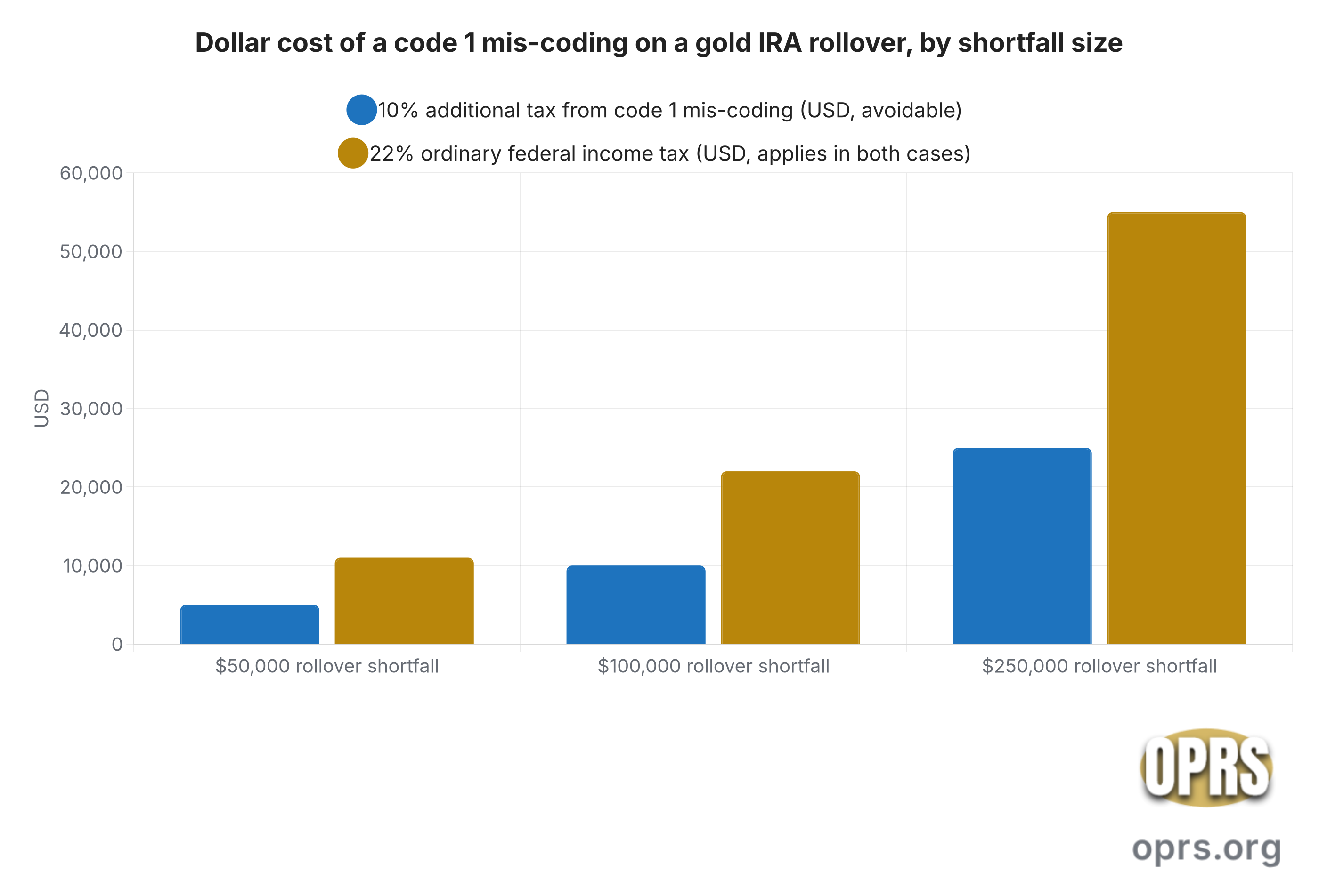
The dollar penalty incurred when an early distribution is mis-coded as 1 instead of 2 is mechanical: 10 percent of the gross. The chart below shows the dollar cost on three rollover-shortfall scenarios that recur on gold IRA files. Each scenario assumes a 22 percent federal marginal income tax rate for the underlying ordinary tax that applies in both correct and mis-coded cases.
Code 4: inherited gold IRA distributions to a beneficiary
When the original IRA owner dies, every distribution from the inherited account carries code 4 in box 7. The age of the original owner and the age of the beneficiary do not matter to the box 7 code. Code 4 means death distribution, full stop. The 10 percent additional tax never applies to a code 4 distribution under IRC Section 72(t)(2)(A)(ii).
A surviving spouse beneficiary has a unique option: roll the inherited IRA into her own IRA. When the spouse executes that rollover, the sending custodian issues a 1099-R with combination code 4G in box 7. The 4 identifies the source as a death distribution. The G identifies the receiving transaction as a direct rollover. The participant reports the gross on Form 1040 line 4a, enters zero on line 4b, and writes Rollover next to the line.
Non-spouse beneficiaries cannot roll the inherited gold IRA to their own IRA. The SECURE Act 10-year payout rule applies to most non-spouse beneficiaries who inherited an IRA after 2019. Each annual distribution from the inherited gold IRA carries code 4. The participant reports the gross on Form 1040 line 4a and 4b.
Code 7: the normal distribution at or after 59 1/2
Code 7 means the participant was age 59 1/2 or older when the distribution was paid. The 10 percent additional tax does not apply.
Code 7 is the default code on a retired saver’s IRA-to-IRA rollover when the participant took possession of the cash before redepositing into the gold IRA within the 60-day window in IRC Section 402(c)(3). The 60-day clock starts the day after the participant receives the funds. A late redeposit converts the distribution to a taxable event reported on line 4b of the 1040.
A code 7 distribution from a Traditional IRA that is then deposited into a gold IRA within 60 days is reported with the gross on line 4a and zero on line 4b, with the word Rollover next to the line.
The participant is limited to one indirect IRA-to-IRA rollover per 365 days under the Bobrow v. Commissioner rule the IRS adopted in 2014. Trustee-to-trustee transfers (no 1099-R issued) and direct rollovers from a qualified plan (code G) do not count against the one-per-year limit.
Code L and Code M: the deemed-distribution traps you cannot reverse
A 401(k) or 403(b) loan that goes into default triggers a deemed distribution. The plan issues a 1099-R with code L in box 7. The defaulted balance becomes taxable income for the year of default. If the participant is under 59 1/2 and no Section 72(t) exception applies, the 10 percent additional tax stacks on top.
Code M is the related, less-known scenario: a qualified plan loan offset. When a participant separates from service with an outstanding plan loan, the unpaid loan balance is offset against the participant’s vested account balance. The offset amount is treated as a distribution on the date of separation.
Code M tells the IRS the participant has until the due date of the federal tax return for the year of offset (including extensions) to roll the offset amount into an IRA or new employer plan. Rolling avoids the taxable event. The Tax Cuts and Jobs Act added this extended window in 2017.
The trap that affects gold IRA rollovers: a code L distribution cannot be rolled to a gold IRA because the dollars have already been deemed-distributed. The dollars are no longer eligible-rollover dollars.
A code M distribution CAN still be rolled to a gold IRA, but only if the participant funds the rollover from other sources before the extended due date. The participant cannot withdraw additional plan dollars to fund the code M rollover, because the offset already cleared the loan balance.
How to verify your 1099-R before filing
The verification routine is a five-step pass through the 1099-R the plan administrator or sending custodian mails (or posts to the participant portal) by January 31 of the year following the distribution. Each step checks one box against the controlling section. The flowchart below shows the sequence and the call-the-custodian outcome when any step fails.

- Confirm box 1 (Gross distribution). Box 1 should equal the sum of every distribution event during the tax year. Compare against the plan administrator statement or the custodian year-end summary.
- Confirm box 2a (Taxable amount). For a direct rollover (code G or H), box 2a should equal zero. For code 7 or code 2, box 2a typically equals box 1 unless the participant had after-tax basis.
- Confirm box 4 (Federal income tax withheld). For code G or H, box 4 equals zero. For code 7 or code 2 on a cash distribution, box 4 reflects the elected withholding (default 10 percent on IRA cash distributions, 20 percent mandatory on qualified plan cash distributions).
- Confirm box 7 (Distribution code). Verify against the controlling section the participant intended. Code G for trustee-to-trustee plan-to-IRA. Code H for designated Roth account to Roth IRA. Code 7 for normal post-59 1/2 IRA distribution. Code 4 for inherited IRA distribution. Code 1 only when no exception applies.
- Confirm boxes 14 to 16 (State withholding). Some states exempt all or part of retirement plan distributions. Boxes 14 to 16 should reflect the participant’s election, with the state exemption then claimed on the state return.
A code G or code H 1099-R that shows box 2a equal to box 1, or box 4 above zero, means the plan mis-flagged the transaction. The participant calls the plan distribution services line, describes the mis-coding with the section reference, and requests a corrected 1099-R. The plan issues a Form 1099-R marked CORRECTED, files it with the IRS, and mails a copy. Lead time runs from two weeks (responsive plan) to four months (partial-distribution complexity).
Common 1099-R mistakes on a gold IRA file
- Treating code 1 as final. A code 1 in box 7 is the plan administrator’s classification, not the IRS’s final determination. If a Section 72(t) exception applies, the participant either obtains a corrected 1099-R or files Form 5329 to claim the exception independently. The 10 percent additional tax is not owed on a properly excepted distribution even if the plan coded it as code 1.
- Letting an indirect rollover deadline lapse. An indirect rollover triggers 20 percent mandatory withholding under IRC Section 3405(c) on qualified-plan dollars. The participant has 60 days to redeposit the full gross (including the withheld 20 percent, sourced from other funds) into the gold IRA or owes income tax on the shortfall. A code G direct rollover avoids the trap entirely.
- Assuming the gold IRA custodian issues a rollover 1099-R. The 1099-R is issued by the SENDING plan or custodian. The receiving gold IRA custodian issues Form 5498, IRA Contribution Information, reporting the rollover as a contribution in box 2. The two forms must reconcile to the same gross dollar amount.
- Forgetting the one-per-365-day limit on indirect IRA-to-IRA rollovers. The Bobrow rule (IRS Announcement 2014-15) limits a participant to one indirect IRA-to-IRA rollover across all owned IRAs per rolling 365 days. A second indirect rollover within the window is fully taxable. Trustee-to-trustee transfers and qualified-plan-to-IRA code G rollovers do not count.
- Missing the Form 5329 exception number. If the plan refuses or delays a corrected 1099-R, the participant files Form 5329 with the 1040 and self-certifies the Section 72(t) exception. Exception number 12 covers distributions due to an IRS levy (Section 72(t)(2)(A)(vii)). Exception 13 covers a qualified reservist distribution. Exception 11 covers the qualified public safety officer age-50 separation. The full table is in the IRS Form 5329 Instructions (IRS, About Form 5329).
- Skipping the dealer due-diligence before paperwork ships. The dealer that sells precious metals into a rollover IRA has no formal role in the 1099-R coding, but slow dealer onboarding can push a direct rollover past the plan’s processing window and force an indirect rollover that loses the code G treatment. See our 2026 list of operators OPRS warns against and the few we consider acceptable before letting dealer paperwork drive the rollover timeline.
Frequently asked questions
Does the gold IRA custodian issue a 1099-R when I open the account?
No. The 1099-R is issued by the SENDING plan or IRA custodian for every distribution event during the tax year. The receiving gold IRA custodian issues Form 5498 by May 31 of the following year to report the rollover as a contribution. The participant should expect one 1099-R from the source plan and one 5498 from the gold IRA custodian for each tax year a rollover occurs.
What does combination code 7G mean on a 1099-R?
Combination code 7G means the participant was age 59 1/2 or older (7) and the distribution was a direct rollover to another plan or IRA (G). The participant reports the gross on Form 1040 line 4a or 5a, enters zero on line 4b or 5b, and writes Rollover next to the line. The combination is common on a traditional 401(k) to gold IRA rollover after the participant turned 59 1/2.
Can a code 1 distribution be rolled to a gold IRA after the fact?
Yes, a code 1 distribution can be rolled to a gold IRA within 60 days of the distribution date under IRC Section 402(c)(3). The 60-day window applies regardless of the box 7 code.
If the distribution was paid as cash with 20 percent withheld, the participant must source the missing 20 percent from other funds to complete the rollover whole. The participant reconciles on Form 1040 line 4a (gross) and line 4b (zero or the unrolled portion) with Rollover next to line 4b.
How long do I have to request a corrected 1099-R?
The plan or custodian has no statutory deadline to issue a corrected 1099-R. Participants typically receive the corrected form within two weeks to four months of the request.
If the deadline for filing the personal tax return approaches without a corrected form, the participant files Form 5329 with the original 1040 and self-certifies the Section 72(t) exception. The IRS accepts the self-certification as the controlling treatment. The participant retains the right to pursue the corrected 1099-R through the plan’s grievance process.
The dealer due-diligence the 1099-R cannot do for you
Box 7 records what already happened. The verdict on whether the receiving operator can hold custodian-grade paperwork together is documented before paperwork ships, not after. The 2026 OPRS dealer list catalogs operator-driven rollover delays, the BBB and state-attorney-general records behind each verdict, and the small group of operators we consider acceptable.
3 of 27+ gold IRA dealers reviewed by OPRS make the 2026 trusted list. Updated July 28, 2026.
More on OPRS
- Form 5498 explained for gold IRA holders: the box-by-box reconciliation to run against the 1099-R
- 1099-R distribution codes for a qualified public safety officer: how a separated PSO verifies box 7 across a partial direct rollover and an ongoing HELPS draw
- Public safety officer age-50 exception and gold IRA: who qualifies, what code 2 unlocks, and where SECURE 2.0 expanded the carve-out
- The 2026 OPRS list of operators we warn against and the small group we consider acceptable
Sources cited
- IRS Instructions for Forms 1099-R and 5498, including the box 7 distribution code reference table and combination-code rules.
- IRC Section 72, Annuities; certain proceeds of endowment and life insurance contracts (Cornell LII), subsection (t)(1) 10 percent additional tax and (t)(2) statutory exceptions.
- IRC Section 402, Taxability of beneficiary of employees’ trust (Cornell LII), subsection (c)(4) eligible rollover distribution and direct rollover treatment.
- IRC Section 3405, Special rules for pensions, annuities, and certain other deferred income (Cornell LII), subsection (c) 20 percent mandatory federal withholding on eligible rollover distributions paid to the participant.
- IRC Section 408, Individual retirement accounts (Cornell LII), subsection (d)(3) rollover treatment and the one-rollover-per-365-day limit for IRA-to-IRA indirect rollovers.
- IRC Section 408A, Roth IRAs (Cornell LII), subsection (d) qualified Roth distribution rules and the five-year holding period that controls code T treatment.
- IRS Form 5329, Additional Taxes on Qualified Plans (Including IRAs) and Other Tax-Favored Accounts, exception-number table for self-certified Section 72(t) exceptions.
- IRS About Form 5498, IRA Contribution Information, the receiving custodian’s annual report that must reconcile to the 1099-R issued by the sending plan or custodian.
- IRS Publication 590-B, Distributions from Individual Retirement Arrangements (IRAs), including the rollover rules and the Bobrow one-per-365-day limit on indirect IRA-to-IRA rollovers.