

Updated: July 30, 2026
OPRS may receive compensation when readers open an account through partner links on this page. Our analysis is based on independent research, BBB data, and IRS publications.
30-second verdict
- Closing a gold IRA is not a single transaction. The custodian, the depository, and the dealer each settle separate paperwork, and the holder picks one of four exit paths before any of them moves.
- The four exit paths are cash distribution, in-kind distribution under IRC Section 408(d), trustee-to-trustee transfer to another IRA, and Roth conversion under IRC Section 408A. Only the trustee-to-trustee transfer is non-taxable.
- The custodian issues Form 1099-R for the exit tax year on every path except the trustee-to-trustee transfer. The reported amount is the fair-market value of the metals on the distribution date, not the dealer’s bid net of spread.
- The closure window runs 2 to 6 weeks in normal conditions. A holder who plans the exit one tax year ahead retains more cash and avoids the documentation errors the IRS flags most often.
Closing a gold IRA looks straightforward from the outside. The metals leave the depository, the cash settles, the holder receives a 1099-R, the account closes. The reality runs longer. Four separate operators have to coordinate paperwork, the holder has to elect one of four distribution paths before anything moves, and the tax treatment lands on the elected path. Most closure errors are not mechanical. They are documentation errors that compound a path choice the holder made without seeing the math.
This page lays out the closure procedure in order. Element I defines what closing means inside the IRA wrapper. Element II walks the seven-step custodian sequence. Element III compares the four exit paths on tax and net-proceeds math. Element IV covers the documentation chain (Form 1099-R, Form 5498, and the close-out letter). The closure window and the four common errors close the page.
See the OPRS shortlist of gold IRA dealers we clear and the ones we warn against before any closure paperwork is filed. The buyback policy, the custodian close-out fee, and the depository pull schedule are all set at the entry stage. By the time the closure request arrives at the dealer, the price math has already been written into the original purchase ticket.
Confirm the closure terms in writing before the rollover paperwork
The dealer’s buyback policy, the custodian’s close-out fee schedule, and the depository’s pull and shipping fees are written into the original agreement. A reader who plans to close eventually wants those three documents in hand at the entry stage. The OPRS shortlist screens dealers on whether they publish those terms before the entry signature. This is for your spouse or heirs as much as for you.
3 of 27+ gold IRA dealers reviewed by OPRS make the 2026 trusted list. Updated July 2026.
What closing a gold IRA actually means inside the wrapper
A gold IRA is a self-directed IRA under IRC Section 408. The metals live in an IRS-approved depository under the custodian’s account, not the holder’s. Closing the account is the procedure that empties the wrapper and reduces the custodian’s account balance to zero.
Three operators have to coordinate. The custodian holds legal authority and issues the tax documents. The depository physically holds the metals and releases them on the custodian’s instruction. The dealer (when involved) buys the metals at a bid price the day they arrive. A trustee-to-trustee transfer to another IRA bypasses the dealer entirely.
Closing is not the same event as distributing. A distribution moves value out of the IRA wrapper to the holder. A transfer moves value from one IRA wrapper into another. IRS Publication 590-B treats those as separate reporting events. The custodian issues Form 1099-R on a distribution and not on a trustee-to-trustee transfer.
The IRA wrapper does not change the dealer’s buyback price. The dealer pays the same bid a walk-in seller would receive that day. The wrapper changes the tax treatment of the distribution and the documentation trail filed with the IRS. For the price-math layer of the exit, our gold IRA liquidation price math guide walks the dollars at three product tiers on a 200,000 dollar position.
The seven-step custodian closure sequence
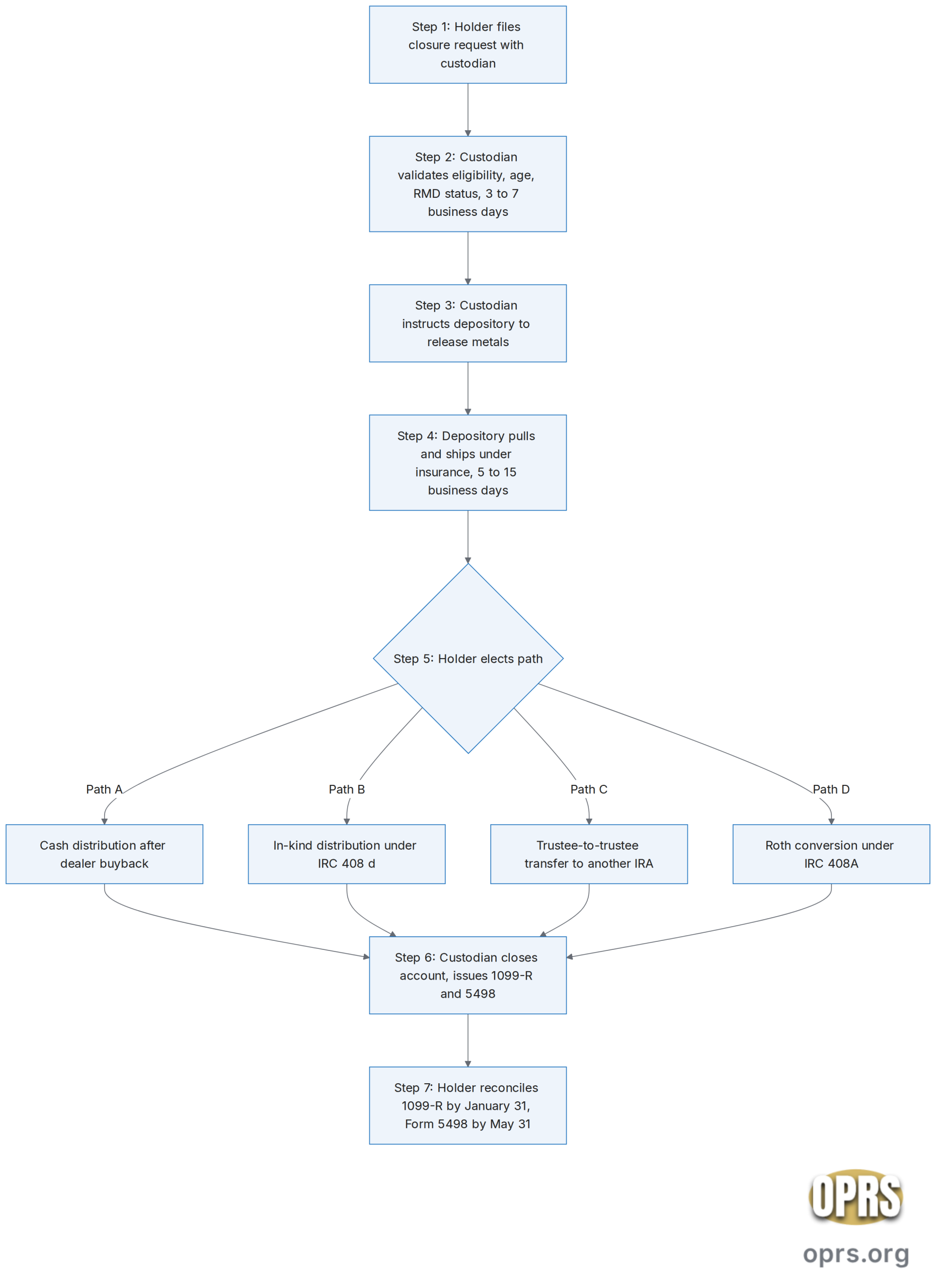
Every gold IRA closure runs the same operational sequence regardless of which exit path the holder elects. The variation is in step 5, where the path choice routes the metals and the cash. Steps 1 through 4 and steps 6 and 7 are identical across paths.
- Holder files the closure or distribution request with the custodian. The custodian’s form requires the account number, the elected distribution path, the holder’s tax-withholding election, and the bank routing information for any cash leg. The form has to be notarized in most custodians’ procedures.
- Custodian validates the request and confirms eligibility. The custodian checks the holder’s age (relevant for the 10 percent early-distribution penalty under IRC Section 72(t)), any RMD obligations, and identity. This step runs 3 to 7 business days.
- Custodian instructs the depository to release the metals. The instruction names the destination: a dealer’s vault for buyback, the holder’s address for an in-kind distribution, the receiving custodian’s depository for a transfer, or a Roth-titled position within the same depository for conversion.
- Depository pulls and ships the metals. The depository runs a final inventory check, executes the pull, and ships under insurance. This step runs 5 to 15 business days depending on destination and queue. The depository invoices a pull fee plus insured shipping.
- Path-specific settlement. Cash path: the dealer accepts the metals, pays the bid, wires cash to the custodian. In-kind path: the metals arrive at the holder’s address. Transfer path: the receiving custodian books the metals into the new account. Roth path: the same custodian re-titles the metals from Traditional to Roth.
- Custodian closes the account and issues final documents. The custodian settles the close-out fee against the remaining cash, wires any residual to the holder’s bank, and issues the closure confirmation. The custodian also produces the year-end Form 1099-R on any distribution leg and the Form 5498 on the receiving IRA in any transfer or conversion leg.
- Holder reconciles the tax documents. The 1099-R lands by January 31 of the following tax year. The Form 5498 lands by May 31. The holder confirms the distribution code on the 1099-R matches the elected path (codes documented in our Form 1099-R distribution codes for gold IRA guide) and addresses any miscoding with the custodian before the tax return files.
The chart below renders the seven-step procedural sequence in flow form. The path-choice decision at step 5 sits at the center; the upstream steps are identical regardless of path.
Can you roll your account into a precious metals IRA? Eligibility checker
Most retirement money can move into a precious metals IRA once it qualifies as an eligible rollover distribution. Pick your account type and situation for a general answer. Always confirm specifics with your plan administrator or custodian.
General guidance only, not tax or financial advice. Eligibility depends on your specific plan document and IRS rules; confirm with your plan administrator and a tax advisor. A direct trustee-to-trustee transfer avoids the 60-day rule and 20% mandatory withholding.
The right dealer explains every fee up front. Get Augusta's free precious metals IRA company checklist.
The four exit paths: tax treatment and net-proceeds math
The path-choice decision at step 5 above is where the closure math diverges. The four paths produce four different tax bills and four different net-cash outcomes on the same underlying position. The choice ought to land before the closure form signs, not after.
- Path A: Cash distribution after dealer buyback. The dealer buys the metals at the bid price. The cash settles into the IRA, the holder elects a cash distribution, and the custodian wires the funds out. The 1099-R reports the fair-market value of the metals on the distribution date, not the bid net of spread. The holder owes ordinary-income tax on the reported amount. If the holder is under 59-and-a-half, the 10 percent early-distribution penalty under IRC 72(t) also applies.
- Path B: In-kind distribution under IRC 408(d). The depository ships the physical metals to the holder. The dealer is not involved. The 1099-R reports the fair-market value at spot on the distribution date. The buyback spread is bypassed; the holder owns the metals personally and can sell later to any willing buyer at a competitive price. Custodian close-out and depository pull fees still apply.
- Path C: Trustee-to-trustee transfer to another IRA. The metals move from one custodian’s depository account to another’s. No distribution occurs. No 1099-R issues. The receiving custodian books the position at the existing cost basis. The holder pays only the closing custodian’s close-out fee and any depository transfer fee. This is the only path with no tax event.
- Path D: Roth conversion under IRC Section 408A. The custodian re-titles the metals from the Traditional IRA position to the Roth IRA position. No sale occurs; the metals stay in the depository. The conversion is a taxable event on the fair-market value of the metals. The holder owes ordinary-income tax on that amount. Future qualified distributions from the Roth are tax-free under IRS Publication 590-A.
The table walks the four paths on a single 200,000 dollar gold IRA position, held by a 65-year-old holder with a 22 percent marginal federal tax rate (no state tax for simplicity) and a 5-year holding period at flat spot. The line items show the net cash retained after each path, before any state income tax that may apply.
| Line item | Path A: Cash distribution | Path B: In-kind distribution | Path C: Trustee transfer | Path D: Roth conversion |
|---|---|---|---|---|
| Starting position (fair-market value) | $200,000 | $200,000 | $200,000 | $200,000 |
| Dealer round-trip spread (LBMA bullion) | ($10,000) | None | None | None |
| Custodian close-out fee | ($150) | ($150) | ($150) | ($75) |
| Depository pull and shipping fee | ($75) | ($75) | ($75) | $0 |
| 1099-R reported amount | $200,000 | $200,000 | $0 | $200,000 |
| Federal income tax at 22 percent marginal rate | ($44,000) | ($44,000) | $0 | ($44,000) |
| 10 percent early-distribution penalty (if under 59.5) | ($20,000) | ($20,000) | $0 | $0 |
| Net cash retained (holder age 65, no penalty) | $145,775 | $155,775 in metals + tax owed | $199,775 in new IRA | $155,925 in Roth + tax owed |
| Status (relative to starting position) | ~73 percent retained | Metals retained; tax paid externally | ~99.9 percent rolled forward | Future distributions tax-free |
The chart below visualizes the dollar comparison across the four paths.
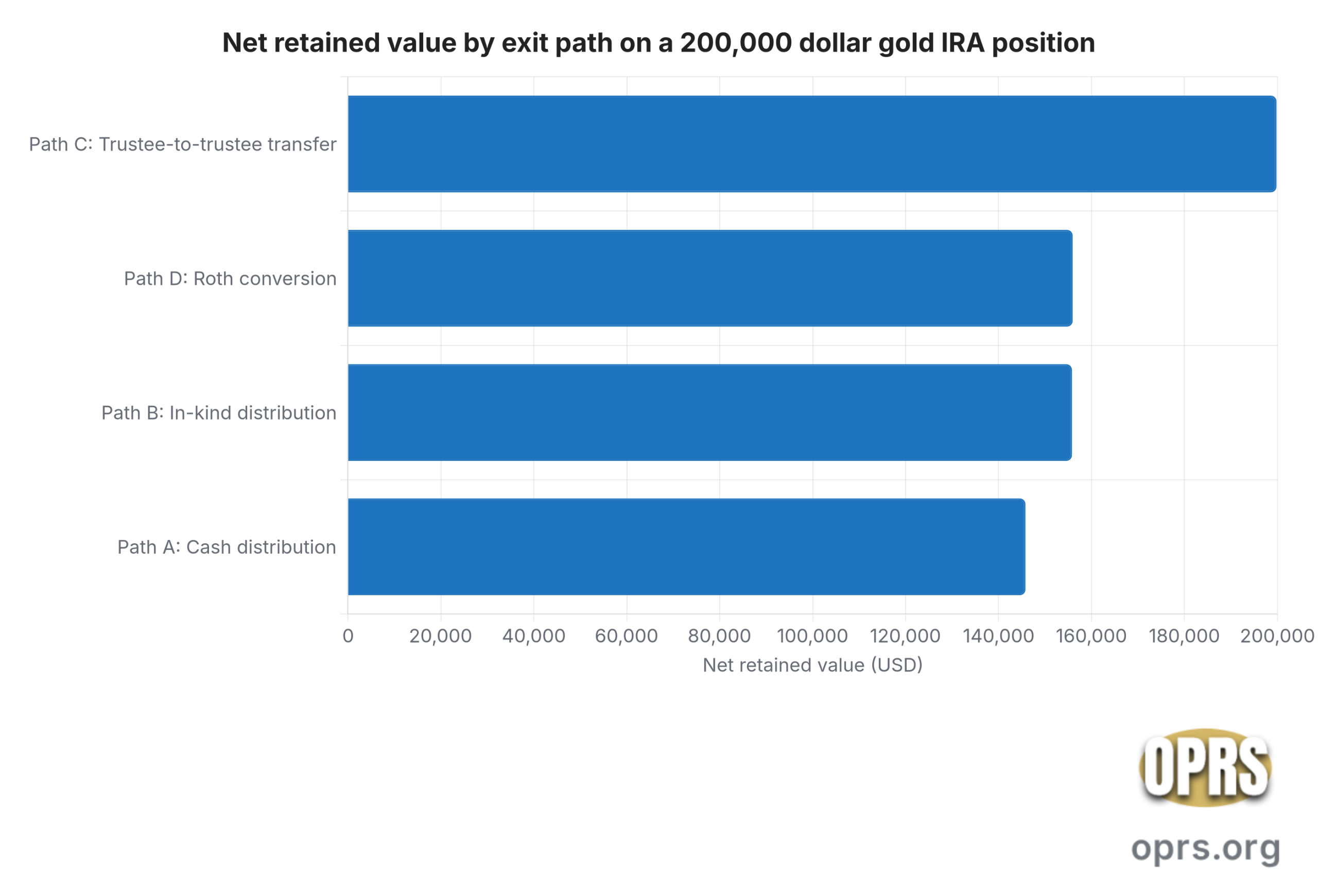
Our view: the path-choice math is the single most consequential decision in the closure. A holder who needs cash for a defined liability picks Path A. A holder who wants the metals personally picks Path B. A holder moving the IRA between custodians picks Path C. A holder optimizing the lifetime tax bill picks Path D. The custodian executes any of the four. The holder owns the choice.
The documentation chain: Form 1099-R, Form 5498, and the close-out letter
The IRS receives notice of any IRA closure event through two custodian-filed forms. Form 1099-R reports distributions out of an IRA. Form 5498 reports the year-end fair-market value and any rollovers in. The holder receives a copy of each.
On Path A (cash distribution), 1099-R box 1 shows the fair-market value of the metals on the date of distribution. Box 7 shows the distribution code: a 7 for a normal distribution at age 59-and-a-half or older, or a 1 for an early distribution. The full reference sits in our Form 1099-R distribution codes for gold IRA page.
On Path B (in-kind), the 1099-R reports the same fair-market value in box 1, with the same age-based code in box 7. The IRS treats the in-kind distribution as a distribution event at fair-market value, even though no cash changed hands. The holder owes the tax in cash from a non-IRA source.
On Path C (trustee-to-trustee transfer), no 1099-R issues. The receiving custodian’s Form 5498 shows the rollover-in. The prior custodian’s Form 5498 shows a zeroed-out year-end fair-market value. The IRS matches the two and confirms the transfer is non-taxable.
On Path D (Roth conversion), the 1099-R reports the fair-market value in box 1 with distribution code 2. The receiving Roth account’s Form 5498 reports the conversion-in. The reading walkthrough sits in our Form 5498 explained for gold IRA holders. The custodian also issues a separate account close-out letter confirming the residual zero balance.
Four common errors at the closure ticket
The errors below are the ones OPRS sees most often in reader correspondence and in published FINRA precious metals fraud guidance. Each has a correction that costs nothing if applied at the planning stage.
- Error 1: Picking the path on closure day. The four paths produce different tax bills and cash outcomes. A holder who walks in without a pre-elected path is often routed to Path A by default. The correction is to elect the path in writing one tax year ahead, with a worksheet of the four net-cash outcomes.
- Error 2: Treating an indirect rollover as a transfer. An indirect rollover is a cash distribution to the holder with a 60-day redeposit window. It is a Path A event, not Path C. A 1099-R issues. If the redeposit misses the window or omits the mandatory 20 percent withholding, the distribution is permanent and taxable. The correction is to instruct the custodian to wire directly to the receiving custodian.
- Error 3: Forgetting the state income tax on a cash or conversion path. The 22 percent federal marginal rate above is one of two tax layers on Paths A, B, and D. A holder in a state with a 5 percent income tax owes an additional 10,000 dollars on a 200,000 dollar reported distribution. Some states partially or fully exempt retirement-account distributions. Model both layers before the path-choice signs.
- Error 4: Misreading the box-7 distribution code on the 1099-R. Box 7 distinguishes a normal distribution (code 7), an early distribution (code 1), a Roth conversion (code 2), and a direct rollover (code G), among others. A miscoded 1099-R triggers either an unexpected penalty or an unexpected exemption. Verify the code against the elected path before filing.
Each of these errors compounds with the others. A holder who picks Path A on closure day, misses the state tax layer, and receives a miscoded 1099-R can lose a material portion of the position value in avoidable taxes and penalties. For your spouse or heirs, the framework only holds together if the four-path worksheet sits in the household file.
The closure window: how long the procedure actually takes
The closure window in normal conditions runs 2 to 6 weeks from the moment the holder files the form to the moment the cash settles or the metals arrive. The variation comes from the depository queue, the dealer’s settlement schedule, and the receiving custodian’s intake process on a transfer.
Validation (step 2) runs 3 to 7 business days. The depository pull (step 4) runs 5 to 15 business days. Path-specific settlement (step 5) runs an additional 3 to 10 business days. Close-out documentation (step 6) lands within 30 days of final settlement. The tax forms follow the IRS calendar: 1099-R by January 31, Form 5498 by May 31 of the following tax year.
An RMD-driven closure under IRC Section 401(a)(9) has a December 31 calendar deadline. A holder who files the closure form in mid-November runs a real queue risk on the depository step. The OPRS editorial suggestion is to file by mid-October for a year-end exit, or split the RMD across two tax years if timing is tight. This is for your spouse and heirs as well. A clean closure today is a cleaner estate event later.
Vet the dealer on the 4-award trust stack before the rollover
Augusta Precious Metals publishes a free company comparison checklist. It walks through the custodian, depository, fee, and buyback documentation a closure plan eventually has to coordinate against.
The trust posture rests on a four-award public stack. Money Magazine has named Augusta Best Overall Gold IRA Company from 2022 through 2026. Investopedia has named Augusta Most Transparent Gold IRA Company across the same window. The BBB shows an A+ rating with zero complaints, accredited since 2014. More than 4,000 5-star ratings sit across Trustpilot, Google, and Consumer Affairs.
The Education-First process (Learn, Talk, Decide) routes the closure conversation through a salaried, non-commissioned educator. Augusta’s industry-reported minimum is around 50,000 dollars.
OPRS may receive compensation when readers proceed. Editorial selection is independent. Updated July 2026.
Can I close my gold IRA without selling the metals?
Yes, on Path B (in-kind distribution) and Path C (trustee-to-trustee transfer). On Path B, the depository ships the physical metals to the holder; no dealer or buyback spread applies. On Path C, the metals stay in the IRA system but move to a different custodian. The dealer’s bid only enters the math on Path A.
On Path B, the holder still owes income tax on the fair-market value reported on the 1099-R. The tax is owed whether the metals are sold or not, and is paid in cash from a non-IRA source. Path C is the only path with no tax owed.
What happens if my gold IRA custodian goes out of business mid-closure?
The metals belong to the IRA, not to the custodian. They sit at the IRS-approved depository under the IRA account number. If the custodian ceases operations, a successor custodian assumes the account. The closure paperwork pauses and resumes once the successor is in place. The holder’s metals are not at risk; the timing of the closure is.
The same exposure applies if the dealer ceases operations mid-buyback on Path A. The metals stay at the depository under the custodian’s control. The custodian then has to route the buyback through a different dealer, with a potentially different bid spread. SEC investor.gov guidance on commodity-related investments covers the operator-risk frame at a higher level.
Do I owe tax if I close one gold IRA and open another the same year?
Not on Path C (trustee-to-trustee transfer). The receiving custodian books the position at the existing cost basis; no 1099-R issues; no tax is owed. The IRS treats a direct transfer as a non-event for tax purposes.
The tax exposure arises if the closure is structured as an indirect rollover, where the cash settles to the holder before being redeposited at the receiving custodian. That is a Path A event with a 60-day window to redeposit, mandatory 20 percent federal withholding, and a hard one-rollover-per-12-months rule on IRA-to-IRA indirect rollovers under IRS guidance on IRAs. The correction is to instruct the closing custodian to wire directly to the receiving custodian, never to the holder’s bank account.
Sources cited
- IRC Section 408, Individual Retirement Accounts
- IRC Section 408A, Roth IRAs
- IRC Section 72(t), Additional 10 Percent Tax on Early Distributions
- IRC Section 401(a)(9), Required Minimum Distributions
- IRS Publication 590-A, Contributions to Individual Retirement Arrangements (IRAs)
- IRS Publication 590-B, Distributions from Individual Retirement Arrangements (IRAs)
- IRS Form 1099-R, Distributions From Pensions, Annuities, Retirement or Profit-Sharing Plans, IRAs, Insurance Contracts, etc.
- IRS Form 5498, IRA Contribution Information
- IRS, Individual Retirement Arrangements (IRAs)
- FINRA, Precious Metals Fraud Insights
- SEC Investor.gov, Commodity Pool Investments
More on OPRS
- Gold IRA liquidation price math for the dollars-and-cents view of the dealer round-trip spread on the cash-distribution path.
- Gold IRA buyback programs compared for the head-to-head dealer comparison on buyback posture across the three operators on the OPRS shortlist.
- Form 1099-R distribution codes for gold IRA for the box-7 code reference the closure produces.
- Form 5498 explained for gold IRA holders for the year-end fair-market-value statement the IRS receives.